
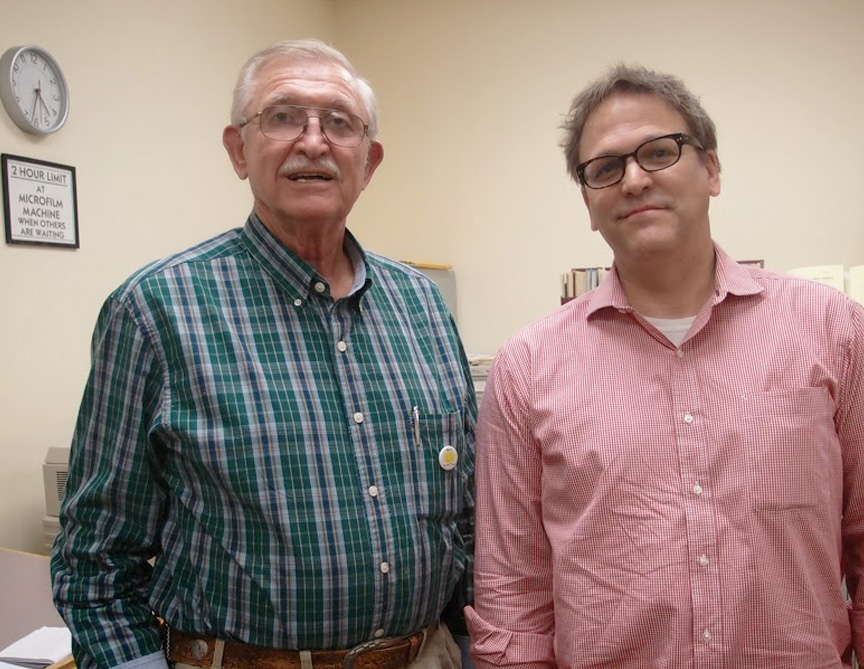
Photo: My father and me in the Genealogy Room at the Brownsville library /
The last time I was in Haywood County, Tennessee, my father and I stopped by the Genealogy Room at the Elma Ross Public Library. I was glad he was with me because he noticed something I likely would have missed. My great-aunt, Betty Joan “Jo” Culbreath Williams (1939-2012), is featured in a small display because she was a delegate to the 1984 Democratic National Convention in San Francisco.

Case of artifacts from Jo Williams
I don’t believe I ever met her. She was married to Dempsey Hardie Williams (1929-2014), the half-brother of my grandfather, Jessie Lloyd “Bo” Williams (1910-2008). Bo’s mother, Janie Elizabeth Williamson Williams (1888-1914), died when he was 4. His father, William Lafayette “Will” Williams (1888-1962), later married Eva Iris Overton Williams (1896-1970). Together, Will and Eva had eight children, including Dempsey.
Jo was a real estate broker, owner of Williams Real Estate, a licensed auctioneer in Tennessee and Mississippi, chair of the Haywood County Democratic Party for five years and a member of First Baptist Church in Toone.

Jo Williams at the 1984 Democratic National Convention
You can tell from the pictures that Jo Williams had a great time at the convention. The 1984 Democratic National Convention was held at the Moscone Center in San Francisco. History was made that year when Geraldine Ferraro became the first woman nominated for vice president by a major U.S. political party.

Jo Williams at the 1984 Democratic National Convention
Walter Mondale, who had served as vice president in the Jimmy Carter administration, was nominated for president at the convention. His opposition for the nomination had included Jesse Jackson and Sen. Gary Hart. Mondale later lost to Ronald Reagan in one of the largest landslides in U.S. presidential history.
Paul Kengor, a political scientist and presidential scholar, wrote that Mondale had expanded the vice president’s role “from that of figurehead to presidential advisor, full-time participant, and troubleshooter for the administration.” 1
Mondale later served as U.S. ambassador to Japan under President Bill Clinton.

Jo Williams at the 1984 Democratic National Convention
Jo was no doubt present for Mario Cuomo’s (1932-2015) keynote address at the convention. His “Tale of Two Cities” speech became one of the most celebrated speeches in modern U.S. politics because it offered a powerful response to Ronald Reagan’s sunny description of America as a “shining city on a hill.”

Mario M. Cuomo, former governor of New York, electrified the Democratic National Convention in 1984 with his keynote address. Photo credit: Getty Images
Cuomo argued that the country looked prosperous for some, but that many Americans were still being left behind. The speech helped define Cuomo as one of the Democratic Party’s strongest voices and remains his most famous national address.
A writer for the New York Times observed years later, “he received a torrent of praise from across the country and predictions of presidential ambitions. But that was not meant to be — Mr. Cuomo, who died in 2015, never ran for higher office.” 2

Jo Williams at the 1984 Democratic National Convention

Jo Williams’ buttons from the 1984 Democratic National Convention

Spell something right in Memphis
I can sort of understand someone misspelling “Haywood,” but there’s really no excuse for misspelling “County.” At least they got her name right.

James K. Polk and James “Lean Jimmy” Jones historic marker
On the way back to my parents’ house, we went through Dancyville because of construction on Interstate 40. Dancyville is on the southwestern edge of Haywood County, near the Fayette County line.
Coincidentally, it turned out this was where Jo Williams was buried, so I wanted to stop and look around.
Right outside the Dancyville United Methodist Church Cemetery is a historic marker that commemorates another political event that took place long before 1984.
On June 23, 1841, James K. Polk (1795-1849) debated James C. Jones (1809-1859) in Dancyville as part of the 1841 Tennessee governor’s race.
Jones’ nickname was “Lean Jimmy” because he was 6 feet, 2 inches tall and weighed about 125 pounds. He defeated Polk and served two terms as governor of Tennessee. He later became president of the Memphis and Charleston Railroad and served in the U.S. Senate. He spent the end of his life on his farm near Memphis and was buried in Elmwood Cemetery.
Polk went on to become the 11th president of the United States and served from 1845 to 1849.
Most applicable for me, Polk oversaw the establishment of the Smithsonian Institution and the groundbreaking for the Washington Monument. I drive past both almost every day.
Polk is often considered one of the most consequential presidents in U.S. history, largely because the United States expanded dramatically during his administration. He died of cholera less than four months after his term ended and is buried on the grounds of the Tennessee State Capitol in Nashville.

Dempsey and Jo Williams headstone

“Betty Joan (Jo) Culbreath Williams,” The Jackson Sun (Jackson, Tennessee), February 18, 2012, B3.
Jo Williams died of cancer on February 16, 2012, at the age of 72, and was buried in the Dancyville United Methodist Church Cemetery. The oldest graves in the cemetery date to about 1830, and it includes veterans, political leaders and people whose lives help tell the larger story of Haywood County.
The most well-known person buried there is likely Burchett Douglass (1793-1849), who established the Bank of Fayette County and served as its president until his death. He was elected to the Tennessee House and Senate, served two sessions as speaker of the House and was a presidential elector on the Whig ticket in 1840.

Dancyville United Methodist Church
Dancyville United Methodist Church, which sits just behind the cemetery, is a historic landmark. The first church was built of logs in 1837, and the present building was completed in 1850. It has long been known as the oldest United Methodist church building in West Tennessee.
You know the oldest church in a town called Dancyville would be Methodist. No Baptist would plant a church in a town with “dance” in the name.
According to “Goodspeed’s History of Tennessee,” published in 1887, Dancyville was named for Isaac Dancy, the earliest settler. 3
The merchants were asked whether there were any businesses in the community.
They answered, “Nothing except a blacksmith shop run by Isaac Dancy.”
The wholesalers replied, “We will call it Dancyville and ship the goods there.”
Local legend says that when a couple of merchants bought their first merchandise in St. Louis, they were asked where it should be shipped. There was no post office, and the community did not yet have a name. The merchants were asked whether there were any businesses in the community.
They answered, “Nothing except a blacksmith shop run by Isaac Dancy.”
The wholesalers replied, “We will call it Dancyville and ship the goods there.”
So that is how the boxes were addressed — Dancyville, Tennessee — and they went by boat down the Mississippi River and up the Hatchie River to Lowery’s Landing. From there, they were hauled by ox cart to what became known as Dancyville.
That is one of the things I love about genealogy. You never know what twists and turns you’ll take and what unusual things you are going to discover when you start exploring.
- Paul Kengor, Wreath Layer or Policy Player: The Vice President’s Role in Foreign Policy (2000), p. 85. ↩︎
- Jesse McKinley, “A Torrent of Praise for Mario Cuomo’s 1984 Democratic Convention Speech,” New York Times, July 27, 2016, 1. ↩︎
- Goodspeed Publishing Co., History of Tennessee from the Earliest Time to the Present: Together with an Historical and a Biographical Sketch of Lauderdale, Tipton, Haywood and Crockett Counties (Nashville: Goodspeed Publishing Co., 1887), 827. ↩︎


Leave a Reply