
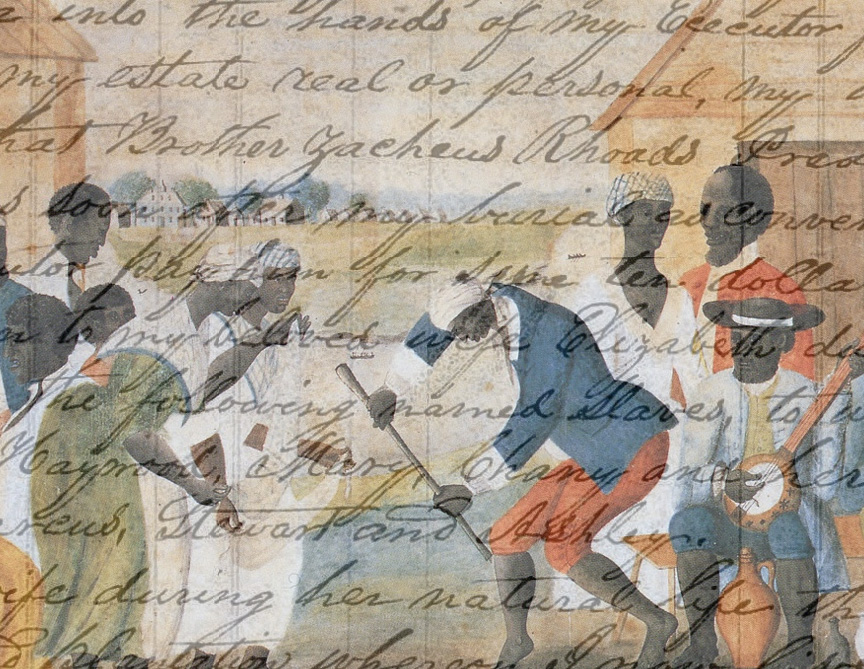
The Old Plantation is an American folk art watercolor probably painted in the late 18th century on a South Carolina plantation. The painting is currently held by the Abby Aldrich Rockefeller Folk Art Museum in Williamsburg. /
My most recent post included an exploration of Francis M. Wood’s bible. In this post, we’ll take a look at his will.
Before writing about this will, I want to acknowledge the horror at the center of it. Francis M. Wood (1777-1843) was my fourth-great-grandfather, and this document makes clear that he enslaved people and treated them as property to be loaned, inherited and divided among his descendants. It is impossible for me to understand how people of that era justified something so cruel and dehumanizing. However, I think its important that we not forget slavery happened and just how evil it truly was, so ignoring it or pretending it was less horrible than it was, doesnt make it go away.
I am including the names of the enslaved people in this will because names are often the only surviving clues for descendants searching for their own family history.
Francis M. Wood died April 27, 1843. His will tells us a great deal about his status in what was then Haywood County, Tennessee, and later became Crockett County. He described himself as a “planter,” and the will supports that. He owned land, livestock, crops, household furniture, farming equipment and enslaved people. .
His will also shows a man who had accumulated enough property that he had to plan his estate carefully so it would stay inside his male family line. I wonder if he assumed in 1843 that slavery would go on forever? Little did he know, the Civil War was 20 years in the future. Wood “loaned” property to his wife and daughters during their lifetimes, then directed that it pass to children or grandchildren. By “loaning” property to women rather than giving it outright, he could provide for them while also trying to keep land and enslaved people from passing outside the Wood bloodline or under the full control of husbands.
Francis loaned his wife, Elizabeth Milburn Wood (c. 1780-unknown), use of the home on the plantation, livestock, household goods and several named enslaved people during her lifetime. After her death, much of the estate was to be sold or divided among his surviving children and grandchildren. He also allowed his daughter-in-law, Marina Manning Wood (1820-1858), widow of his son William M. Wood (1811-1840), to live with Elizabeth free of charge as long as Marina remained a widow.
The will also shows that Francis placed a great deal of trust in his son-in-law, Charles Randall Johnson (1802-1864) who was my third geat-grandfather and the husband of Margaret Louisa Wood Johnson (1808-1862), my third great-grandmother. Francis named Charles executor of his will and asked that he serve as guardian for several grandchildren. That tells me Charles had already become one of the central men running the plantation by 1843.
The most striking part of the will is how many enslaved people are named. Some were in Francis’ household, while others were already living with his children and grandchildren. That would explain why census records show fewer enslaved people in Francis’ household than the number named across the will and family Bible. Some had likely already been “loaned out.”
The will names Ben, Redmond, Haywood, Mary, Chany, Alsira, Darkus, Stewart, Ashley, Charly, Dickey Clayton, Julia, Burton and Warry. I compared the names to the Wood family Bible I wrote about last week, and it does add birth dates for some of these people and possibly connects others into family groups. Redmond may be the same person listed in the Bible as Ridmont, son of Ben and Chana, born Jan. 10, 1826. Stewart appears to be the same person listed as Stuard, born March 18, 1828. Ashley was born Oct. 30, 1827. Haywood was born July 30, 1833. Alsira, listed as the child of Chany in the will, appears to be the Alsira born Dec. 3, 1835. Julia may be the Julia listed in the Bible as born Nov. 8, 1827.
| Book Recommendation If you are curious about learning more about slavery in Tennessee, I recommend “Tennessee Slave Narratives: A Folk History of Slavery in the United States from Interviews with Former Slaves.” This is a collection of first-person interviews with formerly enslaved people. The Works Progress Administration’s Federal Writers’ Project collected these accounts between 1936 and 1938. The records offer eyewitness proof of what life was like for enslaved people in Tennessee. |
Considering many enslaved people took on the last names of their enslavers, this may help some of their descendants get one more generation back.
The will also reveals how slavery separated families and treated future generations as inheritable property. Francis repeatedly used the phrase “and all her increase,” meaning the future children of enslaved women. That language reduced children not yet born to future estate assets.
After Congress banned importing enslaved people from Africa and the Caribbean in 1808, enslavers in the South like Francis were motivated to support the ban: It made the people they already enslaved, and the children born to them, more valuable.
That phrase is one of the most disturbing parts of the will to me. After Congress banned importing enslaved people from Africa and the Caribbean in 1808, enslavers in the South like Francis were motivated to support the ban: It made the people they already enslaved, and the children born to them, more valuable.
Historian Nicholas P. Wood writes that the framers recognized “that the Upper South had financial reasons for opposing the Atlantic slave trade.” During the ratification debates, one observer put it even more bluntly: Virginia “will gain by stopping the importations. Her slaves will rise in value, and she has more than she wants.” In wills like this one, the phrase “increase” meant the future children of enslaved women, reducing even children not yet born to inheritable property. 1
Francis also directed that Dickey Clayton be hired out yearly for the benefit of his grandchildren Angeline Foster and Joseph Foster, another reminder that enslaved children and adults could be separated, leased and used to generate income.
The will confirms some family relationships. Francis’ daughter Margaret Louisa Wood Johnson, my third-great-grandmother, first married William R. Wortham and later married Charles Randall Johnson. Her son from the first marriage, John Francis Wortham (1827-unknown), received 50 acres, an enslaved boy named Warry, a sorrel horse, a feather bed and furniture. Francis also refers to John Francis Wortham’s half brothers and sisters, meaning Louisa’s children with Charles Randall Johnson.
Francis’ daughter Nancy Arsena Wood Winburn (1821-1906) received a life interest in Julia and Burton, with the enslaved people to pass to her children after her death. Francis’ daughter Elizabeth Ann Wood Foster (1814-before 1843) had died before the will was written, so Francis provided for her children, Angeline Foster and Joseph Foster. Their father, James L. Foster, received only 50 cents. That small bequest was almost certainly intentional. It likely means Francis wanted to acknowledge him legally while preventing him from receiving a meaningful share of the estate. Francis instead placed property for the Foster children under the control of Charles Randall Johnson to keep it “in the family.”
The will also gives small personal details. Francis wanted to be buried on his own plantation, in a grave “not exceeding four feet,” and he wanted the burial ground enclosed as soon as possible. He asked that Brother Zackius Rhodes preach his funeral and directed his executor to pay him $10. That suggests Francis had a specific religious community and expected a formal funeral, even rural Haywood County.
Combined with his Bible, the will shows Francis M. Wood was an early West Tennessee settler with land, enslaved labor, family connections and local standing. Unfortunately, it also shows his wealth and security were tied directly to the forced labor of enslaved people.

| The Last Will & Testament of Francis M. Wood I Francis M. Wood of the County of Haywood and State of Tennessee, planter, do make and publish this my last will and testament, hereby revoking and making void all former Wills by me at any time heretofore made; And first, I direct that my body be decently intered at the burying Ground on my own plantation in said County in grave dug not exceeding four feet, and that it be enclosed as soon as can conveniently be done; And as to such worldly estate as it hath pleased God to entrust me with, I dispose of the Same as follows. First, I direct that all my debts and funeral expenses be paid as soon after my decease as possible out any moneys that I may die possessed of, or may first come into the hands of my Executor from any portion of my estate real or personal, my wish and desire is that Brother Zackius Rhodes to preach my Funeral as soon after my burial as convenient, And that my Executor pay him for same ten dollars. Secondly, I loan to my beloved wife Elizabeth during I also loan my wife during her natural life the tract of land and plantation whereon I now live except so much of the Same as is hereafter provided for together with all my Stock of Horses, Cattle, Hogs Sheep, farming Utensils, House hold and Kitchen furniture, and it is my desire that Marina Wood widow of my Son William M. Wood dec’d should live with my wife Elizabeth, free of Charge, So long as she may deem necessary, or during her the said Marinas Widowhood. 2nd I give and bequeath to my daughter Louisa Johnson, negro woman Charly which is now and has been for several [years?] in her possession together with all her children six in number. 3rd At the death of my wife Elizabeth, I give to my Grandson Francis J. M. Wood Son of William M. Wood deceased the two negro boys named Stewart and Ashley, provided he should survive my wife Elizabeth, and arrive at the age of twenty one years, And provided also that he should live to have lawful heirs, If not it is my will and desire that the said negroes should fall back, and remain in the mass of my estate the same as though this bequeath had not been made. 4th I give and bequeath to James L. Foster the sum of fifty cents as his share of my Estate. 5th At the death of wife Elizabeth, I give to my Grand Children Angeline and Joseph Foster, the negro woman Dorcus and all her increase after this date, I also give at this time to the said Angeline and Joseph Foster the negro Boy named Dickey Clayton now in the possession of James C. Foster, and it is my desire that Charles R Johnson be appointed their Guardian to take said negro Boy Clayton in possession and hire him out yearly for the benefit of said Children, and when the oldest Child, to wit Angeline shall arrive at the age of Twenty or should marry then it is my desire that the negroes hereby given shall be divided equally between them if they Should be both living, if either die the one living to have and enjoy the property here given, and if neither of them should live to have lawful heirs then it is my will and desire that the property here given fall back and remain in the mass of my Estate, the same as if I had not made this bequest. 6th I loan to my daughter Nancy A. Winbourn during her life, and at her death I give to her children the following slaves, to wit; Julia and Burton— 7th I give and bequeath to Grandson John Francis Wortham fifty acres of land out of the South West corner of the tract of land on which I now live, to be run in an oblong North & South, also my negro Boy named Warry, one young sorrel horse with a star in his forehead, and one feather Bed and furniture; and it my desire that Charles R Johnson be appointed his Guardian; and if the Jno Francis should not live to arrive at the age of twenty one years, or to have lawful heirs, then it is my desire and will that said property here given, be equally divided amongst his half Brothers & Sisters, heirs of his mother Louisa Johnson — 8th At the death of my wife Elizabeth It is my will and desire that the slaves heretofore loaned to her, to wit; Ben, Redmond, Haywood, Mary, and all her increase, Chany & her Child and all her increase, be equally divided between my Children Louisa Johnson and Nancy A. Winbourn, and my Grand Children Francis John Wood and Angeline & Joseph Foster, provided they be living and should live to have lawful heirs, if not then to be divided amongst the heirs of the said Louisa Johnson and Nancy A Winburn, It is also my will and desire at the death of my wife Elizabeth, that my tract of land and plantation together with all my crops, stock provisions on hand, Household and Kitchen furniture be sold on a twelve month credit by my Executor and the proceeds be equally divided share and share alike between my Children Louisa Johnson, Nancy A Winburn, and my Grand Children Francis John Wood son of Wm M Wood decd and Angeline & Joseph Foster heirs of Elizabeth A Foster decd if they the said minors be living, or should live to have heirs if not, then to be divided amongst the heirs of my Daughters Louisa Johnson and Nancy A. Winburn, The provision of the above bequeath to my daughter Nancy A Winburn is to be understood and taken only as a loan to her during her natural life, and then to descend to her Children. I do hereby make, ordain and appoint my Son in law Charles R. Johnson, Executor of this my last will and Testament. In Witness whereof I Francis M. Wood the said testator have to this my will written on one sheet of paper, set my hand and seal this twentieth day of February in the year of our Lord one thousand eight hundred and forty three. Signed, sealed & published in the presence of us, who have subscribed in the presence of the testator and of each other. Francis M Wood (Seal) Isaac M. Johnson Jas F. Wortham Alsey H. Caton |

On April 14, 1864, the same day Charles Randell Johnson (1802-1864) died at Johnsons Grove, Union Maj. William F. Bradford (1827-1864) was reportedly shot and killed near Brownsville after being captured at Fort Pillow. Bradford had taken command of the Union garrison after Maj. Lionel F. Booth was killed during the April 12 attack by Confederate Maj. Gen. Nathan Bedford Forrest. The fort, located on the Mississippi River about 40 river miles above Memphis, was defended by white Tennessee Unionists and U.S. Colored Troops.
After it fell, many Union soldiers, especially Black troops, were killed, and “Fort Pillow Massacre” became a Union rallying cry. For families in Haywood County, the war was not distant. It was close enough that one of the most notorious episodes of the Civil War had reached Brownsville at the very moment Charles died. Lee’s surrender at Appomattox, which the National Park Service says signaled the “effective end” of the war, was still nearly a year away. 2
You can find more about what happened with this family and their involvement in the Civil War in this blog post.
For more of my genealogy research, visit rscottwilliams.info.
- Nicholas P. Wood, “Abolitionists, Congress, and the Atlantic Slave Trade, 1790–1808,” in A New Constellation: Slavery and the U.S. Constitution, ed. Matthew Mason and John Craig Hammond (Charlottesville: University of Virginia Press, 2021), 119–20; “One of the People Called Quakers in the State of Virginia,” Virginia Independent Chronicle, March 12, 1788, quoted in Wood, “Abolitionists, Congress, and the Atlantic Slave Trade,” 119. ↩︎
- National Park Service, “Fort Pillow,” Battle Detail: The Civil War; Charles L. Lufkin, “‘Not Heard From Since April 12, 1864:’ The Thirteenth Tennessee Cavalry, U.S.A.,” Tennessee Historical Quarterly 45, no. 2 (1986): 142-43; National Park Service, “Appomattox Court House National Historical Park.” ↩︎


Leave a Reply