
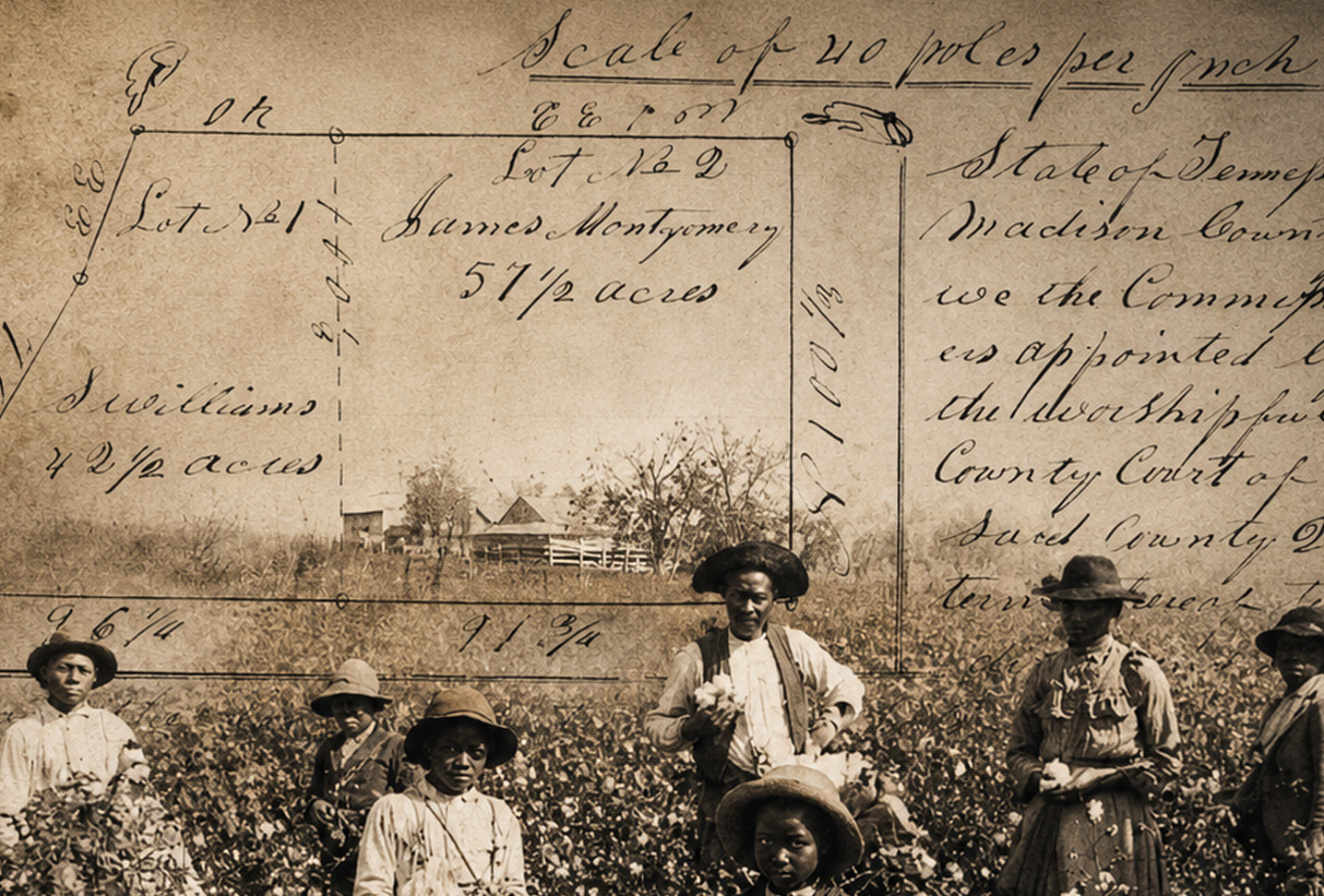
I received an email from my cousin Betsy, who had received an email from Deb Kueter, a genealogy researcher studying her Montgomery family line.
Deb had located more records in FamilySearch.com concerning the daughter of my ancestor, the Rev. George Williams (c. 1797-1852). Mariah Williams Montgomery (unknown-before 1848) married Hugh A. Montgomery (1810-1868) on Dec. 7, 1843, in Madison County, Tennessee. Together, they had a son, James Alexander Montgomery (c. 1845-about 1859). Mariah died while James was still a small child and before Hugh married his second wife in February 1848.¹
I spent several weeks going through the records, hoping they would help me go back another generation and identify George’s parents.
While they did not, they did provide direct proof of George’s children and grandson, a clearer picture of his life as a Baptist minister and landowner and a disturbing account of how enslaved people were examined, priced, sold and seized as property.
George’s death must have been unexpected since he died without a will in Madison County on Oct. 3, 1852 at age 55. His son, Solomon Williams (c. 1820-1864), became administrator of the estate, and the settlement generated more County Court documents than any of my other ancestors left behind.
The surviving records seem to me to show a formal, court-supervised estate settlement, but they do not show any conflict among George Williams’ widow, son and grandson’s guardian. They must have knon what George’s wish were, so he likely communicated them to his heirs verbally, and they acted on his wishes. Nancy Williams, Solomon Williams and Hugh A. Montgomery appear to have settled the land and inheritance amicably. There was some conflict, however. Those were directed at outside purchasers who challenged a sale or failed to pay the estate.
The legal documents identify George as the Rev. George Williams, but I was already certain how he got to Haywood and Madison Counties and how he got there.
Holly Grove Baptist Church, Bertie County, NC

Holly Grove Baptist Church is located on Highway 13 North in Bertie County, N.C. The church was originally organized as Outlaw’s Chapel, named after Ralph Outlaw, in 1804 with 99 members.
An abstract of the surviving minutes of Holly Grove Baptist Church in Bertie County, North Carolina, first mentions “Brother George Williams” on Dec. 13, 1828. By January 1829, the church referred to him as “Elder,” indicating that he had been recognized as a minister.
In May 1835, George and Henry White reportedly agreed to serve the church together. The original Holly Grove minutes covering 1822 to 1910 survive on microfilm in the Duke University collections.³
Zion Baptist Church, Haywood County, Tennessee


Zion Baptist church commemorative plate that belonged to my grandmother; produced by World Wide Art Studios, a division of Atlas Crystal Works Inc. in Covington, Tennessee. This commemorative plate records the history of Zion Baptist Church. Issued sometime after the completion of the church’s 1959 building, it was likely sold or distributed to members as a keepsake and may also have helped raise funds for the congregation.
A history compiled by Bernie W. Cobb (1908-1995) provides the clearest account of George’s arrival in West Tennessee.1
On the Saturday before the third Sunday in November 1836 — Nov. 19, 1836 — the members of Zion Baptist Church met in their new building and opened their conference with prayer.
The congregation then elected a pastor.
A motion was made and seconded that “Brother George Williams” serve as pastor for the following year. A church member was instructed to write to Williams, inform him of his selection and request that he attend the next meeting.
Zion elected George pastor again in 1838 and agreed to pay him $60 a year. By 1846, his annual salary had increased to $75, paid in installments.
An April 1849 entry provides a rare personal glimpse of his ministry. George sent Zion a three-page “epistle” in which he recalled preaching under oak trees. He also urged members to pray for the young people, asking that God would convert them, prosper them and keep them in heavenly places.⁴
The reference to preaching under oak trees suggests that George had been part of the congregation during its earliest years, when services may have been held outdoors before a permanent building became available.
The letter also shows that George remained connected to Zion for more than a decade after the church first called him as pastor.
Taken together, the Holly Grove and Zion records suggest that George served as a Baptist minister in North Carolina during the late 1820s and early 1830s, then moved to West Tennessee by 1836 where he served as the first pastor of Zion Baptist Church.
George’s move to Tennessee is also reflected in his land purchases.
The estate papers refer to two adjoining Madison County tracts conveyed to him in 1837. One deed, dated Jan. 2, 1837, covered about 245 acres. A second deed, dated March 5, 1837, covered approximately 126 acres.
The land was probably on the east side of present-day Old Medina Road, south of the Middle Fork of the Forked Deer River.
The estate petition described the combined property as containing 371 acres.
About eight years before George’s death — around 1844 — he placed his son, Solomon, in possession of the northern portion of one tract. Solomon was expected to improve and occupy the property with the understanding that it would become his when the land was eventually divided.
The record says Solomon continued living on and improving the property until George’s death.

In the United States census of 1850, George and Nancy F. Hampton Williams (1795-1850) were living in District 11 of Madison County with their 17-year-old daughter, Harriet A. Williams. In 1859, Harriet married Andrew Jackson “Jack” Outlaw (1825-1903).
George’s land was worth $3,700. On the farm on one side of George is living 30-year-old son, Solomon Williams, George’s 23-year-old wife, Catherine A. Williams and their children, 6-year-old Elizabeth and 4-year-old George.
On the other side of Rev. George’s farm was the family of George and Nancy’s daughter, Mariah Williams Montgomery, wife of Hugh Montgomery. She had died after 1945, leaving behind a son who was 5 years old in 1850. After his wife’s death, Hugh married Elizabeth Tabitha who was 20 in 1850.
George died October 3, 1852.
After George’s Death
After George’s death, the court ordered commissioners to lay off Nancy’s dower and divide the remaining property between his son, Solomon, and his grandson James Montgomery (1845-unknown).
Nancy received a 100-acre dower tract. Dower gave her the right to use and benefit from the land during her lifetime, although ultimate ownership would pass to the male heirs. This allowed land and enlaved people to stay in the husband’s bloodline.
Solomon received approximately 126¼ acres. James received about 131¾ acres.
Because James’ parcel was valued at $55 more than Solomon’s, the court ordered Hugh, acting as James’ guardian, to pay Solomon $27.50 to equalize their shares.
Nancy later married a man named Edward Williams. Nancy and Edward then sold her interest in the dower property to Solomon and Hugh, acting for James.
The former dower tract was divided again in December 1853. Solomon received approximately 42½ acres and James received about 57½ acres. Despite the difference in acreage, each parcel was valued at $1,150.
The records trace James’ financial inheritance as well. Hugh reported receiving $471.99 from Solomon as administrator on Dec. 8, 1854. He later received $390.71 from the proceeds of the estate sale. With interest added and expenses deducted, James’ guardianship account showed a balance of $881.63 on Aug. 1, 1855.²
The Enslaved People
The estate also included four enslaved people:
- Milly (c. 1832-before 1853), a woman about 20
- Ned, also called Edmund (c. 1849-unknown), a boy about 3
- Winny (c. 1851-unknown), a girl about 19 months
- Henrietta (c. 1837-unknown), a girl about 15
The court papers preserve their names and approximate ages, but only because Tennessee law classified them as property belonging to George’s estate.
The petition stated that the estate’s debts were small enough to be paid without selling the land or enslaved people. Nevertheless, the heirs told the court that the four people could not be “advantageously or conveniently divided” among Nancy, Solomon and James.
They asked that the enslaved people be sold and that the money be divided instead.
Milly, who was 20, died before the sale.
Henrietta, Ned and Winny were first offered for sale at the courthouse in Jackson on Jan. 1, 1853. Henrietta initially brought $759. Ned and Winny were sold together for $503.
The sales were soon canceled because questions arose about the health of Henrietta and Winny.
Henrietta
The most disturbing document in the collection concerns the physical examination of Henrietta, who was only about 15.
Two men examined her after the purchaser questioned whether she was physically “sound.” Their written report discussed both her mental condition and her ability to have children.
They described her as possessing the intelligence expected of what they called a “coarse field hand.” They reported that her menstrual periods had been suppressed since the spring of 1852, a condition Henrietta described and Nancy confirmed.
The examiners did not necessarily consider the condition incurable. They recommended protection from exposure and medical treatment. Their central concern, however, was Henrietta’s financial value. The report warned that the condition could diminish her value “as a breeding woman,” damage her health and reduce her usefulness as a laborer.
The language reveals the brutal economic system surrounding slavery. Henrietta was a teenage girl, but the examination evaluated her body according to her ability to work and bear children who would also be enslaved. The law treated enslaved people as property within the same legal and commercial framework applied to livestock and other movable property. Their health, age, strength and reproductive capacity were inspected because each factor affected market value.
Of course, their wishes, relationships and right to control their own lives were not considered.
Winny’s sale was also canceled after the purchaser complained that she was more dangerously “burst” than he had realized. In the medical language of the period, the term probably referred to a rupture or hernia. The concern was again presented primarily as a defect affecting a sale.
Horrors of Slavery
The court ordered Henrietta, Ned and Winny sold again.
On March 5, 1853, Alexander Matthews purchased Henrietta for $650 and Ned and Winny together for $490. The total sale price was $1,140.
That was $122 less than the amount produced by the first attempted sale.
Matthews did not pay cash. He signed a 12-month promissory note, and the court retained a lien until the purchase price was paid.
The note came due March 5, 1854, but it apparently remained unpaid. On Nov. 8, 1854, the court commissioner notified Matthews and his sureties that he intended to seek judgment against them.
A writ of fieri facias, abbreviated “fi. fa.,” was issued in March 1855. The writ directed the sheriff to seize property belonging to Matthews to satisfy the debt.
On March 27, 1855, the sheriff levied on two more enslaved people, Harriet and Emily, describing them as Matthews’ property. The writ was marked satisfied shortly afterward.
This is hard to imagine today, and many would rather we just forget about it. Henrietta, Ned and Winny were sold as property. When their purchaser failed to pay for them, Harriet and Emily were seized as property to collect the debt.
One group of human beings was used to enforce payment for another group of human beings. And that was only a little over 150 years ago.

A 1995 transcription published by the Mid-West Tennessee Genealogical Society placed The Montgomery Cemetery east of Cooper Anderson Road, beneath the high-voltage power lines, between the second and third transmission towers. Another description placed it about a mile south of Ashport Road and roughly three-tenths of a mile east of Cooper Anderson Road.
One other observation. The Montgomery family buried some of their family members on their land. Deb’s research indicates there were at least seven family members buried there, including. Although their names are not listed, it’s certainly possible Mariah Williams Montgomery was laid to rest there and later, her father, George Williams, joined his daughter.

Unfortunately, a housing development called Walnut Trace was built close to the cemetery along Cooper Anderson Road in Madison County. I have not been by to check, so hopefully the cemetery is still there.
I will continue to research this family with this new information to see if I can break through the brick wall.
For more of my genealogy research, visit rscottwilliams.info.
- Bernie W. Cobb, A History of Zion Baptist Church (Brownsville, TN: self-published, 1981). ↩︎


Leave a Reply