
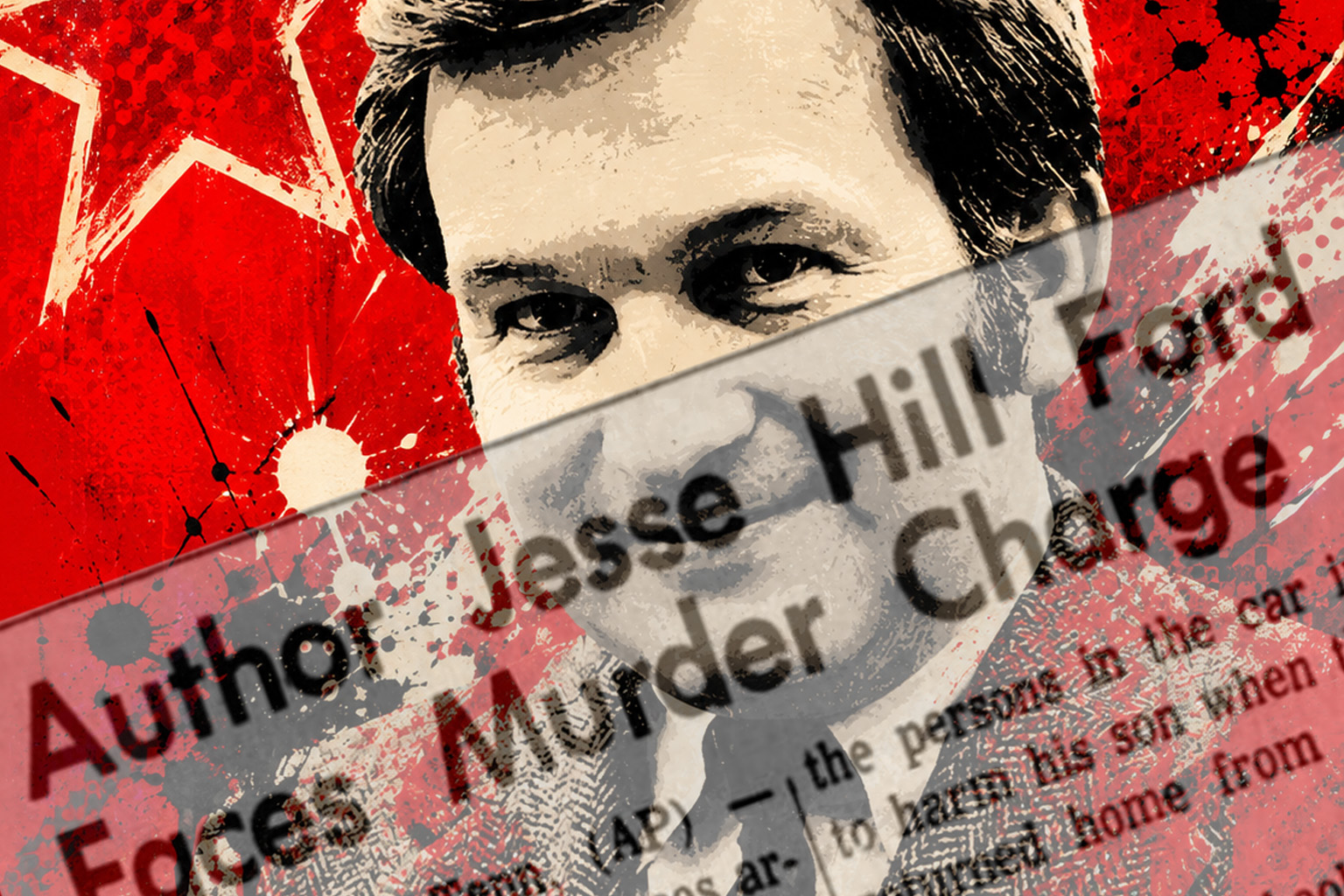
A few weeks ago, I discovered the Brownsville, Tennessee, train depot had been used as a filming location for the movie “The Liberation of L.B. Jones.” Of course, I wanted to watch the film and see whether any other familiar West Tennessee locations appeared.
I had never heard of the movie, the novel on which it was based or its author, Jesse Hill Ford (1928-1996). Once I began digging, however, I discovered far more than a few interesting glimpses of West Tennessee.
What started as a search for old footage of my region led me into a complicated story of literature, racial injustice, murder and a fascinating irony in the life and death of a southern writer.

The Memphis Press-Scimitar, July 2, 1971, 1.
As I had hoped, the film does provide a fascinating look at West Tennessee as it appeared in 1969. The Brownsville train depot is clearly visible, and anyone familiar with Trenton will recognize scenes filmed around the town square.
The movie was based on “The Liberation of Lord Byron Jones,” a 1965 novel by Ford. I finally finished the book this morning. If, like me, you are not a fan of racial slurs, racism, bullies, brutality and cruelty, you will have a difficult time getting through it. That discomfort is part of the point. Ford was not trying to make racism easier to look at. He was attempting to expose the racial hierarchy, hypocrisy and imbalance of power in a small Southern town. The novel takes place in fictional Somerton, Tennessee, a community that bears a striking resemblance to several small towns across West Tennessee and other parts of the rural south.
Jesse Hill Ford
Ford was born Dec. 28, 1928, in Troy, Alabama, and grew up in Nashville. He attended Vanderbilt University, where he studied under Donald Davidson (1893-1968), a poet, critic and member of Vanderbilt’s Fugitive and Southern Agrarian movements. While still a student, Ford worked as Vanderbilt’s campus correspondent for The Nashville Tennessean. There he became acquainted with fellow reporter John Seigenthaler (1927-2014), whom I had the pleasure of meeting with a few times many years later.
Before his death in 2014, Seigenthaler was a passionate supporter of the Newseum and a tireless defender of the First Amendment. He remembered Ford as an intense young man who took himself and his ambitions more seriously than most beginning reporters.1
Ford graduated from Vanderbilt in 1951 and served as a U.S. Navy officer during the Korean War. He later studied creative writing at the University of Florida under Andrew N. Lytle (1902-1995), earning a master’s degree in 1955.
After working in public relations for medical associations in Nashville and Chicago, Ford decided at age 28 to devote himself to writing. In 1957, he and his family moved to his wife’s hometown of Humboldt, where the lower cost of living would allow him to write full time.2
His career began promisingly. His short story “The Surest Thing in Show Business” won an Atlantic Monthly award in 1959. CBS aired his television play “The Conversion of Buster Drumwright” in 1960, and his first novel, “Mountains of Gilead,” appeared in 1961. The title referred to a group of prehistoric Native American mounds south of Humboldt that local residents called the Mountains of Gilead.
One journalist gushed in 1964, “Trying to picture Jesse Hill Ford in any role other than that of a Southern writer is like trying to visualize Dr. Ben Casey selling perfume.”3 For those without a grasp of 1960s pop culture, Dr. Ben Casey was a fictional neurosurgeon played by actor Vince Edwards in the ABC medical drama “Ben Casey,” which aired from 1961 to 1966.
He rises to his feet and addresses teen-age girls as ‘Ma’am’ and he would not look out of place sipping a mint julep under a magnoilia tree.”
The journalist, clearly enamored, added, “Ford, 32, is a handsome, soft-spoken Southern gentleman of the classic mold. He rises to his feet and addresses teen-age girls as ‘Ma’am’ and he would not look out of place sipping a mint julep under a magnoilia tree.”4
The killing that inspired the novel
Ford’s imagination was soon captured by stories surrounding the unsolved 1955 killing of James Welton Claybrook (1905-1955), a successful Black undertaker from Humboldt. Claybrook was found shot to death along a rural road outside town. As often happens when a crime remains unsolved, facts became mixed with gossip, suspicion and speculation.
Ford heard a version of the story in which Claybrook’s wife had become involved with a white police officer. According to the rumor, Claybrook’s decision to divorce her threatened to expose the relationship and led to his death. While those allegations were never established in court, Ford nevertheless used the rumors surrounding the killing as the foundation for “The Liberation of Lord Byron Jones.”5
In the novel, Lord Byron Jones is a prosperous Black funeral director who wants to divorce his much younger wife after learning she is pregnant by a white police officer. At a time when Tennessee still prohibited interracial marriage, exposing the affair in court could ruin the officer and publicly challenge the racial order that protected him. Jones refuses to withdraw the divorce case. The officer and another policeman eventually pursue him into a junkyard and brutally kill him. The town’s white leaders then choose to protect the officers rather than seek justice for Jones. Ford’s fictional Somerton is a town where many people know what happened but lack either the courage or the desire to challenge the established racial order.
A national success
Published in 1965, “The Liberation of Lord Byron Jones” became a Book-of-the-Month Club selection and brought Ford national attention. Ralph McGill (1898-1969), the Pulitzer Prize-winning editor and columnist for The Atlanta Constitution, praised the book in The Atlantic. McGill believed Ford had captured the people and power structures behind the civil rights conflicts Americans were seeing in newspaper photographs and television reports.6
While the novel was named a finalist for the 1966 National Book Award for fiction, the award went to “The Collected Stories of Katherine Anne Porter” by Katherine Anne Porter (1890-1980). Ford also received a Guggenheim Fellowship for fiction in 1966.
For a time, he appeared destined to join the most prominent Southern writers of his generation. Critics compared his work to that of William Faulkner (1897-1962) and Flannery O’Connor (1925-1964), although other reviewers criticized his novel’s sensationalism and some of its characterizations. The movie rights were sold soon after the book appeared. Ford eventually shared screenplay credit with Stirling Silliphant (1918-1996), who had won an Academy Award for writing “In the Heat of the Night.” Success also introduced Ford to the temptations and excesses that sometimes accompany sudden fame. Those temptations would eventually contribute to the complete unraveling of life.
Hollywood comes to West Tennessee
“The Liberation of L.B. Jones” was directed by William Wyler (1902-1981), one of the most honored filmmakers in Hollywood history. Wyler won three Academy Awards for directing “Mrs. Miniver,” “The Best Years of Our Lives” and “Ben-Hur.” His other films included “Roman Holiday,” “The Children’s Hour,” “How to Steal a Million” and “Funny Girl.” “The Liberation of L.B. Jones” would be his final feature film.
The cast included Lee J. Cobb (1911-1976), Anthony Zerbe (1936-present), Roscoe Lee Browne (1922-2007), Lola Falana (1942-present), Barbara Hershey (1948-present), Yaphet Kotto (1939-2021) and the six-million-dollar man himself, Lee Majors (1939-present). Principal photography began May 21, 1969, on location in Humboldt. The company spent about two weeks filming in Tennessee before moving production to Columbia Pictures’ studio facilities in Hollywood. In “William Wyler: The Authorized Biography,” Axel Madsen (1930-2007) wrote that Wyler traveled to Humboldt in February 1969 to scout locations and meet Ford.
Madsen described West Tennessee as flat cotton country dotted with strawberry fields, cattle farms, cypress swamps and the prehistoric mounds that had inspired the title of Ford’s first novel. According to Madsen, the company spent more than $200,000 in Humboldt and the surrounding area and filmed in Humboldt, Trenton, Gibson and Brownsville. The approximately 80 members of the cast and crew stayed at a local Holiday Inn.7
Imagine the excitement of having one of Hollywood’s most celebrated directors, along with a major cast and crew, suddenly arrive in small-town West Tennessee. For those of us interested in West Tennessee history, the movie now preserves images of places that have changed dramatically or disappeared altogether. As I recently wrote, the Brownsville depot was later demolished, making the footage especially valuable.

“The Liberation of L.B. Jones” premiered in New York on March 18, 1970 to mixed reviews. Some critics believed the filmmakers had flattened Ford’s complicated characters into stereotypes and turned a serious examination of racial injustice into melodrama. Others believed that by 1970, the film’s treatment of racism seemed less groundbreaking than it might have appeared several years earlier. While the film never achieved the literary stature of Ford’s novel, Variety included it among the “Big Rental Films of 1970” and reported cumulative domestic rentals of $1.3 million. That figure alone, however, does not establish whether the movie ultimately made a profit.
In a 2020 reassessment for The New Yorker, film critic Richard Brody argued that despite the movie’s flaws, it remained historically valuable for its blunt depiction of police violence, racism and the refusal of white institutions to hold white officials accountable.8 The film also created some controversy. Some white viewers at advance screenings reportedly feared that it would provoke racial unrest. Following disturbances at screenings on U.S. Army bases in Europe, military officials temporarily banned the film from those installations.
Trouble at home
The movie’s release brought additional attention to Humboldt, much of it unwanted. Many people in the community had never read Ford’s novel. The film became their first opportunity to see what their famous neighbor was telling the rest of the country about Southern small-town life. Some white residents believed Ford had portrayed them as violent racists. Some Black residents objected to the story’s sexualized Black characters and believed it exploited Black suffering. People on both sides were angered. Ford and his family received threatening telephone calls and experienced harassment and vandalism. Later accounts described garbage being dumped on the lawn at Canterfield, the large home Ford had built outside Humboldt.9
At the same time, the community was struggling with the tension surrounding court-ordered school integration. Accounts written after Ford’s trial described conflicts involving the Humboldt High School football team. White athletes reportedly retained their starting positions after the schools were integrated. When Black players skipped a practice in protest, they were removed from the team.
One of Ford’s sons was a starting player. Threats reportedly were directed toward him, his school desk was vandalized and rocks were thrown at a car carrying him during a homecoming parade. It is difficult today to separate every verifiable event from the stories that grew around the case. What is clear is that Ford and his family believed they were in danger. Their fear intensified after the release of a movie many Humboldt residents considered an attack on their community. Ford, already intense by nature, became increasingly anxious and convinced someone intended to harm his family.
“Dr. Feelgood”
Ford’s emotional condition may have been complicated further by his relationship with Max Jacobson (1900-1979), the physician who became widely known as “Dr. Feelgood.” While working on the screenplay in Los Angeles, Ford came under Jacobson’s care. The physician was known for giving prominent patients injections that he described as vitamin treatments. Some of those injections contained amphetamine or methamphetamine along with vitamins and other substances. Later accounts claim Jacobson injected Ford with a mixture containing vitamin B-12 and methamphetamine sulfate. Ford reportedly continued using the injections after returning to Humboldt.
Methamphetamine can cause anxiety, insomnia, agitation and paranoia. There is no conclusive evidence, however, establishing whether Ford had taken the drug on the night of the shooting or whether it caused his actions. It does provide important context for the increasingly fearful and unstable state of mind described by people who knew him.
The shooting at Canterfield
On the evening of Nov. 16, 1970, Ford noticed a car parked in the grass near the driveway at Canterfield. Convinced the driver might be waiting to ambush his son, Ford retrieved a .30-06 rifle while his wife called law enforcement. The driver was George Henry Doaks Jr. (1949-1970), a 21-year-old Black Army private and the son of a respected local minister. A young woman and a 4-year-old child she was babysitting were also in the car.
Ford later testified that he fired a shot in an attempt to frighten the driver into stopping. As the car began moving away, Ford fired again. One of the bullets struck and killed Doaks. Ford maintained that he intended to fire warning shots and did not mean to hit anyone. Prosecutors argued that he had fired a high-powered rifle toward an occupied vehicle.10
The case contained an extraordinary coincidence. The young woman accompanying Doaks was related to the woman whose alleged affair had helped inspire “The Liberation of Lord Byron Jones.” The novelist who had written about the killing of a Black undertaker, an alleged interracial affair and a racially unjust legal system was now at the center of his own racially charged killing.
The trial
A Gibson County grand jury indicted Ford on a first-degree murder charge. His trial began in the summer of 1971 and lasted five days. The courtroom drama attracted national attention. On one side stood a celebrated white novelist known for condemning Southern racism. On the other stood the family of a young Black soldier killed while sitting in a car.

Detroit Free Press, July 18, 1971, 19.
Ford and his wife welcomed reporters to Canterfield before and during the trial. Food and liquor were served, and journalists sometimes remained at the house talking late into the night. Reading the accounts today, it is difficult not to be struck by how insensitive the hospitality must have appeared. A young man was dead, yet the atmosphere around Ford sometimes resembled the celebration of a book launch.¹⁴
The 12-man jury included one Black juror. After hearing Ford’s claim that he believed his family was in danger and that he had fired only to stop the car, the jury found him not guilty. Ford walked out of the courthouse a free man.

The New York Times, June 30, 1971, 24.
For many Black residents, the verdict reinforced the very point Ford had made in his novel: A white man who killed a Black man in the South could receive the benefit of every doubt. In television footage recorded after the verdict, one of Doaks’ sisters expressed that belief plainly. “If my brother had killed him, it would be quite different,” she said. “He would have been gone a long time ago.”¹⁵
Ford later held a news conference at Canterfield. He called the killing a tragedy that had changed everyone involved and said he was deeply sorry. His wife observed that the week had seemed like one of Ford’s novels, except it had ended better because her husband did not believe in happy endings. Although Ford had been acquitted, a happy ending was not in his future.

“The Continuing Trial of Jessee Hill Ford”
The legal trial ended in 1971, but Ford’s trial in the court of public opinion was only beginning. One of the most damaging accounts appeared in the Oct. 29, 1971, issue of Life magazine. The article, “The Continuing Trial of Jesse Hill Ford,” was written by Marshall Frady (1940-2004), a Southern journalist known for examining race, religion and political power. Frady spent time with Ford and the people of Humboldt. His article portrayed a gifted but deeply troubled man who had written insightfully about the South’s legacy of slavery, racism and violence, only to become consumed by those same forces.
Frady suggested that Ford had surrendered himself to the “old demons and dark charms of violence” he had once examined as a novelist.11 The article was devastating because it did not portray Ford simply as a misunderstood writer who had made a terrible mistake. Frady presented him as arrogant, self-absorbed and completely insensitive to the Doaks family. The article also portrayed Humboldt as a community struggling with racism, resentment, fear and hatred. Ford had written about those forces from a position of moral authority. After the shooting, much of that authority was gone.
A career in decline
The shooting and trial damaged Ford financially, professionally and personally. His legal expenses were enormous. Speaking invitations disappeared. At Memphis State University, where he had served as a writer in residence, members of the English department reportedly circulated a petition calling for his dismissal.
His marriage also collapsed. His wife had learned that he had been unfaithful while working in Los Angeles. Two years after Ford walked out of the Humboldt courthouse following his acquittal, he returned to watch the same judge grant the couple a divorce. Ford eventually left Humboldt. In 1975, he published “The Raider,” a sprawling historical novel set in West Tennessee before and during the Civil War. He had worked on the book during the period surrounding the trial.
It received some favorable attention but failed to restore his career to its former promise. It would be his final published novel. Of course, I have now ordered a copy to add to my growing stack of books I plan to read when I get the chance. Unfortunately, I seem to have more books in the stack than time to read.
Ford moved to Nashville, remarried and continued to teach and write. He also reportedly worked anonymously revising screenplays in Hollywood. From 1985 to 1992, he contributed occasional columns to USA Today. The once-liberal Southern writer had become an outspoken conservative, often writing angrily about political and cultural issues.
After undergoing open-heart surgery in 1995, Ford experienced severe depression. On June 1, 1996, he died by suicide at his Nashville home. He was 67. Ford left behind an unfinished autobiography. In it, he reflected on his departure from the West Tennessee town that had given him a home, a career, a subject for a book and, ultimately, the setting for his downfall.
He said goodbye to Humboldt’s “strawberry seasons, parades, bands, football games, summer heat, autumn geese, thunderstorms, politicians, preachers, bootleggers” and all the people who had provided him with “so much rich material for stories.”12
Ford wrote courageously about racism when many white Southern writers avoided the subject. His best-known novel exposed the corruption, fear and violence that allowed injustice to survive in small communities. He also shot and killed an innocent man. Although the jury found Ford not guilty of murder, the verdict could neither restore Doaks’ life nor repair Ford’s reputation. Instead, it added a final, bitter irony to Ford’s legacy: He benefitted from the same racial system he had spent years condemning.
- John Taylor, “The Liberation of Jesse Hill Ford,” Esquire, February 1997, 74-79, 112-13. ↩︎
- John V. Glass, “Jesse Hill Ford,” Tennessee Encyclopedia, last modified March 1, 2018; Alan Brown, “Jesse Hill Ford,” Encyclopedia of Alabama, last modified Sept. 1, 2023. ↩︎
- Pat Houtz, “Jesse Hill Ford,” The Huntsville Times, June 28, 1964, 35. ↩︎
- Ibid. ↩︎
- “Humboldt Undertaker Found Shot to Death,” Jackson Sun, May 31, 1955; Taylor, “Liberation of Jesse Hill Ford.” ↩︎
- Ralph McGill, “The Clearest Truth Is in Fiction: Jesse Hill Ford’s Novel of the South,” The Atlantic, August 1965. ↩︎
- Axel Madsen, William Wyler: The Authorized Biography (New York: Thomas Y. Crowell, 1973), 100-112. ↩︎
- Richard Brody, “What to Stream: ‘The Liberation of L. B. Jones,’ a 1970 Film About the Agonies of Racial Injustice,” The New Yorker, May 21, 2020. ↩︎
- Taylor, “Liberation of Jesse Hill Ford”; Marshall Frady, “The Continuing Trial of Jesse Hill Ford,” Life, Oct. 29, 1971, 56-74. ↩︎
- American Film Institute, “Liberation of L. B. Jones”; United Press International, “Author Denies Intent to Kill Black,” July 2, 1971. ↩︎
- Marshall Frady, “The Continuing Trial of Jesse Hill Ford,” Life 71, no. 18 (October 29, 1971): 56–74.
↩︎ - Taylor, “Liberation of Jesse Hill Ford.” ↩︎


Leave a Reply