
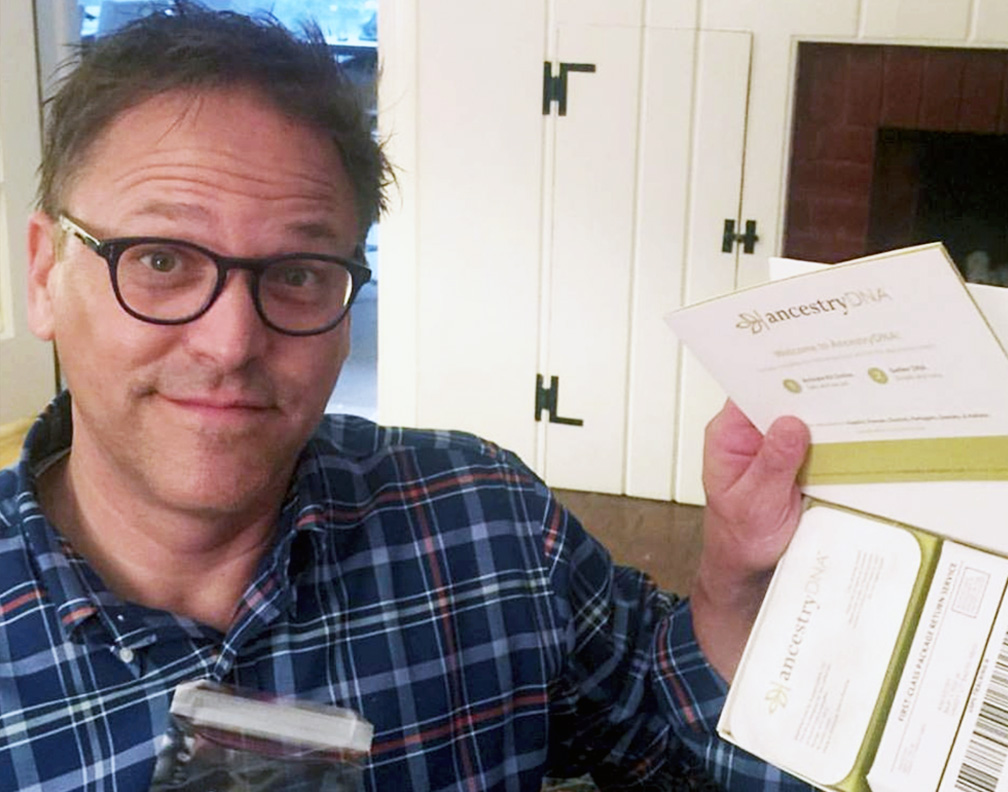
Photo: Receiving my DNA way back in 2016 /
DNA: a decade later
In July 2016, I wrote a blog post after receiving my first AncestryDNA results. At the time, the company’s DNA database had just passed 2 million samples, and my results consisted largely of broad ethnicity estimates and a list of possible cousins. Ten years later, more than 25 million people are part of Ancestry’s DNA network. That enormous increase gives the company many more relatives, family trees and migration patterns to compare with my DNA.
Ancestry claims it now compares customers with a reference panel of more than 185,000 people representing 146 populations. Regions that were once grouped under broad labels such as Ireland or Great Britain can now be separated into places including Munster, Connacht, southern Wales, Cornwall and northern Scotland. New tools can divide my results by parent, connect me to historically identifiable populations such as Eastern North Carolina settlers and suggest how DNA matches may fit into my family tree through something they call “ThruLines.”
Consumer DNA testing has also moved beyond genealogy. Since 2016, federal regulators have allowed certain direct-to-consumer tests to report carrier status, selected genetic health risks and limited information about how a person may respond to some medications. These reports can provide useful clues, but they do not test for every disease-causing variant and cannot replace clinical testing or a physician’s diagnosis. Ancestry briefly entered the health-testing business but discontinued AncestryHealth in 2021 to concentrate on family history. Seems a lot safer.

The decade also exposed the risks of handing a company something as permanent and personal as DNA. The health-focused company 23andMe experienced a major 2023 security incident in which hackers gained access to thousands of accounts and information connected to millions of DNA-relative and family-tree profiles. The company filed for Chapter 11 bankruptcy protection in March 2025, and its assets were purchased that July by the nonprofit TTAM Research Institute, founded and led by 23andMe co-founder Anne Wojcicki. The sale prompted federal concern about what could happen to customers’ genetic information when a DNA company changed hands.
In 2016, my results were an interesting snapshot of where my ancestors might have come from. By 2026, the same sample has become a much more powerful, although still imperfect, genealogical tool. It can now place me within specific populations, sort many connections by family branch and point toward possible ancestors. It doesnt replace written documentary evidence or boots-on-the ground research, but it does provide a few more possible connections and places to look.
My DNA story

My DNA essentially reinforces a family story I already knew stretching from Britain and Ireland to eastern North Carolina and into West Tennessee. Did they also provide clues involving two of my most elusive ancestors?
If you follow me on social media or have read this blog, you know that for years, I have tried to reconstruct my family history with courthouse records, census schedules, wills, deeds, old letters and the occasional family Bible. But for two of my family lines, Williams and Castallaw, I hit a brick wall making some solid, proven connections several generations back.
What the test actually examined
According to the site, AncestryDNA does not sequence every letter of your genetic code. It examines hundreds of thousands of selected locations called single nucleotide polymorphisms, or SNPs. These are places in human DNA where people commonly differ from one another.
Ancestry compares those markers with reference groups whose families have lived in particular regions for generations. It also compares my DNA with other customers who agreed to participate in matching.
My downloadable file contains nearly 669,000 markers spread across my chromosomes. Ancestry says its autosomal test examines about 700,000 locations inherited from both sides of a person’s family.
In simpler terms, Ancestry looked for two things: Where in the world does my DNA most closely resemble long-established populations, and who else inherited some of the same pieces of DNA?
My ancestral regions
Ancestry assigned my DNA to 12 regions:
- Southeastern England and Northwestern Europe, 40%
- Central Scotland and Northern Ireland, 24%
- Denmark, 11%
- Southern Wales, 8%
- Cornwall, 3%
- Munster, Ireland, 3%
- North East Scotland, 3%
- Connacht, Ireland, 2%
- France, 2%
- The Netherlands, 2%
- West Midlands, 1%
- Brittany, France, 1%
Taken together, 84% of my estimate was assigned directly to England, Scotland, Wales, Northern Ireland or Ireland.
That was not a surprise. The surnames I have researched most extensively — Williams, Lovelace, Castellaw, Cobb, Brantley, Joyner, Yelverton, Dougan, Marbury and Patterson — have long pointed toward Britain and Ireland.
That was part of the motivation behind a 2025 trip to visit Scotland.

Still, the results gave that family tradition a genetic foundation. My ancestry is overwhelmingly concentrated around Britain, Ireland, the English Channel and the North Sea.
While I would love to think my results are special, they are pretty common for a Tennessean. A large genetic study of self-identified European Americans found that British and Irish ancestry averaged more than 50% in Tennessee, Arkansas and Mississippi, higher than in many other states. The researchers connected that pattern to early British Isles settlement and comparatively limited later immigration from other European populations.1 My 84% British Isles-associated result is above that regional average, but it fits the historical pattern found in Tennessee.

Me at Capeharts Baptist Church in Bertie County, North Carolina, 2013; More from my 50th Birthday Genealogy Road Trip
A much more specific North Carolina connection
Ancestry also assigned me to a genetic community called “Eastern North Carolina Settlers,” with a more specific connection to “Inner Coastal Plain Settlers.” This region stretched across the inland counties of eastern North Carolina, between the coastal Tidewater area and the Piedmont, and included communities along the Roanoke, Tar, Neuse and Cape Fear river systems.
Although many of my documented ancestors lived in nearby Bertie County, which is generally considered part of the Outer Coastal Plain, families often moved among Bertie, Halifax, Edgecombe, Martin, Northampton, Pitt and surrounding counties. The DNA connection appears to reflect this broader network of related families who lived in eastern North Carolina for generations before many of their descendants moved west into Tennessee.
Ancestry calls these groups “ancestral journeys.” The company builds them by studying networks of customers who share DNA with one another more often than they share it with people outside the group. It then uses linked family trees and historical research to determine where the group’s ancestors lived and how they moved.
As I have written frequently through the years, many of my most thoroughly researched families lived in Bertie County and surrounding areas of eastern North Carolina before descendants moved west and eventually settled in Haywood County, Tennessee. Among them were the Castellaw, Cobb, Yelverton, Outlaw, Brantley and Dawson families.
Did DNA prove my connection to Gabriel Johnston?
One of the most interesting names Ancestry associated with my Eastern North Carolina journey was Gabriel Johnston (1698-1752). Johnston was a Scottish-born scholar who served as royal governor of North Carolina from 1734 until his death. About 1740, he married Penelope Golland Johnston (about 1695-1741), the wealthy, thrice-widowed stepdaughter of former Gov. Charles Eden (1673-1722). They lived at Eden House, the plantation on the Chowan River that I have researched for years.

Gabriel Johnston and his armorial bookplate
Historical sources confirm that Gabriel and Penelope Johnston had a daughter, Penelope Johnston Dawson, who married Col. John Dawson. Their son, William Johnston Dawson, later served in Congress and helped select the site of Raleigh.
My family tree carries the line through another proposed child, Margaret Dawson, who married John Castellaw (1723-1813). Their son (supposedly), John Dawson Castellaw, became part of the family migration from Bertie County to Haywood County. So, did AncestryDNA finally prove that Gabriel Johnston was my ancestor?
Nope.
Ancestry did not find the name Gabriel Johnston written somewhere in my chromosomes as I wished. It found that I belong to a DNA network associated with eastern North Carolina. It then examined people in my family tree whose dates and locations fit that journey.
The result supports the place, population and general family network. It does not independently prove every parent-child relationship between Gabriel Johnston and me.
The historical record establishes that Gabriel Johnston existed, that he married Penelope Golland and that their daughter Penelope married John Dawson. The critical genealogical question for my line remains whether the Margaret Dawson who married John Castellaw was their daughter or related in some way and whether every subsequent generation has been correctly identified.
My DNA result makes the connection more plausible because it places me squarely within the same eastern North Carolina population. It is corroborating evidence, but it is not proof of descent from Gabriel Johnston.
The honest conclusion is this:
Gabriel Johnston is a plausible ancestor supported by a historically consistent family tree and a strong Eastern North Carolina DNA connection, but the DNA test alone does not prove the relationship.
The mystery of James Williams
The test also produced a lead involving the family line that has frustrated me the longest. My fourth-great-grandfather George S. Williams (1797-1852) was born in North Carolina and later settled in Madison County, Tennessee. He was a Baptist minister, and court records identify his widow, Nancy, his son Solomon and his grandson James Alexander Montgomery.
What I have never been able to prove is the identity of George’s parents. Ancestry’s “ThruLines” feature now suggests that a man named James Williams, born about 1780, may have been George’s father, as I suspected.
At first glance, the evidence looks impressive. The results say I may be related to 12 DNA matches through James Williams. A closer look tells a different story. Eleven of those matches descend through George S. Williams. They help support my connection to George, but they cannot tell us who George’s father was because all 11 lines pass through the man whose ancestry is in question.
Only one match follows a different proposed branch. That person reportedly descends from John W. Williams, born about 1809, whom Ancestry identifies as another possible son of James Williams.
The match and I share “9 centimorgans across one DNA segment.” A centimorgan is a unit genealogists use to describe the amount of DNA two people share. Nine centimorgans is a small match. It is compatible with the distant relationship Ancestry proposes, but it is not large enough to prove that the relationship shown in the trees is correct.
The connection is also based primarily on user-submitted family trees. On the screen I reviewed, one tree linked to a DNA match and eight additional member trees proposed James as George’s father. Most listed no supporting records. That creates the possibility that several people copied the same unproved claim from one another, as often happens on Ancestry.com.
The 9-centimorgan match could represent a genuine connection through James Williams. It could also come through another family shared by both testers, particularly in a community where the same families intermarried repeatedly.
For now, James Williams is not a proven ancestor, but he is the most promising new lead the DNA results give me.
The next step is to document John W. Williams and identify additional descendants from his line. The case would grow much stronger if I matched several people descended from different children of John, with each generation supported by records.
A dedicated Y-DNA test could also help. Y-DNA passes from father to son, making it especially useful for investigating a direct paternal surname line. A close Y-DNA match between a male-line descendant of George S. Williams and a male-line descendant of John W. Williams would strongly support the argument that the two men belonged to the same paternal Williams family.
What I know now
After studying the results back in 2016 and again in 2026, I know a little more about my ancestry than I did when I mailed off that tube 10 years ago. Still, what DNA has revealed pales in comparison with what I have learned through old-fashioned research in libraries and online and from relatives willing to share their photographs, documents and memories.
For more of my genealogy research, visit rscottwilliams.info.
- Katarzyna Bryc, Eric Y. Durand, J. Michael Macpherson, David Reich and Joanna L. Mountain, “The Genetic Ancestry of African Americans, Latinos, and European Americans across the United States,” The American Journal of Human Genetics 96, no. 1 (Jan. 8, 2015): 37–53, ↩︎


Leave a Reply