
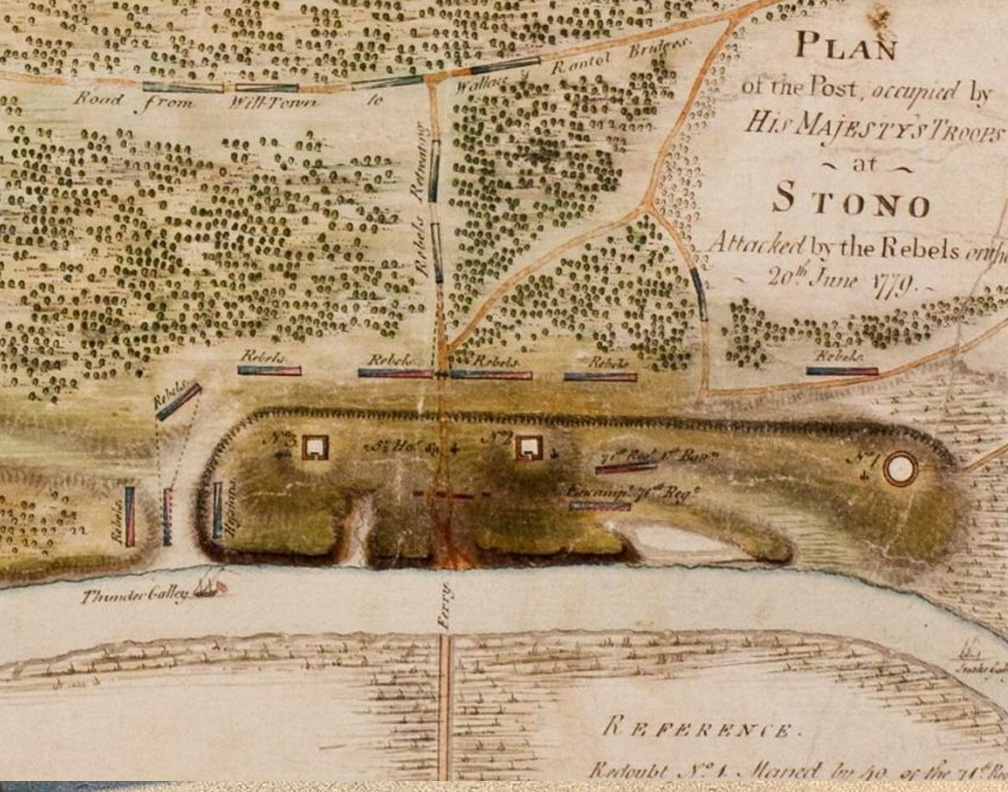
Photo: A British map of Stono Ferry referencing the 1779 battle. Source: South Carolina Battleground Preservation Trust /
As I blogged a few days ago, I have been trying to learn more about a George Williams who served in the North Carolina militia during the American Revolution. If further research prooves the connection, he would be my 6th great-grandfather. According to his wife’s pension application, he said he served from Bertie County around 1778 and/or 1779 under Capt. Charles Rhodes, Col. Jonas Johnston and Gen. John Butler. He also stated he marched into South Carolina and Georgia and was near Camden, South Carolina, when he suffered a severe leg wound after jumping from a cart.
As with many Revolutionary War stories passed down through families, this one appears to contain both strong clues and a few details that do not line up perfectly.
The best lead I found is a George Williams listed as a private under Capt. Charles Rhodes in the Bertie County Regiment of the North Carolina militia. Rhodes’ company is also connected to the Battle of Stono Ferry, fought in South Carolina on June 20, 1779. So, while I cannot yet prove this George Williams is the one I am looking for, I can say there was a George Williams serving under the right captain, from the right county, at the right time. 1
| About the Battle of Stono Ferry The Battle of Stono Ferry took place June 20, 1779, in Charleston County, South Carolina, as the British tried to expand their control of the South after capturing Savannah the previous year. British Brig. Gen. Augustine Prevost had moved toward Charleston but pulled back after finding the city better defended than expected. To cover his withdrawal, Lt. Col. John Maitland left about 900 British, Hessian and Loyalist troops at Stono Ferry. Maj. Gen. Benjamin Lincoln attacked with about 1,200 Americans, including North Carolina militia under Brig. Gen. John Butler. The fighting lasted about an hour, but the British position proved too strong, and Lincoln withdrew when British reinforcements began arriving. The battle did not give the British Charleston in 1779, but it helped them learn the terrain, defenses and weaknesses they would use the following year when they captured the city. Source: American Battlefield Trust, “Stono Ferry: Charleston County, South Carolina | Jun 20, 1779,” accessed June 27, 2026. |
The larger history of the Bertie County Regiment also fits the geography of the story. The regiment was created in 1775 after the North Carolina Provincial Congress authorized the county militias, and it remained active through the war. Units from the regiment are listed as having taken part in Brier Creek in Georgia on March 3, 1779, Stono Ferry in South Carolina on June 20, 1779, the Siege of Charleston in 1780, Little Lynches Creek in South Carolina on Aug. 11, 1780 and Camden a few days later on Aug. 16, 1780. 2
That makes the claim that George Williams “marched into South Carolina and Georgia” very believable. It also makes the Camden part of the story possible, especially if his service continued into 1780.
But this is where the record gets more complicated.
Capt. Charles Rhodes fits the Bertie County part of the story very well. Col. Jonas Johnston and Gen. John Butler are harder to explain. Johnston appears in records connected to the Edgecombe County Regiment, not Bertie County. 3 Butler served as brigadier general of the Hillsborough District Brigade, another North Carolina militia command, and he is connected with several of the same Southern Campaign battles, including Stono Ferry, Little Lynches Creek and Camden. 4 Both men were real Revolutionary War officers. Both were connected to the same general military battles. They just do not appear to be the most natural officers for a Bertie County private serving under Charles Rhodes.
That does not mean the story is wrong. It may mean the account combined memories from different parts of the war. It may mean George Williams served more than once, under more than one command. It may also mean that when the story was written down years later, some of the officer names were remembered imperfectly. That happened often in Revolutionary War pension statements and family histories, especially when elderly veterans were trying to remember details from events that had taken place 50 years earlier.
The most intriguing part of the story remains the injury near Camden. The Camden campaign involved long marches, supply wagons, carts and militia units moving through difficult country. A serious leg injury from jumping from a cart may not have happened in the heat of battle, but it could certainly have happened during the movement of troops before or after Camden.
For now, the safest conclusion is this: George Williams served as a private under Capt. Charles Rhodes in the Bertie County Regiment, and that company is tied to Stono Ferry in 1779. The Bertie County Regiment also served in the same South Carolina and Georgia campaign trail described in the family account, including battles and movements that reached Camden in 1780.
So this is not a finished story yet. But it is a strong lead.
For more of my genealogy research, visit rscottwilliams.info.
Endnotes
- J.D. Lewis, “Capt. Charles Rhodes,” The American Revolution in North Carolina, accessed June 27, 2026, https://www.carolana.com/NC/Revolution/patriots_nc_capt_charles_rhodes.html. ↩︎
- J.D. Lewis, “Bertie County Regiment of Militia,” The American Revolution in North Carolina, accessed June 27, 2026, https://www.carolana.com/NC/Revolution/nc_bertie_county_regiment.html. ↩︎
- J.D. Lewis, “Edgecombe County Regiment of Militia,” The American Revolution in North Carolina, accessed June 27, 2026, https://www.carolana.com/NC/Revolution/nc_edgecombe_county_regiment.html. ↩︎
- J.D. Lewis, “John Butler,” The Patriot Leaders in North Carolina, accessed June 27, 2026, https://www.carolana.com/NC/Revolution/patriot_leaders_nc_john_butler.html. ↩︎


Leave a Reply