
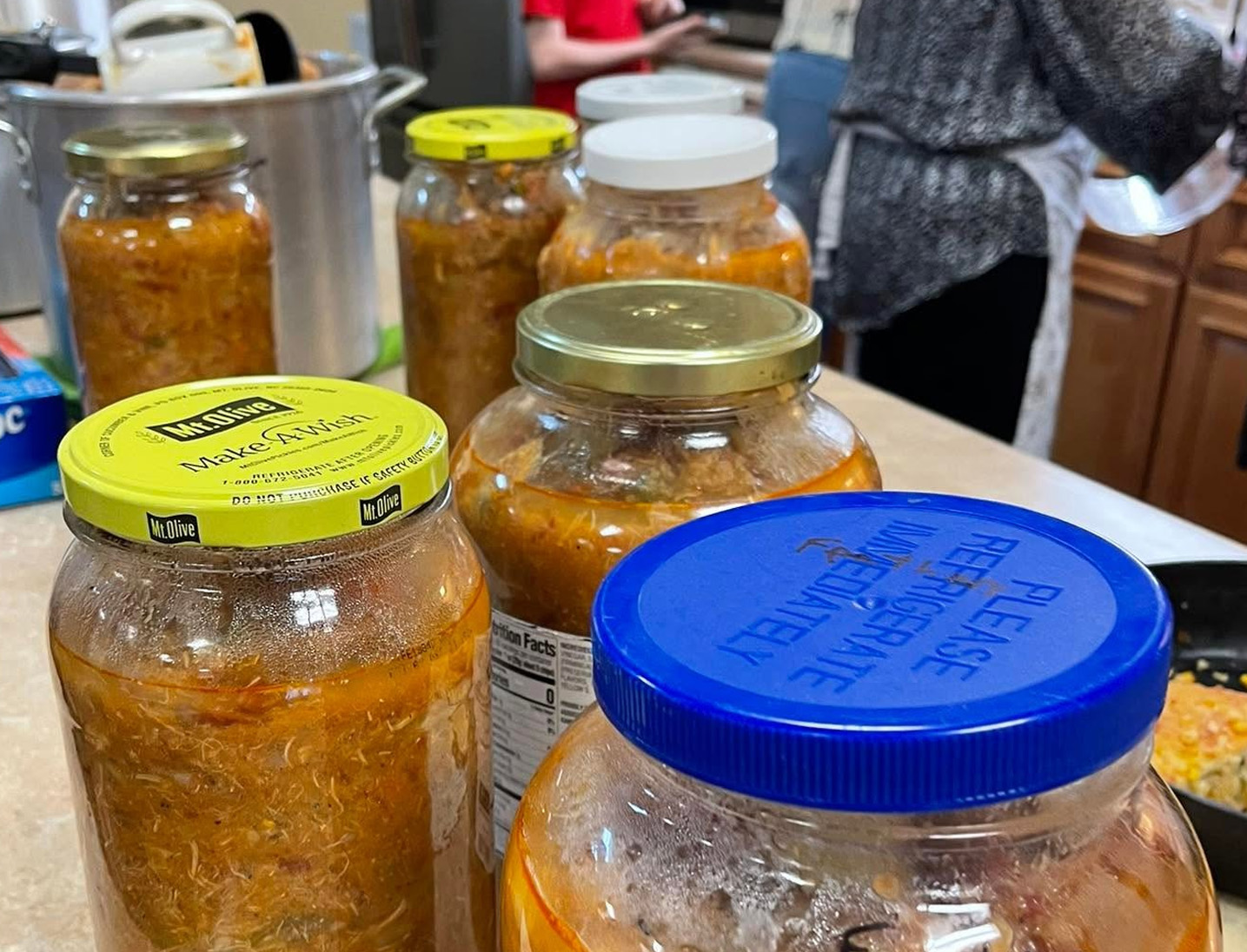
Photo: Jars with stew from Kirk Baptist Church in Piperton, Tennessee /
I have always wondered why someone in Haywood County, Tennessee, did not package and distribute the stew local cooks prepare in enormous black pots.
As it turns out, someone did, sort of.
My wife and I attended a stew at Holly Grove Baptist Church in 2011. Like most church and community group stews, it required far more than a recipe. It took a crew of people to cook the meat, prepare the vegetables, tend the fire and continuously stir the heavy mixture so it would not scorch on the bottom of the pot.

My paternal grandmother, Elizabeth Castellaw Williams, and my maternal grandmother, Virginia Brantley Lovelace
That gathering reminded me of the stew I had eaten all my life. Both of my grandmothers, Elizabeth Castellaw Williams (1915-1998) and Virginia Brantley Lovelace (1917-2007), were excellent cooks. Their family dinners featured the traditional Southern food you would expect, but both women frequently had stew on their table.
It was simply called “stew.” No clarifying adjective was necessary. At their tables, there was only one kind.
Because the stew looked and tasted much the same at both houses, I grew up assuming it was a standard part of every large Southern family gathering. I later discovered that the thick, chicken-and-corn stew familiar to generations of Haywood County residents is much more regional than I realized.
Haywood County’s version of stew
A version of stew was firmly established in northeastern North Carolina, including Bertie County, where many of Haywood County’s early settlers had lived before moving west. In July 1921, a newspaper account of a large public picnic at Kelford High School reported that guests were served barbecue and Brunswick stew. Later accounts of clubhouse suppers in Bertie and neighboring Martin County described Brunswick stew being cooked in a large black pot alongside pork, chicken and wild game. Bunn’s Bar-B-Q, which opened in Windsor in 1938, also made Brunswick stew a traditional companion to chopped pork, slaw and cornbread.1
A 1939 guide to North Carolina described Brunswick stew as a thick mixture of chicken, butter beans, onions, corn and tomatoes, seasoned with salt pork and often cooked outdoors for community groups.2 That description sounds remarkably similar to the stew prepared by my Haywood County family.
I would describe the stew my family prepared as closer to porridge than soup. The meat and vegetables cooked together so long that they nearly lost their separate identities. Fresh corn contributed flavor, texture and sweetness, while the potatoes and other vegetables helped thicken the mixture. Since the stew is typically cooked over a fire in large stew pot, there is smokey flavor to it as well.
Preparing it is a multiple-day undertaking. Cooks stir it with a wooden paddle or boat oar, scraping the bottom of the pot to prevent scorching. When the stew is finished, families divide it among containers or Mason jars and stored it away for future meals.
That method still makes stew especially suited to churches, reunions and community fundraisers. One enormous pot can feed a crowd, and the work of preparing it naturally becomes a shared social activity.
There was also a slightly different version of stew being cooked up in Haywood County kitchens.
A Southern dish with several origin stories
Virginia and Georgia have argued for generations over which place deserves credit for their version of Brunswick stew. Virginia’s best-known story places its creation in Brunswick County in 1828, when an enslaved camp cook prepared a squirrel stew during a hunting expedition. Brunswick, Georgia, points to an iron pot said to have held the first Georgia Brunswick stew in 1898. Neither story fully explains the dish.
Food historians have noted that Brunswick stew belongs to a much older family of one-pot meals. Southeastern Native peoples combined game with corn, hominy, squash and other available foods long before Europeans settled the region. African American cooks, including enslaved cooks, then played an essential role in transforming those ingredients and techniques into the camp meals, barbecue accompaniments and communal stews that became identified with the South.3
What can be said with certainty is that Brunswick stew was well established in Virginia by the 1840s. An 1846 newspaper account of a barbecue at Huguenot Springs described “a capital squirrel stew—called by some a Brunswick stew.” Three years later, the Alexandria Gazette called Brunswick stew a “genuine South-side dish” made with squirrels, chickens, bacon, corn and tomatoes. Those contemporary accounts appeared more than half a century before Georgia’s celebrated 1898 stew pot.4
The early recipes often called for squirrel or other game because cooks used what was locally available. Chicken eventually became the most common meat in many Virginia-style recipes. Elsewhere, cooks added pork, beef or leftover barbecue.
Corn and tomatoes appear in most modern versions, while onions, lima beans, potatoes and okra vary by region and family. Some cooks produce a relatively loose stew that can be eaten from a bowl. Others cook it down until it becomes much thicker.
Kentucky’s burgoo is a close relative. Burgoo also developed as a communal, long-cooked stew made from several meats and seasonal vegetables. Western Kentucky versions are especially associated with mutton, although recipes may also contain chicken, pork, beef or game.5
A Virginia recipe comes to Haywood County
The connection between Virginia Brunswick stew and Haywood County appears to run through Mary S. White Sturdivant (1832-1908). Mary was born in Brunswick County, Virginia. She married Edward Claiborne Sturdivant (1823-1919), and the couple came to Haywood County in 1849, settling in the Tabernacle community.
Mary was related to a member of Virginia’s Mason family who was regarded as a “keeper of an old Brunswick stew recipe.” Whether its true or not, it makes for a compelling connection between Brunswick County and Haywood County.
Edward and Mary had three sons, Robert Marcus Sturdivant (1854-1912), Edward Claiborne Sturdivant Jr. (1856-1942) and Franklin Sturdivant (1860-1932). The family’s stew became popular well beyond its own table, as son on Franklin enhanced his mother’s stew with good-old-fashioned storytelling.

The Greensboro Record, November 25, 1932, 2.
Their stew was made under the supervision of “Miss May,” and apparantley she had help in the kitchen from enslaved men and women.

Portion of a brochure produced by Franklin Sturdivant in 1924 called “Twelve Pearls: Old Virginia Brunswick Stew” from the collection of Joseph R. Haynes6
Brownsville turns stew into an industry
A National Register of Historic Places study of Brownsville identifies the Sturdivant Stew Factory as one of several industries established in the city during the 1870s. The factory stood on Wilson Avenue, just north of Margin Street, in the industrial area near Brownsville’s railroad corridor. The location made commercial sense. A family could prepare stew almost anywhere, but a packing operation needed access to fuel, supplies and transportation. Brownsville’s railroad connections allowed a canned Tennessee product to reach customers far beyond Haywood County.

The federal historic study states that the Sturdivants’ stew was sold across the country. It also records that Franklin expanded or commercialized the operation in 1918.7 The product was marketed as “Old Virginia Brunswick Stew,” preserving the recipe’s Virginia identity even though it was being cooked and packed in Brownsville.

A Sturdivant advertisement from the 1920s reveals how the company attempted to transform a regional community dish into a modern grocery product. The primary customer was the household’s cook, whom the ad promised a “delicious lunch” in 10 minutes at an “economical cost.”8 This would have been especially relevant for those who migrated to the cities from rural communities. It was a lot harder to spend days over a stewpot set up outdoors if you lived in Memphis.
Sturdivant reassured consumers that convenience did not require sacrificing quality. Its stew was packed under federal inspection in a kitchen described as a “dream of snowy whiteness,” prepared with tender meats and vegetables and based on an authentic Virginia recipe. That was especially important for consumers who were not used to eating food out of a can.
And if that was not enough, they promised that, after a dinner of Brunswick Stew, “you will have a song on your lips and a smile of oceanic expansion, and if your youth had departed, it will return.”
For a small West Tennessee city, this was a remarkable enterprise. The Sturdivants had taken a food associated with family tables, hunting camps and outdoor gatherings and converted it into a shelf-stable consumer product.
From Sturdivant to Kelly’s
Brownsville’s National Register documentation states that the recipe was sold during the 1940s to Kelly’s Foods in Jackson, Tennessee. Kelly’s continued selling canned Brunswick stew for decades. A federal trademark filing submitted by Kelly Foods in 1998 specifically included Brunswick stew among the company’s products, along with chili, beef stew, corned beef hash, Vienna sausage and potted meat. A later Kelly’s filing in 2003 also listed Brunswick stew.9
I remember Kelly’s television commercials from the 1960s. For many West Tennesseans, Kelly’s chili, tamales and canned meats were familiar grocery-store products. Kelly Foods continues to market Kelly’s chili, tamales and beef stew and describes the brand as dating to 1938. Brunswick stew, however, does not appear among the products currently advertised by the company. Somewhere along the way, one of West Tennessee’s most distinctive commercially packed foods disappeared from the shelves.
Was the canned stew the same?
I asked a few family members who remembered Kelly’s Brunswick stew fondly, but they did not remember it as being identical to the thick chicken-and-corn stew still prepared by their Haywood County families. One relative recalled two different stews being prepared at family gatherings: the familiar chicken, tomato and corn version and another version containing beef and finely chopped vegetables. Another remembered Kelly’s stew as good but noticeably different from her grandmother’s recipe for “Haywood County stew.”
What remains of the factory
The former Sturdivant Stew Factory is still standing. It is listed among the city’s few surviving historic industrial buildings, but a recent survey reported that Brownsville’s old factories had suffered substantial deterioration and alteration.
Edward and Mary remained closely associated with the Tabernacle community, where they and several of their descendants are buried. Family accounts maintain that later generations of Sturdivants continued preparing the stew from the tradition Mary brought from Virginia, long after her death in 1908.
Notes:
- “Odd Fellows Picnic at Kelford,” Roanoke-Chowan Times (Rich Square, NC), July 21, 1921, 1; “Roxobel-Kelford,” Bertie County NCGenWeb, under “Social Life of Kelford—1950s,” accessed July 26, 2026; Michael Stern, “Bunn’s Bar-B-Q,” Roadfood, January 16, 2021. ↩︎
- Federal Writers’ Project, North Carolina: A Guide to the Old North State (Chapel Hill: University of North Carolina Press, 1939), section on North Carolina foodways. ↩︎
- John A. Burrison, “Brunswick Stew,” New Georgia Encyclopedia, originally published April 6, 2005, last edited August 6, 2013; Carrie Helms Tippen, “History and Memory: Arguing for Authenticity in the Stories of Brunswick Stew,” Food and Foodways 24, nos. 1-2 (2016): 48-66. ↩︎
- “Barbecue at Huguenot Springs,” Richmond Commercial Compiler, June 4, 1846, 2; “An ‘Old Virginia’ Barbecue,” Alexandria Gazette (Alexandria, VA), September 14, 1849, 2. ↩︎
- Joseph R. Haynes, Brunswick Stew: A Virginia Tradition (Charleston, SC: Arcadia Publishing, 2017); Burrison, “Brunswick Stew”; “Kentucky Burgoo,” Digital Traditions, South Carolina ETV. ↩︎
- Joseph R. Haynes, Brunswick Stew: A Virginia Tradition (Charleston, SC: The History Press, 2017), 116. ↩︎
- Rebecca Hightower, Historic Resources of Brownsville, Tennessee, 1823-1970, National Register of Historic Places Multiple Property Documentation Form (Nashville: Thomason and Associates, February 17, 2014), sec. E, 6, and sec. F, 15. ↩︎
- Clarion-Ledger, March 26, 1926, 2. ↩︎
- Hightower, Historic Resources of Brownsville, sec. F, 15; Kelly Foods Inc., “Kelly’s,” trademark application serial no. 75512384, filed July 2, 1998; “Kelly’s,” serial no. 76539520, filed in 2003. Both filings included Brunswick stew among the listed products. ↩︎


Leave a Reply