
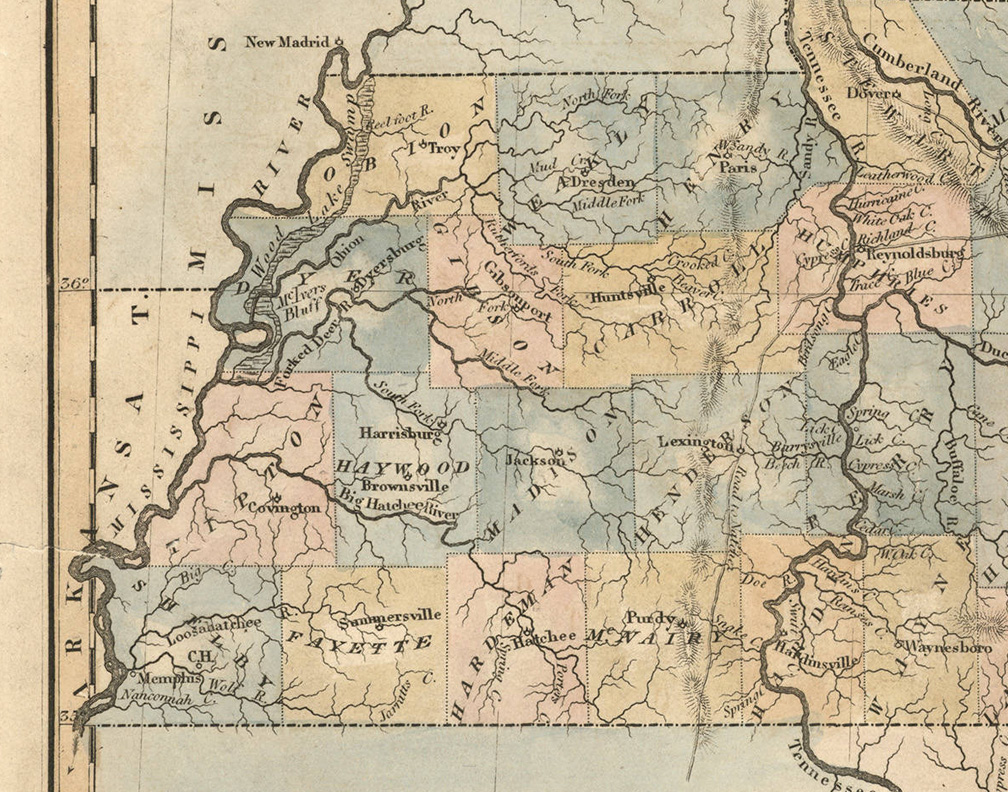
Photo: Tennessee, 1826. Created and published in Baltimore by Fielding Lucas Jr. (1781-1854), this color map shows Tennessee shortly after the Chickasaw cession opened the lands between the Tennessee and Mississippi rivers to settlement. Photo credit: the Tennessee State Library and Archives, TSLA Map Collection. /
I recently wrote about finally finding time to read “Beginnings of West Tennessee: In the Land of the Chickasaws, 1541-1841” by Samuel Cole Williams (1864-1947). A little vacation reading on the beach helped fill in some of the blanks about what may have motivated my ancestors to leave their established farms and plantations in Bertie County, North Carolina, and begin again in Haywood County, Tennessee. It also helped me better imagine the world they entered when they arrived.

Portrait of Samuel Cole Williams; photo credit: Vanderbilt University Photographic Archive
Williams had a personal connection to the migration he described. He dedicated the book to his parents, who had been taken as infants by their families from North Carolina to West Tennessee during the early 1830s, when the region was still in its infancy.¹ That was essentially the same journey made by many of my own ancestors.

“Westward Ho, the Wagons!” is a 1956 live-action Disney film starring Fess Parker. Always looking to promote his attraction, the title was inspired by a Frontierland refreshment kiosk at Disney World.
Why North Carolinians Went West
While western migration has been romanticed in the years since, Williams tells a different story. He described widespread economic distress in North Carolina during the early 19th century. Speculation had left many families in financial difficulty, while poor roads and the high cost of transporting agricultural products made it difficult for farmers to reach profitable markets. A son of Capt. Herndon Haralson (1757-1847), one of the early migrants into West Tennessee, responded to favorable reports from his father by declaring his intention to go to what he called the “Land of Canaan.”
By 1824, Williams wrote, the desire to leave North Carolina could be found in nearly every part of the state. Cotton, tobacco and other products were expensive to transport over poor roads, while reports of fertile and inexpensive land in the West encouraged families to move. A Knoxville newspaper estimated that 4,000 to 5,000 wagons, carts and carriages passed through the community each year carrying migrants westward. A severe drought in North Carolina in 1826 produced near-famine conditions in some areas, adding to the pressure.
By the 1830s, Williams wrote, the migration from North Carolina to West Tennessee had become a “veritable hegira.”

“Westward the Course of Empire Takes Its Way” (also known as “Westward Ho”) is a 20-by-30-foot painted mural painted by Emanuel Gottlieb Leutze in 1861. It is displayed behind the western staircase of the House of Representatives chamber in the United States Capitol Building.
Some of those leaving North Carolina already owned large tracts of land in West Tennessee through state grants or speculation. Those grants could become liabilities when the owners lacked the money to pay taxes on thousands of acres they had never developed. Williams found that enormous tracts in Haywood County were advertised for tax sales during the 1820s. For families such as mine, the attraction was obvious. West Tennessee offered rich soil, abundant timber and the possibility of acquiring more land.
The journey, however, was neither easy nor safe. Families had to load their possessions into wagons, leave behind homes and communities they had known for generations and travel hundreds of miles into a region that had only recently been opened to white settlement. For some, the decision must have felt like an enormous gamble. For others, economic conditions in North Carolina may have left them with few attractive alternatives. Either way, when most of them bid farewell to their North Carolina friends and family, they never saw them again.
The Darker Side of Opportunity
The opportunity offered by West Tennessee came with a much darker side.
Many of the families who established cotton farms and plantations in the region brought enslaved people with them from North Carolina. Others purchased enslaved laborers after they arrived. The migration did not merely transplant North Carolina families into a new state. It also extended the plantation economy and the institution of slavery into newly opened sections of Tennessee.
The rich soil that promised prosperity required tremendous labor to clear, cultivate and plant. Enslaved men, women and children performed much of that work, turning forests and canebrakes into farms and cotton plantations.
That fact is part of my own family history. The records left behind by several of my ancestral families show that they enslaved people in North Carolina and continued to do so after moving to West Tennessee.
A Land That Was Not Empty
Accounts of Tennessee settlement often describe pioneers entering an empty wilderness. Of course, they did not. West Tennessee was part of the Chickasaw hunting ground. Under the 1818 treaty commonly associated with the Jackson Purchase, Chickasaw leaders ceded a vast territory between the Tennessee and Mississippi rivers. Still today, its not uncommon for west Tennesseans to find arrowheads on creekbanks or in freshly plowed fields.
The agreement opened the region to a rush of land speculation and white settlement. It also represented another stage in the dispossession of the Chickasaw people.
Williams’ book reflects some of the attitudes and language of the period in which he wrote. Today, it;s helpful to place those passages in context. The founding of counties, towns, farms and plantations followed the transfer of land that generations of Chickasaw people had occupied, hunted, defended and traveled through. That context makes the speed of development after 1818 even more remarkable.
Within only a few years, settlers established farms, stores, river landings, churches, roads, courts and county governments throughout the region. Land that had been part of the Chickasaw homeland was rapidly surveyed, divided, sold and settled.

Haywood County, Tennessee, 1877. Published in Philadelphia by D.G. Beers & Co. and engraved by Worley & Bracher, this detailed color map identifies roads, railroads, streams, schools, stores, post offices, residences, landowners and property acreages throughout the county. Photo credit: Tennessee State Library and Archives, TSLA Map Collection.
The Beginnings of Haywood County
Haywood County was created in 1823 and named for John Haywood (1762-1826), a Tennessee jurist and historian whose writings helped preserve much of the state’s early history.
Williams identified Richard Nixon (1769-1831) as the founder of the first permanent white settlement near what became Brownsville. Nixon arrived in 1821 and established his home near Nixon Creek, about three miles east of Brownsville, a few hundred feet from the home on Poplar Corner Road that my Lovelace ancestors settled and where my aunt and uncle still live today.
According to Williams, Chickasaw people were encamped along the creek when Nixon arrived. He befriended them them and spent time in their camp.
Nixon’s home became the location of the county’s first court sessions and one of its earliest religious services. He also operated an early store and used a bluff along the Hatchie River, later known as Nixon’s Landing, as a place of business. His family claimed thousands of acres in the area through a Revolutionary War land grant issued for his father’s military service. Brownsville became the county seat, and the county court continued meeting at Nixon’s home until public buildings could be constructed.
Within little more than a decade, the region had been transformed from Chickasaw territory into a rapidly growing agricultural district populated by migrants from North Carolina, Virginia and other older states.
The Missing Voices of the Pioneers
One passage in Williams’ book directly addressed a question I have often considered: Why are there so few surviving journals or written accounts describing the journey from North Carolina to West Tennessee?
Williams concluded, “These pioneers were not of a writing generation.” He searched unsuccessfully for even one complete journal documenting an overland migration into West Tennessee.²
Of course, that absence is frustrating for those of us trying to reconstruct the lives of our ancestors. Official documents can tell us when they sold property, joined churches, bought land, appeared in court, paid taxes or died. Census records can place them in a particular county during a particular year. Wills and estate inventories can reveal what they owned.
Those records rarely tell us what the journey felt like.
They do not tell us what families discussed before deciding to leave North Carolina. They do not tell us how they selected their route, what they carried in their wagons, where they slept or what illnesses they encountered along the way. They do not tell us how family members reacted when they realized they might never again see the homes, churches, cemeteries and neighbors they had left behind.
They also do not tell us what they thought when they first saw the dense forests, river bottoms and canebrakes of West Tennessee. Did they immediately recognize the agricultural potential of the land? Were they overwhelmed by the amount of work required to clear it? Did they regret leaving North Carolina? Did they believe they had finally reached their own “Land of Canaan”?
Those are the details I would most like to know.

More Than Names and Dates
“Beginnings of West Tennessee” helped me better understand the economic pressures, opportunities and historical forces that encouraged my ancestors to leave Bertie County and begin again in Haywood County. Their migration was not an isolated family event. It was part of a much larger movement of people from North Carolina, Virginia and other older states into the newly opened lands of West Tennessee.
Some came seeking opportunity. Some were escaping debt, poor roads, exhausted soil or depressed agricultural markets. Others already held land grants and moved west to claim or develop their property. They entered a region undergoing tremendous change. Chickasaw land was becoming American counties. Forests and canebrakes were becoming farms. Landings, churches and courthouses were appearing where few permanent white settlements had existed only a few years before. The same migration also carried slavery and the plantation economy westward, creating wealth for some through the forced labor of others.
For me, genealogy research is about more than names, dates and family relationships. To understand why our ancestors made the choices they did, I must also understand the world in which they lived.
Williams’ book helped me see that world more clearly. It did not answer every question I have about my ancestors’ journey from North Carolina to Tennessee. In some ways, it left me with even more questions. But it provided something almost as valuable: the historical setting in which their individual stories unfolded.
For more of my genealogy research, visit rscottwilliams.info.


Leave a Reply