
I’ve been working on my Forrest and Sherrod family lines during the holidays, and today I came across an interesting young couple whose courtship appears to have been interrupted by the Civil War and imprisonment.
The story also adds another piece to the complicated family history of my third great-grandmother, Ann “Annie” W. Sherrod Yelverton (1834-1880). You can read more about the Sherrod, Forest and Yelverton conection here.
In the 1860 U.S. census for Haywood County, Tennessee, 16-year-old James Edward Sumner/Sumler (1844-1920), was listed as a farm laborer in the household of my third great-grandparents, Samuel W. Yelverton (1828-1876) and Annie Sherrod Yelverton.
Samuel and Annie were raising five young children at the time.
Living nearby were Samuel W. Forrest (1794-1860) and Zilpha Sherrod Forrest (1797-1870), my fourth great-grandparents. Annie had lived in their household before marrying Samuel Yelverton, and the available evidence suggests Samuel and Zilpha Forest helped raise her even though Annie’s maiden name was Sherrod.
Samuel Forrest was also Samuel Yelverton’s uncle. Samuel Yelverton’s mother, Mary A. Forrest Yelverton (1791-1862), was Samuel Forrest’s sister.
The repeated use of names such as Samuel, William, Mary and Annie among the Forrest, Sherrod and Yelverton families has made this line especially difficult to untangle.
Samuel and Zilpha do not appear to have had biological children of their own, but census records show that they regularly took younger relatives into their home.
By 1860, they were raising 14-year-old Susan “Susie” Sherrod Sumler (c. 1844-1923). Susie appears to have been a daughter of William K. Sherrod (c. 1818-c. 1858) and Priscilla Winifred Howell Sherrod, although that relationship still needs additional documentation.
William K. Sherrod was probably a close relative of Zilpha, possibly a nephew. His death in 1858, when Susie was around 14, may explain why Susie was living with Samuel and Zilpha by 1860.
James Sumner lived next door.
It is easy to imagine the two young people becoming acquainted while living in neighboring households. Susie was about 14 and James was about 16 when the census taker recorded them in 1860.
Whatever relationship was developing between them was soon interrupted by the Civil War.
James Goes to War
James and his brother, Shelby Sumner, enlisted in the Confederate Army.
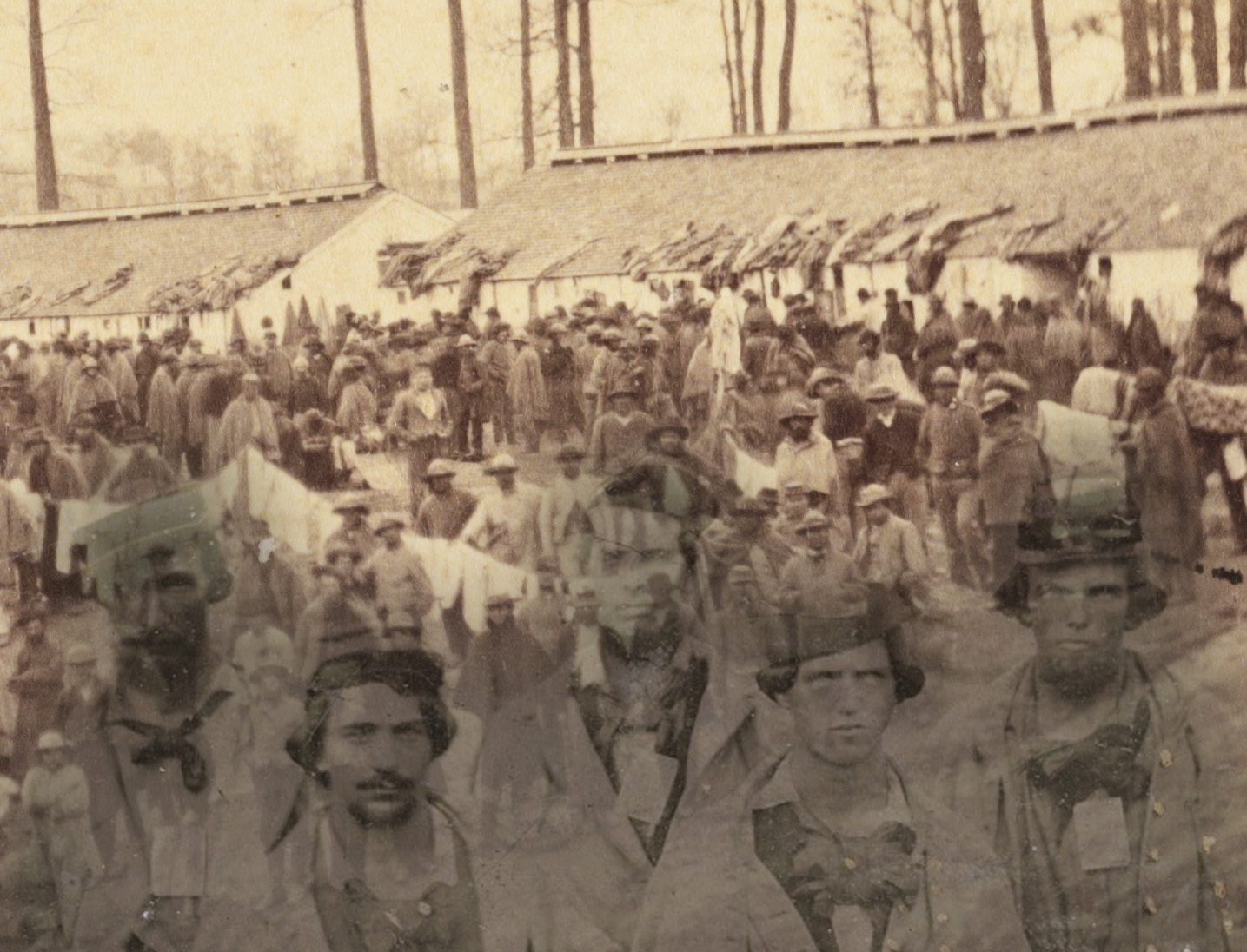
James served in a Tennessee cavalry unit before Union forces captured him in July 1863. He was sent to Camp Morton, a prisoner-of-war camp in Indianapolis, Indiana, where he remained until near the end of the war.

Camp Morton was a place of cold, hunger, filth and disease. By the summer of 1864, nearly 5,000 Confederate prisoners were crowded into less than 5 acres. The barracks were poorly ventilated, badly maintained and often little more than drafty sheds with dirt floors. Some buildings had wide gaps where boards had disappeared, allowing rain, snow and bitter wind to blow directly onto the prisoners. Hundreds of men were packed into four-tier bunks with about 2 feet of space allotted to each person.
Blankets and clothing were scarce, vegetables were largely absent from the diet and open excavations served as latrines. Scurvy became common, while pneumonia, diarrhea and other illnesses spread rapidly among men already weakened by exposure and inadequate food. Federal inspectors described the barracks as overcrowded, filthy and in desperate need of repair. Between December 1864 and March 1865 alone, 373 prisoners died and nearly 1,200 were admitted to the hospital.1
Former prisoner John Allan Wyeth (1845-1922) remembered men huddling together in groups of three beneath a single blanket, sleeping fully dressed and competing for places near the few stoves. He said the daily ration was not enough to satisfy hunger and claimed he watched prisoners become so emaciated that even minor illnesses killed them. “I counted eighteen bodies carried into the dead-house one morning after an intensely cold night,” Wyeth recalled.2 During Camp Morton’s operation, approximately 1,763 of the 12,082 prisoners held there died — a mortality rate of about 14.6%. Its inadequate hospital, meager rations, deficient clothing and brutal Indiana winters turned confinement into a prolonged struggle against starvation, sickness and exposure. Men who had survived battle arrived at Camp Morton only to waste away in overcrowded barracks, surrounded by the sick and dying, uncertain whether they would ever return home.3
James survived his imprisonment and returned to Haywood County after the war. We know nothing of his return home and the difficulty of adjusting to post-war life, but it was likely not easy.
On Nov. 14, 1866, James and Susie were married.
Their marriage record appears under the surname Sumner, but James later used the spelling Sumler. Most subsequent records for the couple and their children use Sumler, although both versions continue to appear.
A New Life in Arkansas
James and Susie remained in Tennessee for several years after their marriage.
Their first child was Margaret Ann “Maggie” (1867-1936). Then came Abraham J. “Abe” Sumler (1869-1934) who was born in 1869. Then came Benjamin Franklin “Frank” (1874-1949), Mary Lee (1878-1958), Alma Alena (1880-1950), Polly (1884-1923) and William “Will” (1885-1916).
Around 1875, James and Susie moved west to Cypress Township in Faulkner County, Arkansas. They were part of the large postwar migration of Southern families searching for inexpensive farmland and new opportunities farther west.
Susie died in 1923, and James died Sept. 14, 1920. They are buried in New Liberty Cemetery in Faulkner County.
Their life together stretched from the cotton fields of antebellum Haywood County through the Civil War, imprisonment, Reconstruction and a new beginning in Arkansas.
Another Sherrod Connection
The story is also important because it reinforces what earlier census records reveal about Samuel and Zilpha Forrest.
In 1850, Annie Sherrod was living with them. In 1860, Susie Sherrod was living with them.
The two young women were almost certainly related to Zilpha and possibly to each other. Both appear to have entered Samuel and Zilpha’s household after losing one or both parents or otherwise needing a home.
Annie went on to form a family with Samuel Yelverton, who was already living in the Forrest household in 1850. Susie later married James Sumler, who was living next door with Annie and Samuel in 1860.
The Forrest home therefore appears to have served as a center of an extended family network rather than simply the residence of a childless couple.
Samuel and Zilpha provided a home for younger relatives, and in doing so they helped bring together at least two couples whose descendants spread across Tennessee and Arkansas.
James and Susie’s story does not solve the mystery of Annie Sherrod’s parents, but it adds another clue. The presence of both young women in the Forrest household strengthens the likelihood that Annie, Susie and Zilpha belonged to the same extended Sherrod family.
For more of my genealogy research, visit rscottwilliams.info.


Leave a Reply