
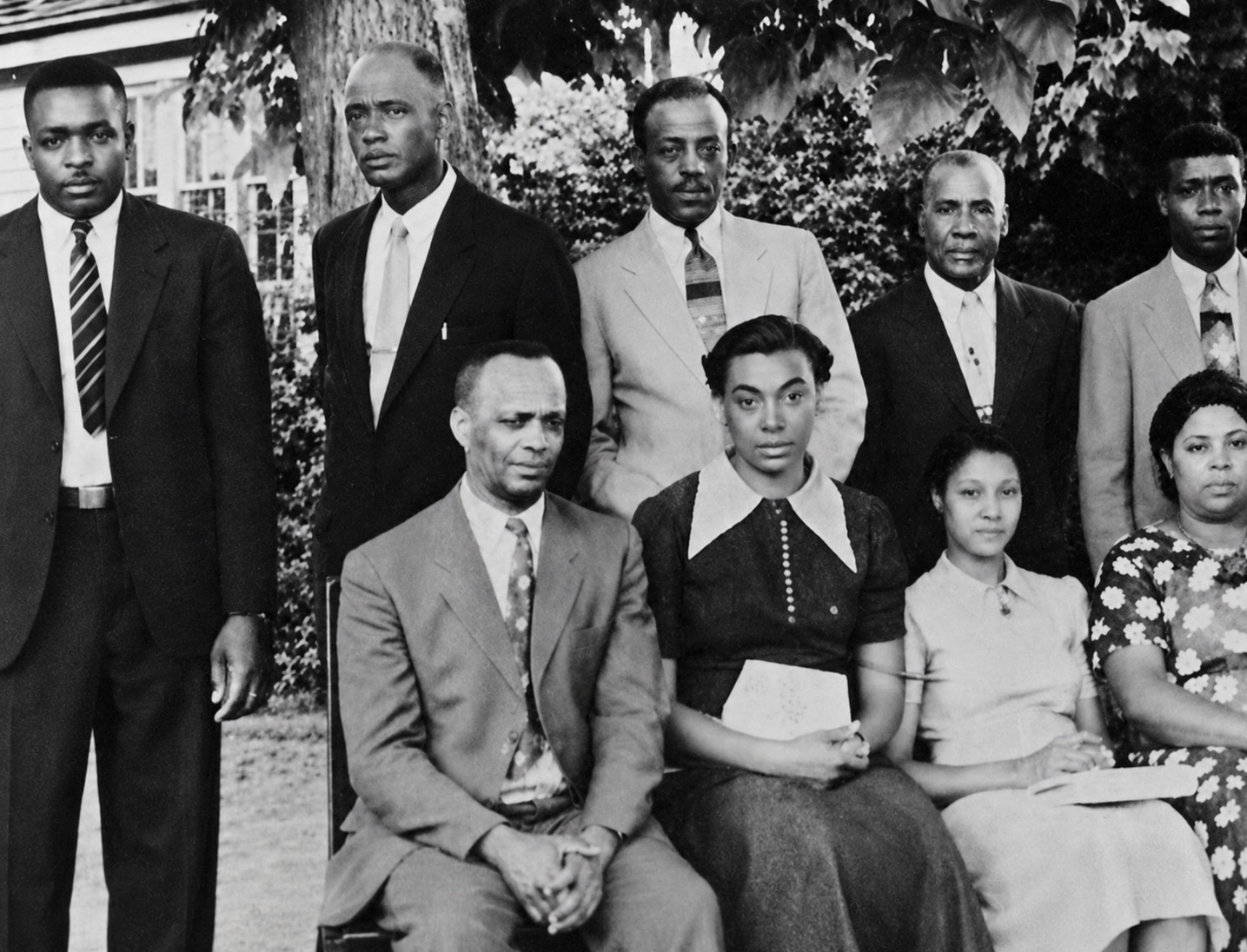
Photo: Elbert Williams (far left), pictured with other members of a Haywood County NAACP chapter. /
I have wanted for some time to include the story of Elbert Williams (1908-1940) on this blog.
Williams’ name is not as widely known as that of the Rev. Martin Luther King Jr. (1929-1968), but his murder belongs to the same long struggle for equal citizenship and voting rights. Williams was killed in Brownsville nearly 23 years before the March on Washington and almost 25 years before the Voting Rights Act of 1965. He is recognized as the first known NAACP member in the nation killed because of his civil rights work.1

Jim Emison, left, with descendants of Elbert Williams at the dedication of the historical marker for Williams, founder of the Brownsville, Tennessee, chapter of the NAACP, who was lynched in 1940.
Brownsville attorney and historian Jim Emison has spent years researching the case and working to restore Williams to his rightful place in American history. Because of Emison’s efforts and those of others, Williams’ story has received national attention through books, news reports, documentaries, podcasts, public programs and government investigations.
I was reminded of Williams’ story while visiting Brownsville and passing the Tennessee historical marker dedicated to him near the town square. The marker stands only a short distance from the center of a community where Black residents were once threatened, abducted and driven from their homes merely for attempting to exercise their constitutional right to vote.
It is a tragic story defined not only by murder, but also by the complete absence of justice. It deserves to be remembered as Americans continue debating how communities should publicly interpret slavery, the Civil War, Reconstruction, segregation and the long fight for civil rights.
A Family in Haywood County
Elbert Williams was born Oct. 15, 1908, in Haywood County, Tennessee. He was the son of Albert Williams and Mary Green Williams, who worked as farmers.
In 1929, Williams married Annie Mitchell Williams. The couple moved to Brownsville, where both worked at the Sunshine Laundry. Elbert continued working there until his death in 1940.
Williams and Annie became charter members of the Brownsville branch of the NAACP, established in 1939. At the time, Black residents made up a majority of Haywood County’s population but had been effectively denied the right to vote through intimidation and discriminatory registration practices.
The system had deep roots. White settlers, including some of my own ancestors, came to Haywood County during the 1820s and brought enslaved people with them. Slavery ended in 1865, but white political control continued through violence, economic retaliation, segregation and the deliberate exclusion of Black citizens from elections.
By 1940, the Brownsville NAACP was challenging that system directly.
On May 6, five Black men went to the Haywood County registrar’s office and attempted to register to vote. They were the Rev. Buster Walker, Taylor Newburn, Elisha Davis, John Lester and John Gaines. They were sent from one official to another and ultimately told that registration would not begin until August.
Their attempt triggered a campaign of white terror.
Threats were directed at NAACP leaders. Black residents were questioned about the organization and warned not to register. More than 20 Black families eventually fled the area, abandoning homes, businesses and property rather than risk further violence.
A Campaign of Abduction and Terror
Several days before Williams disappeared, law enforcement officers and a white mob abducted Elisha Davis from his home. Sheriff Samuel “Tip” Hunter, Brownsville police officer Charles Reed, and members of the mob took Davis to the Forked Deer River. They demanded the names of NAACP members and threatened to kill him unless he left town.
Davis fled Brownsville almost immediately.
Late on June 20, 1940, Hunter and Reed went to the Williams home. Accounts based on the original investigation also place Ed Lee, manager of the local Coca-Cola bottling company and a former Brownsville Chamber of Commerce president, with them.
The men took Williams from his home, supposedly for questioning. They also detained Thomas Davis, Elisha Davis’ brother.
Williams and Thomas Davis were taken to the local jail and questioned about the NAACP’s activities and a planned meeting involving members from Brownsville and Jackson. Police later released Davis into a crowd of 40 to 50 white men gathered outside. He managed to escape.
Williams did not.
Hunter and Reed later admitted taking Williams into custody but claimed they released him. Annie went to City Hall searching for her husband, but she could not find him. She never saw him alive again.

A Body in the Hatchie River
On June 23, three days after Williams was taken from his home, a fisherman found his body floating in the Hatchie River.
Annie was summoned to the river and identified her husband. In a sworn statement, she said his body was bruised and beaten and had holes in the chest. She recalled that it was quickly removed from the river, placed in a box and taken away after the coroner ordered an immediate burial. No autopsy was performed.
Williams was buried that day in an unmarked grave in Taylor Cemetery. The precise location of the grave remains unknown.
A Haywood County grand jury later classified his death as a homicide committed by unknown parties. No one was indicted.
Williams’ murder destroyed the newly organized Brownsville NAACP branch. Its members and suspected supporters understood the message: Attempts to register Black voters could result in abduction, expulsion or death.
Thurgood Marshall Comes to Brownsville
The NAACP sent attorney Thurgood Marshall (1908-1993) to investigate. Marshall later became the principal attorney in Brown v. Board of Education and, in 1967, the first Black justice appointed to the U.S. Supreme Court.
Marshall and other NAACP investigators collected statements, identified witnesses and documented the roles of local officials and members of the white community. The organization repeatedly urged the U.S. Department of Justice to prosecute the case.
The federal investigation was deeply flawed.
Hunter was permitted to remain nearby during some witness interviews, even though he was one of the principal suspects in Williams’ abduction. Black witnesses faced the impossible prospect of describing law enforcement misconduct while members of the same local power structure remained close at hand.
Federal officials initially disagreed about whether the evidence supported further action. Justice Department attorneys eventually concluded that federal law had been violated and discussed presenting the matter to a grand jury. By early 1942, however, the department closed the case without prosecution, claiming the available evidence was insufficient to obtain a conviction.
No one was ever held accountable.
Recovering a Nearly Forgotten Story
For decades, the story remained largely absent from the public history of Brownsville and Haywood County.
Emison encountered the case while researching local history and became determined to uncover what had happened. A Vanderbilt University history graduate and University of Tennessee College of Law graduate, he built a distinguished legal career and served as president of both the Tennessee Bar Association and the Tennessee Trial Lawyers Association.
His legal training gave him the skills to examine witness statements, federal files, cemetery records, investigative reports and other surviving evidence. He also worked with historians, archaeologists, forensic specialists and members of Williams’ extended family.

On June 20, 2015, the 75th anniversary of Williams’ abduction and killing, hundreds of people gathered in Brownsville for a memorial service and the unveiling of a Tennessee historical marker. The marker describes Williams’ death as part of a white terrorist campaign designed to stop Black residents from voting.
Emison and others have also searched Taylor Cemetery in hopes of locating Williams’ grave. Finding his remains could allow for a marked burial and might answer questions about how he died, although the passage of time makes recovery and forensic analysis extremely difficult. As of now, researchers have not identified the location of Williams’ grave.
Recently, District Attorney Garry Brown reopened the state investigation under Tennessee’s civil rights cold-case law. The federal government separately reviewed the case but closed its investigation without prosecution, citing the deaths of potential suspects, expired statutes of limitations and the lack of evidence sufficient to support federal charges.
Emison continues telling the story. His book, Murder on the Hatchie, is scheduled for publication soon
A Call to Remember
U.S. Rep. John Lewis (1940-2020), one of the most important leaders of the modern civil rights movement, connected Williams’ sacrifice to the unfinished work of American democracy:
“It is the blood of individuals like Elbert Williams who have continued to struggle to redeem the soul of America and create the beloved community. … The blood of Elbert Williams is crying out, saying we must not go back, we must not turn around, we must go forward.”
Williams was 31 years old when he was taken from his home and murdered. He was a laundry worker, a husband, a Haywood County native and a citizen who believed Black people should be allowed to register and vote.
That belief cost him his life.
The historical marker near the Brownsville town square cannot provide the justice denied to Williams and Annie. It cannot identify his killers, locate his grave or reverse the terror that destroyed the local NAACP branch.
It can, however, make forgetting more difficult.
Elbert Williams’ story belongs to Haywood County, but it is also part of the larger American story. His murder reminds us that the right to vote was not secured merely through legislation and court decisions. It was won through the courage and sacrifice of people whose names were often omitted from history.
Williams’ name should never be omitted again.
For more of my genealogy research, visit rscottwilliams.info.
Notes:
- Patricia Sullivan, Lift Every Voice: The NAACP and the Making of the Civil Rights Movement (New York: New Press, 2009), 247-53; Jim Emison, “Elbert Williams (1908-1940),” BlackPast, March 16, 2019. The U.S. Department of Justice describes Williams and the other men targeted in Brownsville as founding or suspected members of the newly formed NAACP branch. ↩︎


Leave a Reply