
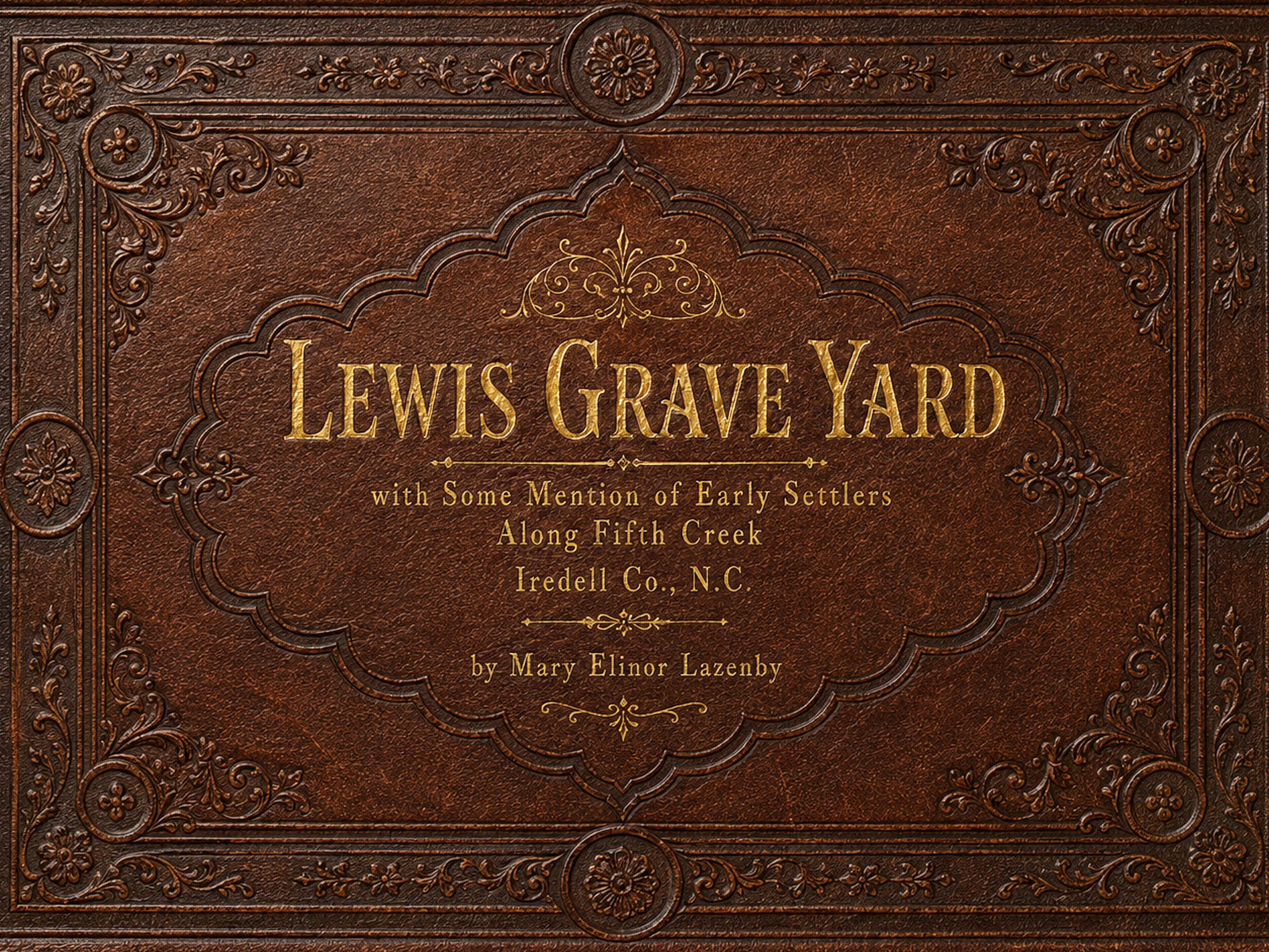
My interest in Lewis Graveyard is personal. Several of my direct ancestors are buried there, including my fourth great-grandparents Thomas Lovelace (1772-1829) and Amelia “Millie” Dyson Lovelace (1761-1828), whose names appear near the end of Mary Elinor Lazenby’s pamphlet. Thomas and Amelia’s son, Thomas A. Lovelace (1812-1876), eventually left Iredell County and settled in Haywood County, Tennessee. From him, my line continues through Charles Buchanan Lovelace, James Luther “Jim” Lovelace, Guy Lovelace and my mother, Shirley Lovelace Williams. My fifth great-grandparents, Charles Lovelace (ca. 1742-1796) and Sarah Robey Lovelace (1731-1796), are also recorded as buried in Lewis Cemetery. Charles was the son of my sixth great-grandmother Eleanor Lovelace Robey (ca. 1720-1777), whose grave is there as well.

There may be another direct ancestor resting there without a marked grave. Sarah Robey Lovelace’s father, Thomas Robey, was also my sixth great-grandfather. Lazenby devotes several paragraphs to the question of where he was buried after his death in the 1770s and concluded that the evidence pointed toward the burial ground that became Lewis Graveyard, although she could not prove it.

You can find some great photo of the Lewis Cemetery on abandonednc.com.
That makes this small cemetery much more than a place I happened across while researching the Lovelace family. It is one of the earliest physical places I have found where several generations of my family intersect — the Maryland families who came to Fifth Creek before the Revolution and the Lovelaces whose descendants eventually carried my family line west to Haywood County, Tennessee.
| About Mary Elinor Lazenby Born into an Iredell County family with deep roots along Fifth Creek, Mary Elinor Lazenby (1875-1955) graduated from the North Carolina State Normal and Industrial School, now UNC Greensboro, in 1896. She spent much of her adult life in Washington, D.C. Over the years she became a serious independent historian and genealogist, corresponding with courthouses, libraries and other researchers, studying wills and deeds and visiting old family properties and cemeteries herself. She published a substantial history of the Lazenby family in 1942, a biography of North Carolina Regulator Herman Husband in 1940 and later a collection of Revolutionary War pension accounts. Her research papers and correspondence survive today in archival collections, evidence of just how methodically she approached her work. “Lewis Grave Yard With Mention of Some Early Settlers Along Fifth Creek” grew naturally from that lifetime of research, but the little pamphlet was also deeply personal. Lazenby’s grandfather, Robert Lazenby, was buried in Lewis Graveyard, and her grandmother descended from Daniel Lewis, on whose land the cemetery developed. By the 1940s, Lazenby realized that both the burial ground and the memory of the people buried there were in danger of disappearing. She wrote of graves marked only by rough stones, an old rock wall that had begun to be dismantled and the names of early settlers already fading from local memory. It appears that the pamphlet was closely connected to an effort to preserve the cemetery itself. A Lewis Graveyard Fund was established in 1945 to provide for its continued care, with Lazenby serving as treasurer. In that sense, her little book accomplished two things at once: It preserved the story of a community that had nearly vanished and helped make sure the ground where many of those people rested did not vanish with it. Lazenby died MArch 5, 1966 at age 90 in a Fairfax, Virginia nursing home and was buried at Oakwood Cemetery in Statesville, N.C. |

Winston-Salem Journal, March 08, 1966, 7.
Lewis Grave Yard with Some Mention of Early Settlers Along Fifth Creek, Iredell Co., N.C.
By Mary Elinor Lazenby, Statesville, N.C., 1944
About 1751 people began moving into Iredell County, along Fifth Creek and its main tributary, the Five Mile Branch, called on some old maps the Saw Mill Branch, and on Sharpe’s Map, 1772, the South Fork of Fifth Creek. It was virgin territory and there were still occasional Indians around the locality.
While the region belonged to Rowan County, two grants to Rev. John Thompson, of 640 acres each, antedate Rowan, and are described as lying in the Parish and County of Anson, on both sides of Fifth Creek. One of these grants passed into the hands of Robert Simonton, June 2, 1754, and he sold it to Ninean Steele (1738-1813) April 30, 1779. But this study is more particularly interested in the adjoining tract, which was conveyed by Mr. Thompson’s heirs to Rev. James Rosebrough, “newcomer,” August 16, 1756.
Rev. John Thompson had come as a pioneer missionary from the New York and Philadelphia Synod. His land grants contained the provision that within three years three acres for every hundred must be cleared and in cultivation. But within three years Rev. John Thompson was dead, and buried near Center Church, in South Iredell, which was his principal charge. It seems unlikely, therefore, that Mr. Thompson established a home on his holdings, although he may have done so. He would certainly have been very lonely if he had, though he might have had for neighbors some of the very earliest Pennsylvanians who were coming in. Among these were the Hall brothers, the Archibald brothers, Robert Simonton, David Hendry (sometimes Henry), and others.
3
Rev. James Rosebrough appears to have been Mr. Thompson’s successor in the mission field as well as on the plantation. It seems probable that he and his wife Margaret, with their three sons, did have a home on the original Thompson tract, which later became the home of John Fitzgerald, and finally the Somerset Holland place. For when Rev. James Rosebrough died in 1767 his grant fell, by law of entail, to his oldest son John, who married Mary, only daughter of John and Jean (Gracy) Knox. When John Rosebrough died in 1777 he willed the use of his plantation to his widow “so long as she remains unmarried.” So when Mary Knox Rosebrough married Abel Armstrong, Dec. 7, 1791, she sold the place to John Fitzgerald, who a few years before had arrived from Montgomery County, Maryland. The tract then fell to John Fitzgerald, Jr., who married Jemima Beall, and later to Somerset Holland by virtue of his marriage with their daughter Emily. This represented only half the original grant, since immediately after his father’s death John Rosebrough, heir at law, transferred half of it to his mother Margaret, who lived on it until her death in 1785.
Another indication that Rev. James Rosebrough established a home at or near the Holland place appears in the names of the witnesses to the will of his widow Margaret. They are Thomas Belt, Zephaniah Ellis and John Archibald. The first two had come from Montgomery County, Maryland, recently, and Thomas Belt was living at the old Belt place, owned as of 1944 by W. Frank Reece. Zephaniah Ellis was in the Providence locality. His daughter Mary married Elias Lazenby and they were the parents of Pinckney Lazenby, whose descendants are numerous in the county. John Archibald’s tract, “on both sides of Fifth Creek,” dated from April 4, 1761, and was in what came to be known as the Watts Mill vicinity. He had married Mary, daughter of James Hall, and his son Samuel, when he grew up, was to marry Thomas Belt’s daughter Rachel.
4
The Pennsylvanians, from Lancaster County principally, had Fifth Creek to themselves for about two decades, when the Marylanders, — mainly from Montgomery County, began to settle along the Creek. The former were mainly Scotch from Ireland; the latter, of English extraction from Yorkshire. The Pennsylvanians had been on this side of the ocean not more than a generation; the Marylanders from two to three generations. There were differences in the strains, which manifested themselves in customs. For example, the Scotch-Irish were strict Presbyterians and would not countenance Sunday visiting. The Marylanders adhered to the Established Church until it was disestablished by the Revolution, and then they became Methodists. That church had been organized in their neighboring city of Baltimore and Rev. Elihu Waters, its first ordained minister, had labored in Montgomery County. They were social-minded and visited on Sunday if occasion offered.
In the forefront of those who came from Maryland was Isaac Lovelace, who bought into the William Archibald tract in 1772, from William Archibald, Jr., and Martha Archibald. Again Isaac Lovelace bought into an old grant when he purchased from Margaret Rosebrough. Dec. 26, 1772, one-half of the Rosebrough land, or 320 acres which had been transferred to her by her son John March 22, 1768, shortly after his father’s death. Two days after buying the land from Margaret Rosebrough Isaac and Catherine Lovelace transferred it to his step-father, Thomas Robey.
The writer can not definitely fix an earlier date to the arrival of any Marylander among those who came in numbers to Fifth Creek and northward to the South Yadkin River than that of the Lovelace-Robey group, into whose background let us glance for a moment.
Montgomery County, Maryland, from which most of the Maryland settlers in Iredell of the
5
immediate Revolutionary period came, was a part of Frederick County until 1776, and so it is at Frederick that we find the will of John Baptist Lovelace, dated July 13, 1765. He left his land, part of the well-known tract called The Hermitage, now covered by Washington suburbs, to his widow Eleanor, during her life, after which it was to go to William, Luke and Elias. His son Charles was to have the remainder of the survey and his son Isaac a tract in Charles County known as “Job’s Comfort,” after the quaint way of naming Maryland land grants. One-third of the personal estate was to go to the widow and the rest to Vachel (sometimes spelled Vechtel), Archibald, Mary Ann and Millicent, all minors. Incidentally, the two Lovelace brothers, Charles and William, married sisters, Catherine and Margaret Beall, respectively, daughters of James and Margaret Edmonston Beall.
The widow, Eleanor Lovelace, married the widower, Thomas Robey, and with him and their families they came to the Fifth Creek property. Their wills show them to have been slave-owners, and Thomas Robey mentions an indentured servant with freedom dues to be paid. Perhaps no other indentured servant came to Fifth Creek, but in Maryland they were not unusual. Eleanor Robey’s will at Salisbury, Oct. 8, 1776, mentions the same children that John Baptist Lovelace named in his will. Mary Ann had become Shaw and Archibald and Millicent were still minors. Descendants of these children held on to the old place along Fifth Creek, and made entries on Hunting Creek and Dutchman Creek, but the name has long since disappeared from the locality. Elias and Vachel, sons of John and Eleanor Lovelace, moved to Kentucky after the Revolution, in which both served.
Thomas Robey, who died three years before his wife Eleanor, mentions some of the Lovelace children in his will. Obviously two daughters married Lovelaces, since he refers in his will to his daughter Sarah Lovelace. His daughter Ann
6
married Elias Lovelace January 11, 1775, he being her step-brother. The will mentions Nathan Robey, who was to have 150 acres on both sides of Fifth Creek, and Prior Smallwood Robey, who was to have 79 acres at the north of Robey’s tract and eventually the 91 acres left as a life estate to the widow Eleanor. The witnesses to Thomas Robey’s will were John Rosebrough, Robert Shaw and Isaac Lovelace. Among the descendants of Thomas Robey who kept the name alive into the next century were John Robey, whose will is at Statesville, 1804, with wife Rachel and children Berry, Elizabeth, Basil, Leonard, Milly Barker, Esther Tucker, deceased, Mary Tucker, Ede Smith and Tobias Robey, who had seven daughters. Then we have John Boswell Robey, whose will at Statesville, 1820, mentions wife Patta (Martha), and children Betsey, who married Ebenezer Holman, Anne, Polly, Cynthia, Matilda, Patta and sons Greenberry, James, Barton, Absalom and John Randolph. The name was on the map for a time as old deeds refer to Robey’s branch, which ran into Fifth Creek.
Within the memory of those living in 1944, when this was written, the names of these old settlers come back as echoes of names mentioned long ago by those who knew them. They have long been gathered to their fathers and soon even their names will be strange to the people along Fifth Creek, where they lived and died and lie in graves not far away. But where exactly are these graves? It is not possible to answer with entire assurance, but at least we know that many of them were buried in the plot known as the Lewis Graveyard.
Let us take a glance over the neighborhood say as of the day that Thomas Robey lay dead in his home on the north fork of Fifth Creek, late in 1773. Where should a man, stranger in a strange land, be interred? So far as appears, he was the first of the Marylanders to die in the neighborhood. The only burying ground was six or seven miles away, by rough road, at what
7
came to be known as Fourth Creek Cemetery. There had been an interments there, as early as 1764 when William Archibald died. It is said that Rev. John Thompson had held religious services there, or near by, and that the beginnings of a congregation were in existence. There they buried Rev. James Rosebrough, when he died in 1767. There was no Bethany until 1775, no New Hope until around 1802 and no Providence until considerably later.
However, the Fourth Creek burying ground had been used, apparently, only, by the Pennsylvanians who held to Presbyterian tenets. Maryland people were of a different strain and custom. It is very likely that the Robey family was not invited to mingle its dust with the dust of the Covenanters. However that may be, there is no record of the interment of Thomas Robey, or any of his family, at Fourth Creek. It must be, then, that after the Maryland custom, they rest on lands that were once their own. May it not be on that spot of higher ground, somewhat away from the creek, which had been willed to Prior Smallwood Robey, and which is known as the Lewis Graveyard?
Meantime, among other very early settlers from Montgomery County, Maryland, came Daniel Lewis and his eighteen-year-old wife, Margery Waters, arriving in the year 1777. He had already served with the Maryland Flying Camp in the Battle of Long Island and had some service ahead of him in his new home. It is likely that he and Margery lived on Prior Smallwood Robey’s land, for the latter is not found again in any local records, until ten years later he transferred to Daniel Lewis the two tracts received in his father’s will, amounting to 170 acres. Here Daniel Lewis lived until his death in 1836, meantime adding to his holdings by small purchases. Prior Smallwood Robey was back in Maryland after his step-mother’s death.
In 1789 Daniel Lewis’s first wife Margery died. She was buried in the plot known as the
8
Lewis Graveyard. Hers is the earliest marked grave, and for this there is an obvious reason. One of their old neighbors, Zachariah Summers, had come from Maryland and settled among them, and he was a skilled stone-cutter. He carved most of the inscriptions in the graveyard, where his headstone stands today, though Ninean Steele (1815-1858) carved some of them, as his name appears on them.
The Lewis Graveyard continued to be the burying ground of those Maryland people who came to the section in early years, until other burying grounds developed around churches. Interments continued to be made there as late as 1878, when some living in 1944 recall that of Margaret Fitzgerald, wife of Henry Fitzgerald, who was a daughter of Daniel Lewis. It was natural that members of families should be buried by those long resting there, even though the old graveyard was getting a little out of date.
The list of marked graves which follows by no means represents the number of graves. Many of them have only a rough stone at the head and foot and it is reasonable to suppose that there are many which do not have even that marker. Stones standing, as of 1932, follow:
Beall, Brooke, born Jan. 1792; died June 30, 1792.
Beall, Zadock. Died 1795. (Records at Queen Ann’s Parish, Prince George’s County, Maryland, show the birth of Zadock, son of Robert and Jane Beall, christened August 31, 1766. Records at Salisbury show his marriage Sept. 16, 1786, to Nancy Begely. She is believed to have married David Fitzgerald second, as her grave is between his and Zadock Beall’s.)
Fitzgerald, David, died 1847, aged 72.
Fitzgerald, Nancy, his wife, died 1840, aged 74.
(Note:) The daughter of David and Nancy Fitzgerald, Cenith, who married David Brandon, is here in an unmarked grave.)
9
Fitzgerald, Henry, died 1841.
(Note: His wife, Margaret, was buried beside him in 1878, but there is no stone.)
Green, Samuel. Died 1849. (Husband of Venelia, daughter of Robert and Margery Lazenby.)
Lazenby, Joshua, died 1841, in his 81st year.
(Revolutionary record.)
Lazenby, Keziah (his wife), died 1826, in her 73rd year.
Lazenby, Joshua, son of Joshua and Keziah, died 1793, aged 4 years.
Lazenby, Henry, (son of Joshua and Keziah Lazenby), born 1797. Died Oct. 8, 1870.
Lazenby, Rezin, (son of Joshua and Keziah Lazenby), died 1856, in his 64th year.
Lazenby, Robert (son of Joshua and Keziah Lazenby), died 1828, in his 43rd year.
Lazenby, Robert Lewis (son of Robert and Margaret Lazenby), died 1838, in his 14th year.
Lazenby, Talitha C., daughter of Henry and Elizabeth (Fitzgerald) Lazenby, died 1833, in 3rd year.
Lazenby, Susan, daughter of Henry and Elizabeth (Fitzgerald) Lazenby, died 1833, in 2nd year.
Lazenby, Keziah, daughter of James and Polly Lazenby, died Nov. 17, 1823, aged 13 years, 28 days.
Lewis, Daniel, died 1836, in 81st year.
Lewis, Margery (Waters), first wife of Daniel Lewis, died 1789, aged 30.
Lewis, Elizabeth (Belt), (second wife of Daniel Lewis), died 1838, in 80th year.
10
Lovelace, Thomas, died 1829, aged 57.
Lovelace, Amelia.
Summers, Zachariah. Died Sept. 3, 1848, in his 85th year.
So reverent was the care the early settlers showed to their burying ground that they erected around it a substantial rock wall. Long ago some one planted myrtle on a grave and today the entire graveyard is covered with it, which serves to keep down weeds and undergrowth to some extent. The wall remained unmolested until after the death of Daniel O. Lazenby and Robert Lazenby, sons respectively of Robert and Henry Lazenby, who annually placed the tract in order. Then some one began to move rock from the wall for building. This was discovered and stopped. The rock was returned but not replaced. To guard against further molestation, Mr. N. C. Summers, who owned the land, deeded the graveyard tract, (one-quarter of an acre) to New Hope Church (Deed Book 110, page 3, Iredell County). This was in 1920. Since then the plot has had no care except such as Lee K. Lazenby has been able to give it.
In 1945 a Lewis Graveyard Fund was begun, to provide continued care. The trustees, whose duty it is to guard the Fund and to see that its proceeds are spent in caring for the plot, are President, R. P. Lazenby, P. O. Box 1043, Charlotte, N. C.; Treasurer, Miss Mary E. Lazenby, 515 West Bell Street, Statesville, N. C.; Mrs. Ethel Brandon Holland, Brookdale, Statesville, N. C.
To the end of October, 1945, the sum of $120 had been contributed, and placed for investment.
Mary Elinor Lazenby.
Statesville, N.C.
1944.
11
Lewis Cemetery on Findagrave.com
For more of my genealogy research, visit rscottwilliams.info.


Leave a Reply