
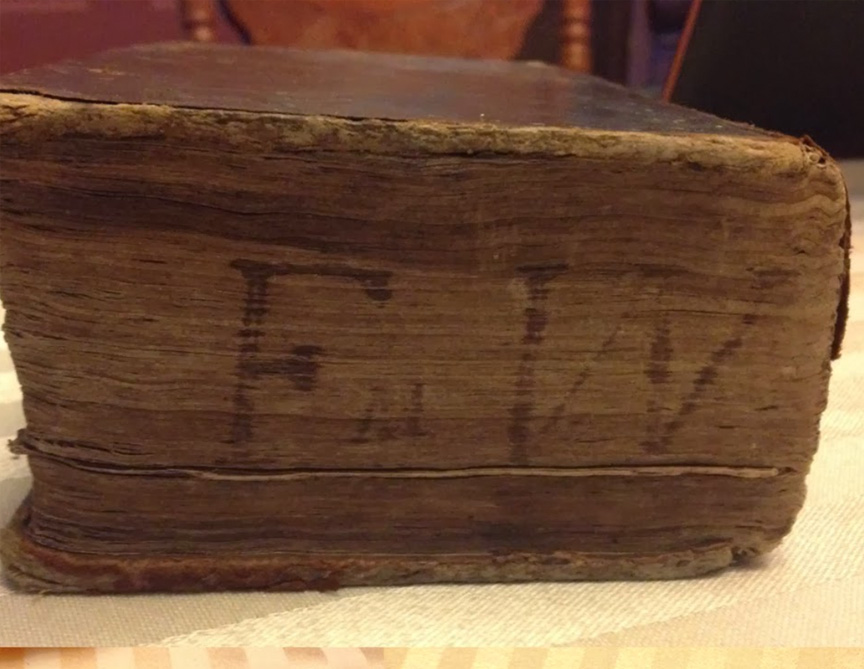
I recently shared the Fowler family photos I received from Jennie West, a mutual descendant of my third-great-grandfather, Lewis Fowler (1848-1938). With this post, I get to share photos of a Bible that belonged to my fourth great-grandfather, Francis M. Wood (1777-1843). The photos were sent to me by another of his descendants, Otis Lundy.
The internet really is the best thing to ever happen to genealogy. Those of us with small fragments of our ancestors’ lives can find each other and put the small pieces together to get a real sense of who our ancestors really were.

Photo credit: Otis Lundy
The inscription in the Bible appears to read: “Francis M. Wood his Bible bought from Bennet Barrow’s Store Price 10/.”
Bennett Barrow was a Tarboro, North Carolina, businessman and slave trader who later moved with other members of his family to the Spanish territory of West Feliciana Parish, Louisiana. The price, 10/, meant 10 shillings, or half a pound, in the old pounds-shillings-pence system.
| Side note: Bennett H. Barrow, Bennett Barrow’s nephew, inherited Locust Grove, later called Highland Plantation, near St. Francisville, Louisiana. The plantation grew to about 1,500 acres and relied on the forced labor of more than 200 enslaved people to produce cotton and, later, sugar. 1 Barrow is remembered today because he kept a detailed plantation diary from 1838 to 1846. Published in 1943 as “Plantation Life in the Florida Parishes of Louisiana, 1836-1846, as Reflected in the Diary of Bennet H. Barrow,” the diary documents the daily rules, production demands and violence used to control the people he enslaved. Its editor, historian Edwin Adams Davis, presented Barrow as a “typical” planter and softened the cruelty recorded in the diary. More recent historians have noted that the diary itself shows a plantation system built on coercion and violence, including frequent “whippings.” 2 |
I am grateful Otis shared this rare family artifact because it helped uncover more about this family. It also includes names and birth dates of some of the people Francis enslaved, information that is often almost impossible to find. I hope this will be helpful for any of their descendants who may be researching their family lines and find this page.
Francis M. Wood was among the earliest settlers of the area of Haywood County, Tennessee, that later became Crockett County.
\Left to right: Robert Lafayette “Bob” Williams, Elizabeth Castellaw Williams , Robert Edward “Bob” Castellaw , Nancy Miranda Johnson Castellaw and the headstone of Margaret Louisa Wood Johnson.

Headstone of Louisa Wood Johnson (1808-1862) and her husband, Charles Randell Johnson (1802-1864), Johnson Grove Cemetery
Francis was the father of Margaret Louisa Wood Johnson (1808-1862), who was the mother of Nancy Miranda Johnson Castellaw (1844-1921), who was the mother of Robert Edward “Bob” Castellaw (1868-1954), who was the father of Elizabeth Castellaw Williams (1915-1998), who was the mother of Robert Lafayette “Bob” Williams, my father (1940-present).
Francis was born in 1777, probably in or near Edgecombe County, North Carolina. Otis also shared information from the will of Joseph Wood, of Edgecombe County, which he found on FamilySearch. Joseph Wood appears to be Francis’ father. The will mentions Joseph Wood’s wife, Ann Wood, and his children: John Horn Wood, Elizabeth Frazer Wood and Francis M. Wood. The middle name is difficult to read in the copy I have.
The executor was John Milbourne. Francis later married into the executor’s family, although with an alternate spelling of the last name. On Jan. 7, 1806, he married Elizabeth Milburn Wood (1780-unknown). John Milbourne’s probate records include Francis Wood and his wife, Betsy, which was a common nickname for Elizabeth.

Title page of Francis Wood’s Bible, photo credit: Otis Lundy
Note the little poem that appears to have been cut out of a newspaper: “A-shopping I will go, and visit every mart.”

The title page shows that Francis M. Wood’s Bible was printed in Boston in 1808 for Thomas & Andrews by J.T. Buckingham. It was a King James Bible, small enough for personal use rather than one of the large decorative family Bibles common later in the 1800s.
Bible bibliographies identify this edition as “Hills 155.” That makes it an early American-printed Bible, published only a few decades after the first complete Bible was printed in independent America.
The handwritten note saying Francis bought it from Bennet Barrow’s store suggests the Bible traveled from Boston’s book trade to a store in Edgecombe County, North Carolina, before Francis eventually carried it west to Tennessee.
Around 1824, Francis migrated with his family and enslaved people to West Tennessee. A history of Crockett County describes the first settlement as being near the Haywood County line, south of the present town of Bells. It says Francis M. Wood and Charles Wortham were among the early settlers, with Francis coming from North Carolina and Wortham coming from Middle Tennessee. 3
That same account describes the land as heavily wooded with poplar, hickory, oak, ash, cypress and cane. Wildlife included deer, bears, wolves, catamounts, panthers, wild turkeys and smaller game. The first settlers relied heavily on that game because food was scarce, and wolves and bears destroyed livestock.
When Francis and Elizabeth first arrived in the area, they brought a household of children and enslaved people. Francis wrote down the names and birth dates of several enslaved people who were born into his household.

Photo credit: Otis Lundy
The Bible entries, with original spelling preserved, read:
Nigrow Julia was born in yeare of our Lord November 8th day 1827.
Nigrow Stuard was born in yeare of our Lord March 18th day 1828.
Negrow Luverne was born in year of our Lord May 8th day 1828.
Negrow Clabern was bornd in year our Lord March third 1830.
Note the burn hole between the words “our” and “Lord,” suggesting the hole was already there when Francis wrote this. Otherwise, one of those words would likely have been where the hole now exists.

Photo credit: Otis Lundy
Ridmont son of Ben & Chana was bornd Jan the 10th 1826
Ashley was bornd the 30 of October 1827
Haywood was born July the 30th 1833
Henry was bournd December 1835
Alsira was bournd December 3th 1835
Benson son of Hary [Harry] was bournd July the 11th 1833
Francis and Elizabeth’s children included:
Margaret Louisa Wood Johnson (1808-1862)
Margaret was my third-great-grandmother. She first married William R. Wortham. After his death, she married Charles Randall Johnson (1802-1864) and settled in the Johnsons Grove area of what is now Crockett County. They had 10 children, including Nancy Miranda Johnson Castellaw, my second-great-grandmother.

My father and me with the headstones of Charles Randall Johnson and Margaret Louisa Wood Johnson
Last winter, my father and I visited the Crockett County cemetery where Louisa and her husband, Charles, are buried. You can read that blog entry for more about that area.
William M. Wood (1811-1840)
William M. Wood (1811-1840) married Marina Manning Wood (1820-1858), and they had one son, Francis John “F.J.” Wood (1839-1909), who was likely named for his grandfather, Francis M. Wood (1777-1843). Goodspeed’s biography of Capt. Francis J. Wood says Francis was born Jan. 27, 1839, in what was then Haywood County, Tennessee, and that William and Marina Wood were both natives of North Carolina. 4
After his father’s early death, Francis was raised by relatives in the merchandise business. He continued in that work until the beginning of the Civil War, when he helped organize Company G of the 27th Tennessee Infantry. He was first elected lieutenant, then captain after the regiment reorganized at Corinth, Mississippi.
Francis was wounded in the leg in Atlanta, Georgia, and later served as provost marshal in Macon, Georgia, where he was captured. Goodspeed includes one memorable story: After Francis was paroled, Federal officers gave him a mule to ride home, and he paid for it with the buttons from his Confederate uniform. When he reached Chattanooga, the post commander refused to recognize his parole and briefly put him in prison.
After the war, Francis returned to merchandising, first at Laynesville and later in Crockett County. When Crockett County was organized in 1871-72, he served as one of the commissioners appointed to survey the county lines, locate the county seat and hold the first election. In 1872, he was elected Crockett County’s first county court clerk and served six years before returning to farming and merchandising. 5
Elizabeth Ann Wood (1814-unknown)
Polly Horn Wood (1817-unknown)
Nancy Arsena Wood Winburn (1821-1906)
Nancy was Otis Lundy’s third-great-grandmother. She married Henry Gatlin “Harry” Winburn (1810-1895). She was his second wife, and they had eight children together: Hardy Latham Winburn, Sarah Elizabeth Winburn, Henry Clay Winburn, Nancy Angel Winburn, Francis W. Winburn, Robert Scott Winburn, John Joseph Winburn and Ida Louisa Winburn.
Otis shared an interesting story about his ancestor, Harry Winburn.
Harry had eloped with his first wife, Mary Ann Cherry Winburn. Her father, Willie P. Cherry, owned Wild Cat Hill Plantation in Martin County, North Carolina. Her grandfather, Darling Cherry, and his brother, Daniel Cherry, were land surveyors and eventually acquired thousands of acres in Tennessee.
According to family history, immediately after they eloped, Harry Winburn and Mary Ann Cherry headed to West Tennessee. Unfortunately, she never arrived. She died on the way while giving birth to their son, Hardy. Harry returned to the home of Mary Ann’s parents, where he left Hardy to be raised.
Harry then headed to Tennessee again. This time, it is thought he traveled with Mary Ann’s brother, Willie P. Cherry, and his wife.
Once settled in the Crockett County area, Harry met and married Nancy Wood, and they began their life together.
Nancy and Harry were members of Dancyville Methodist Church. Harry’s son back in Martin County grew up in the Cherry household and was Otis Lundy’s second great-grandfather.
| Sidenote: Cherryville, Tennessee, was the first incorporated town in West Tennessee. It was incorporated in 1821 and was about 3 1/2 miles west of Bells. The town was first called Harrisbury. In later years, the community has been known as Clarks, Eason’s Store Community and Harris Bluff. |

Photo credit: Otis Lundy
Very faint pencil signature:
“Elizabeth Ann Wood Haywood County Tennessee 1835”
There is only a little information about Francis Wood’s life in what is now Crockett County, so the entries in his Bible are especially helpful.
Written on the back side of the New Testament cover page is:
Francis M. Wood and Elizabeth Milburn was married in year of our Lord 1806 January 7th day.
Luisey Wood was born in year of our Lord 1808 April 4th day.
William M. Wood was born in the year of our Lord 1811 January 24th day.
Departed this life August 5 1840.
Elizabeth Ann Wood was born in the year of our Lord 1814 Feby 6th day.
Poley Horn Wood was born in the year of our Lord 1817 April 14th day.
Nancy Arsena Wood was born in the year of our Lord 1821 January the 30th day.
Another page includes:
Francis Wortham son of William R. Wortham and Louisa his wife was borne Jan 15 day 1827.
This is a reference to Louisa’s first husband and their son together.
The U.S. census also provides information and confirmation about Francis and his family. In the 1830 census, Francis was 53 and had a household of 14. That included nine enslaved people, Francis, Elizabeth and three children: one male age 15 to 19, one female age 5 to 9 and one female age 15 to 19.
In the 1840 census, Francis was 63 and had a household of 12. He still enslaved nine people. In addition to his wife, one male age 10 to 14 was living in the household.
Francis died April 27, 1843, at age 66 in what was then Haywood County and later became Crockett County. He was possibly buried in the Wortham family cemetery, in the middle of a cotton field, as was his son, William. And yes, the next time I’m in West Tennessee, you can bet I’ll be looking for it. I’ll share what I find here on my blog.
Much appreciation goes to Otis Lundy for sharing this prized possession with us.
For more of my genealogy research, visit rscottwilliams.info.
- Hamilton-Barrow Family Papers, Mss. 4458, Louisiana and Lower Mississippi Valley Collections, LSU Libraries, Baton Rouge, Louisiana; Karen Kingsley, “Highland Plantation,” 64 Parishes, Oct. 19, 2014, updated Sept. 13, 2021. ↩︎
- Jonathan Wingerter, “Bennet Barrow’s Diary,” Slavery in Baton Rouge; “Plantation Slavery in Antebellum Louisiana,” 64 Parishes, Jan. 30, 2023. ↩︎
- “Crockett County Area First Settled in 1824: Formed in 1871,” The Crockett Times, 50th Anniversary Edition, March 2, 1983, 9A, transcribed by Sister Mary Francis Cates, TNGenWeb, “More Crockett County History.” ↩︎
- History of Tennessee, Crockett County biographical appendix (Nashville: Goodspeed Publishing Co., 1886), s.v. “Capt. Francis J. Wood,” transcribed at TNGenWeb, “Capt. Francis J. Wood, Goodspeed Biography.” ↩︎
- History of Crockett County, Tennessee, Goodspeed Publishing Co., 1886, transcribed at TN-Roots, “History of Crockett County, TN”; History of Tennessee, s.v. “Capt. Francis J. Wood.” ↩︎


Leave a Reply