
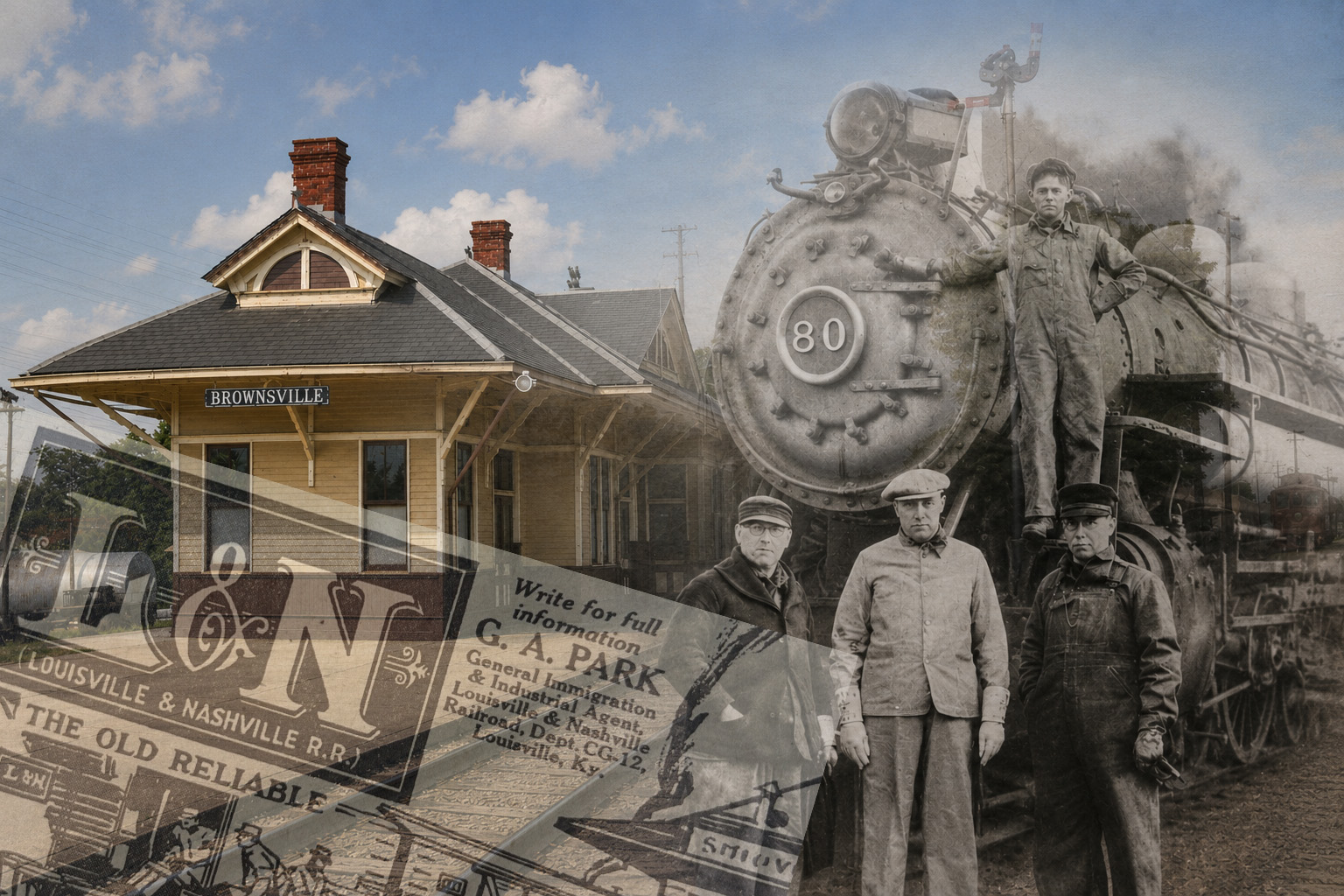
A photograph of the Louisville & Nashville Railroad depot in Brownsville, Tennessee, posted by David Duke in the Facebook group “You Grew Up in Brownsville, Tennessee, If …” generated dozens of comments of memories of the old station and piqued my curiosity about this piece of Haywood County history.

Photo credit: David Duke
The comments make it clear that the depot was much more than a building. Some remembered boarding trains for family visits to Milan, Bells, Stanton or Memphis. Others recalled taking their first train ride with a Cub Scout pack or school group. For many families, simply gathering near the tracks to watch the train arrive was an event. Decades later, they can still remember the sound of the whistle.

Hand-tinted image of the Brownsville depot by H.E. Clement
Once I began researching the depot, I discovered it was part of a much larger story involving early railroad expansion, the Civil War, Hollywood filmmakers and the changing ways Americans traveled.
The railroad arrives in Brownsville
The railroad through Brownsville began as part of the Memphis and Ohio Railroad, commonly called the M&O.
By 1855, the company had completed the first 25 miles of track extending east from Memphis. However, according to railroad historian Maury Klein, selecting the route was not an easy process.
“Ironically, the Memphis & Ohio faced a rather unique problem for its day: the indifference and outright hostility of citizens living along the route. Standing aloof from the commercial aspirations of the terminal cities, they saw no advantage for themselves in the coming Iron Horse. In 1856 the picture brightened considerably. After another long debate the Memphis & Ohio board decided to locate the road directly to Paris via Brownsville.”1
The tracks reached Brownsville in late 1856, connecting the town more directly with Memphis and eventually with Paris, Tennessee.
Railroads and the Civil War
Railroads quickly became essential military resources during the Civil War. Both Confederate and Union forces used Southern rail lines to move troops, weapons and other supplies. Tracks and bridges became targets for destruction because disabling a railroad could delay or even cripple an army’s ability to operate.

Hand-tinted image of the Brownsville depot by H.E. Clement
Protecting a railroad bridge was the impetus for the formation of The Bridge Company. Operating out of Haywood County, it was an independent Confederate unit of about 60 mostly older, married Haywood County men organized in 1861 to protect the M&O Railroad bridge over the Big Hatchie River, a vital link for transportation. Commanded by Capt. N. J. Anderson, the men supplied their own horses, uniforms and provisions and guarded the bridge until retreating Confederate forces ordered it burned around June 1, 1862, as Union troops approached. You can read more about them in this blog post.

Memphis Public Ledger, April 24, 1874, 1.
The L&N survived the war in a stronger position than many Southern railroads like the M&O. Because portions of its system came under Union control early in the conflict, the company earned money transporting federal troops and supplies. Its relative financial stability allowed it to acquire weakened railroads, including the M&O, after the war.
Photo from “Pope’s Manual of Railroads of the United States”
Click to Enlarge
The southern portion of the L&N system in 1901

Map of the Louisville and Nashville Railroad and Connecting Lines: Louisville and Nashville Railroad, 1891
A new depot for a growing town
Brownsville had railroad service for nearly half a century before construction began on the depot most residents remember. According to “Heart of the Tennessee Delta: A Historical Guidebook to Haywood County,” construction began in September 1905. Crews completed the station about five months later.
The new depot served both passengers and freight at a time when the railroad was among the most important links between Brownsville and the outside world. Before dependable highways and widespread automobile ownership, residents relied on the railroad to travel, receive mail and newspapers and ship agricultural products and manufactured goods. The station would have been one of the first places residents learned that relatives were arriving, soldiers were returning or traveling salesmen and public figures were coming to town. Cotton and other agricultural products helped support the local economy, so the freight trains bringing machinery and supplies into Haywood County was crucial for its ability to grow.
The L&N Don’t Stop Here Anymore
Passenger rail service declined rapidly after World War II as automobiles and trucks became more affordable, highways improved and commercial airlines expanded. The L&N discontinued many of its passenger routes during the 1960s. Its remaining passenger service through several Tennessee communities ended in February 1968. Brownsville’s last passenger train departed in 1968.
As Kentucky songwriter Jean Ritchie (1922-2015) wrote, “The L&N Don’t Stop Here Anymore.” The song was later recorded by artists including Johnny Cash (1932-2003), June Carter Cash (1929-2003) and Kathy Mattea (1959- ).
“I was born and raised at the mouth of the Hazard hollow;
The coal cars rolled and rumbling past my door;
But now they standing rusty rolling empty
And the L&N don’t stop here anymore.”
Written and released by Jean Ritchie in 1965
Unfortuantley, the abandoned Brownsville station was eventually sold to a private owner and demolished in 1974. It may have been in terrible condition, but I have not found a reliable account describing its structural condition when it was torn down. It may simply have been viewed as obsolete property occupying valuable land near an active freight line. If that was the case, what a loss of a historic building for the people of West Tennessee. Historic train depots are a destination for many tourists and can generate revenue when those tourists eat in restaurants, stay in hotels and shop in stores. With its proximity to Brownsville’s vibrant square, a historic depot would have been a major draw.
Brownsville goes to Hollywood
Although the depot is gone, the Browsnville Depot survives in a major motion picture. The opening and closing sequences of “The Liberation of L.B. Jones” were filmed at the Brownsville station in 1969, only a few years before its demolition.
“The Liberation of L.B. Jones” was a 1970 film directed by William Wyler. The screenplay by Jesse Hill Ford and Stirling Silliphant is based on Ford’s 1965 novel “The Liberation of Lord Byron Jones.” These scenes from the movie offer a small glimpse at Brownsville and Trenton, Tennessee in 1969.
The film was directed by William Wyler (1902-1981), whose career included “Mrs. Miniver,” “Roman Holiday,” “The Best Years of Our Lives” and “Ben-Hur.” “The Liberation of L.B. Jones” was his final feature film.
Filming took place during June and July 1969, with several scenes shot in Brownsville, including the depot sequences. The movie was adapted from Jesse Hill Ford’s (1928-1996) 1965 novel, “The Liberation of Lord Byron Jones.” Ford lived in Humboldt, Tennessee, and based the novel partly on a real racial murder that occurred in Gibson County during the 1950s.
The film starred Roscoe Lee Browne, Lee J. Cobb, Anthony Zerbe, Lee Majors, Barbara Hershey, Yaphet Kotto and Lola Falana. Whatever one thinks of the movie, those scenes now serve as moving images of a building that no longer exists.

Photograph of the Brownsville depot displayed at Hometown Drugs
Today, there is no surviving depot building and little at the site to indicate the station ever stood there. Photographs, postcards, films and personal memories have therefore become especially important. The photograph displayed at Hometown Drugs offers one small opportunity to see what earlier generations saw when they approached the station. The images shared online have also allowed residents who never saw the depot to understand why it mattered.
The response to a single Facebook photograph demonstrates how strongly a place can remain connected to family memory. People remembered childhood trips, school outings and Cub Scout adventures. They remembered leaving town for vacations and welcoming relatives home. Some remembered parents and grandparents who have long since died. For them, the depot was not merely wood, brick, tracks and a platform. It was the place where journeys began and ended.
My hope is that communities can continue finding ways to document, restore and reuse important historic places before another generation is left asking what once stood there and why is it gone.
- Maury Klein, History of the Louisville & Nashville Railroad (New York: Macmillan, 1972), 20. ↩︎


Leave a Reply