
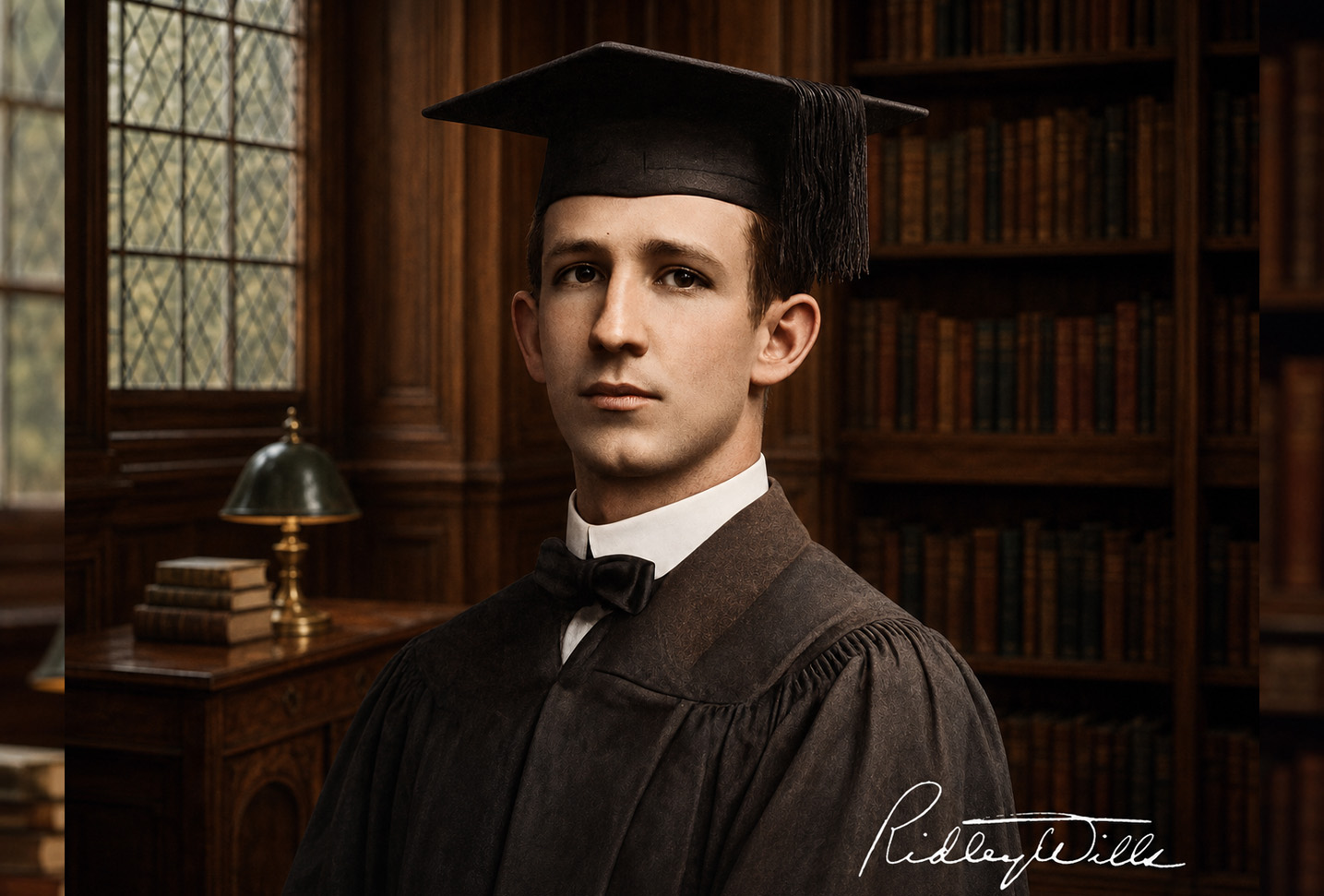
Photo: Enhanced Ridley Wills 1923 Vanderbilt University senior photo /
While researching my ancestors, I am often more curious about what their lives were actually like than I am about names and dates. I want to know what was happening around them, what they worried about, where they gathered and how the wider world affected their daily lives.
Through the early work of Brownsville-born writer William Ridley Wills (1897-1957), I can catch at least a glimpse of that world.
The Federal Writers’ Project’s 1939 guide to Tennessee identified Wills as one of two West Tennessee novelists who wrote with an understanding of their region. The guide praised his novels for their “frank but restrained prose style.”1
The other writer was Jennings Perry of Jackson, Tennessee.
Wills spent his childhood in Brownsville and enrolled at Vanderbilt University sometime before the 1916-17 academic year. In July 1917, at age 20, he left the university and entered the U.S. Army. He served as a second lieutenant in the Field Artillery and spent 17 months in France and Germany during World War I.
After leaving the Army, Wills lived in New York and worked as a freelance journalist rather than returning immediately home or to college. He wrote his first novel, “Hoax,” there and returned to Vanderbilt in 1922 to complete his degree. He joined the Fugitive literary circle late that year and graduated from Vanderbilt in 1923.
sss
The Fugitives, NPT; In the early 20th century, a coterie of poets gathered in Nashville, Tennessee, determined to redefine the way the world viewed the south. They would prove that the South could produce highly intellectual art. The Fugitive, a literary magazine published from 1922-1925, proved that point.
While at Vanderbilt, Ridley Wills became a close friend, roommate and fellow Fugitive of poet Allen Tate (1899-1979). In 1923, Wills and Tate collaborated on “The Golden Mean and Other Poems,” a satirical collection that parodied the Fugitives and the modernist style of T.S. Eliot’s “The Waste Land.”
Tate later became one of the most influential American poets and literary critics of the 20th century, a leading figure in the New Criticism movement and the author of the celebrated poem “Ode to the Confederate Dead.” From 1943 to 1944, he served as consultant in poetry to the Library of Congress, the predecessor of today’s U.S. poet laureate position.

Cover of “Hoax”
Wills’ first novel, “Hoax,” is more autobiographical than he seemed to have wanted readers to know. The story follows Eugene Bennett from late adolescence into young adulthood as he struggles with war, ambition, romance and the battle between choosing a bride from the women he encounters in his adventures or returning to the girl back home. George H. Doran Co. published the book anonymously in 1922.2
While no printed copies of “Hoax” seems to be available for purchase, you can download a digital copy here.
Written largely in the voice of Eugene’s father, the novel is set in Danville, a fictional community that was only slightly disguised from Wills’ hometown of Brownsville.

Ridley Wills around 1923
Like Wills himself, the character Eugene leaves home for college, enters the Army during World War I and serves overseas. After the war, he goes to New York and becomes a newspaper reporter. He eventually covers Broadway, gathering theater news, investigating the claims of press agents and writing secondary reviews when more than one production opened on the same night. As the narrator explains:
“He wrote home of the glitter he encountered in this new field, and was, characteristically, ebullient with enthusiasm for it. … His was the privilege of walking boldly past the theatre box office and the ticket collector and looking over the show with the object of finding something newsworthy about it.”3
Much of the novel centers on Eugene’s uncertainty about his future and the women in his life. He must decide whether to marry his hometown sweetheart or pursue one of the more sophisticated women he encounters elsewhere.
Spoiler alert: He marries the girl back home.
The book’s protagonist, Eugene, also writes a book and has it published anonymously. “Hoax” itself appeared without Wills’ name, reportedly so the author could someday return home without facing too many questions about which characters were based on actual Brownsville residents.

A young writer anonymously publishing a novel about a young writer who anonymously publishes a novel is remarkably meta for 1922. To me, that may be the real hoax.
There is little in the novel that would have created a major scandal. Eugene’s father identifies a few women as gossips and occasionally makes fun of the town’s habits, social ambitions and inflated opinion of itself. However, the book reads less like an exposé than the work of a young man amusing himself by hiding recognizable people and places behind thin fictional disguises.
I read “Hoax” primarily to see what I could discover about Brownsville during the years my ancestors were living on nearby farms.
The strongest connection I found was the river.
My paternal grandmother, Elizabeth Williams, once told me about attending a party in a cabin on the Hatchie River when she was a girl. She described watching people drink booze through a window close to the ground. In “Hoax,” many of Danville’s leading families own cabins along what Wills calls the Fox River.
Wills describes it as a muddy, fast-moving stream that flows through flat bottomland toward the Mississippi River. It lies four miles from Danville, and cabins stand near an iron bridge where the River Road crosses the water.
The resemblance to the Hatchie River is difficult to miss. The Hatchie runs through the low, wooded bottomlands of Haywood County near Brownsville, and historical records document Brownsville’s long connection to river landings, roads and bridges in the area.4 The identification remains an inference, but I believe Wills’ Fox River was his fictional version of the Hatchie.
The novel also preserves what appears to have been a familiar Brownsville custom: families leaving town for a week or two each fall to camp, hunt, fish and visit around communal fires.
“Half of Danville’s upper set camps upon the clay banks of the Fox in fall,” the narrator observes.
Wills writes that summer was too hot and mosquito-filled for comfortable camping. By late September and early October, however, the nights were cool, the mosquitoes were gone and campfires could be seen glowing among the willows on both sides of the river. Anyone who has tried to camp in West Tennessee in the hottest summer months can vouch for the truth in that statement.
That description brought the memory of my grandmother’s story to life. The party in a Hatchie River cabin appears to have been part of a broader social tradition among the Brownsville families who lived in town.
Other recognizable details appear throughout the book, including the town square, a weekly newspaper, an Episcopal church, cotton fields, law offices and the social division between those considered part of the town’s “upper set” and everyone else. Also included is the wealthy white residents treating their black neighbors as servants. Eugene’s family has a man named Fate who functions as a one-man chauffeur, cook and household assistant.

A review published in The Tennessean shortly after the book appeared openly identified Danville as Brownsville. Reviewer Mary Pepper described the fictional town as “old and proud, lazy and gossipy, self-satisfied and happy.” She called Danville a “fairly accurate replica” of Brownsville and specifically pointed to the nearby river, Episcopal church, weekly newspaper, cotton fields and a lawyer’s office on the town square.5
Pepper praised Wills’ clear prose and moving narrative style, noting “more than a hint of Scott Fitzgerald” in the novel. She also criticized the book for being overly egotistical and for failing to maintain its narrative viewpoint. Although Eugene’s father supposedly tells the story, she observed that Eugene often seems to be relating his own experiences and emotions directly.
A later review in The Commercial Appeal concentrated on the universality of the story. The reviewer wrote that “Danville is everywhere” and argued that the town’s faults were minor compared with its virtues. The newspaper called “Hoax” an interesting novel and said its narrative held the reader’s attention.6
That review also offered a useful summary of Eugene’s world. He grows up as a favored son, attends high school and college, goes to war, moves to New York, works for a newspaper and becomes involved with several women before returning to marry his Danville sweetheart.
The plot is rooted in Ridley Wills’ transition from boy to man while experiening the upheaval of World War I and the expanding opportunities offered by newspapers, universities, rail travel and growing cities. Yet Eugene’s struggles will feel familiar to any parent, like me, who has cheered on a child making the uncertain transition into adulthood.
Eugene wants to leave home, but he also wants the security of knowing home is still there. He wants to become a successful writer, but he worries about failure. He is attracted to sophisticated people and places, yet remains emotionally tied to the girl and community he knew when he was young. He is restless, ambitious, vain, romantic and uncertain, but he plows ahead.
“Hoax” does not provide a complete portrait of Brownsville or rural Haywood County. Its main characters are Brownsville’s White, educated and socially prominent families. The novel tells us far less about the Black residents, farmers, tenants, laborers and domestic workers whose lives were also central to the community.
Still, it offers a valuable window into one part of Brownsville life during the early 20th century.
It shows people attending parties, camping by the river, reading newspapers, gossiping about their neighbors, worrying about their children and trying to decide whether happiness could be found at home in Brownsville or somewhere far away.
The Rest of the Story
Ridley Wills’ second novel, “Harvey Landrum,” was published by Simon & Schuster in 1924. The novel is a psychological study of an insecure young man who attempts to conceal his feelings of inferiority behind an exaggerated display of courage.

When the book appeared, a reviewer for The Commercial Appeal wrote, “Wills has written a rattling good story. The narrative runs like a strong thread from beginning to end.” The reviewer also praised Wills as “a skilled surgeon in mental anatomy” who wrote about human nature with unusual insight.7
A newspaper profile published shortly before Wills’ death credited him with a third novel, “The Girl Who Couldn’t Say No.”8 I have not found a library catalog record or surviving copy of that book. It may have appeared under another title, been serialized in a newspaper or magazine or remained unpublished.
In 1923, Wills married Jackson, Tennessee, schoolteacher Louella Whitehead Wilson Wills (1897-1960). They had five children and later divorced.
As a journalist, Wills worked for newspapers around the country and apparently never stayed in one place for long. In Memphis, he became an editorial writer for The Commercial Appeal and later served as editor of the Memphis Evening Appeal. A 1957 profile said he held that position until 1932.9
The same article reported that Wills worked as an editorial supervisor for the state of Texas from 1933 to 1937 while also writing a political column for the Nashville Banner. From 1938 to 1940, he edited a centennial edition of the Cincinnati Times-Star.10
His children seem to have inherited his wanderlust. A 1957 newspaper profile noted that he had a daughter living in Tokyo, a son working as an architect in Paris and another son serving as an Air Force officer. His obituary identified the children as Luella “Tookie” Wills Willard of Tokyo (1924-1998); William Ridley Wills Jr. of Paris, France; Andrew Mann Wills of Shreveport, Louisiana (1927-1981); David Womack Wills of Miami (1929-2007); and John Thomas Thaddus Wills of Atlanta (1931-2008).
Wills died Sept. 8, 1957, at age 60 at the Bay Pines Veterans Hospital in Florida, where he had been a patient for four years. He was buried in the Bay Pines National Cemetery. Even residing in the hospital, Wills continued working as editor of the hospital newspaper. He received the Newsman of the Year award in a contest conducted by Veterans Adminstration.
You could take the newspaperman out of the newsroom, but apparently you could not take the newsroom out of the newspaperman.
Note: I would love to know more about Ridley Wills’ life as a newspaperman. If you have made it here and are a descendant with info and photos, email me at [email protected].
Notes
- Federal Writers’ Project, Tennessee: A Guide to the State (New York: Viking Press, 1939), 150-51. ↩︎
- Ridley Wills, Hoax (New York: George H. Doran Co., 1922). ↩︎
- Ridley Wills, Hoax (New York: George H. Doran Co., 1922), 195. ↩︎
- Wills, Hoax, 113-14. The U.S. Fish and Wildlife Service describes the Hatchie’s Haywood County corridor as flat bottomland containing hardwood forests, swamps, sloughs and streams. Historic documentation also records Brownsville Landing and transportation along the Hatchie River. U.S. Fish and Wildlife Service, “Hatchie National Wildlife Refuge,” accessed July 11, 2026; Thomason and Associates, Historic Resources of Brownsville, Tennessee, 1823-1964 (National Register of Historic Places Multiple Property Documentation Form, 2014), section E, 3-4. ↩︎
- Mary Pepper, “Mysterious Writer Discloses Full Story of a Varied Life,” The Tennessean (Nashville), May 21, 1922, 38. ↩︎
- “When a ‘Hoax’ Is Not a Hoax,” The Commercial Appeal (Memphis), December 14, 1924, 6. ↩︎
- “A Smashing Novel by a Tennessean,” The Commercial Appeal (Memphis), December 14, 1924, 6. ↩︎
- “Hospitalized Editor Wins News Honor,” St. Petersburg Times (St. Petersburg, Florida), June 23, 1957, 1. ↩︎
- Ibid. ↩︎
- Ibid. ↩︎


Leave a Reply