
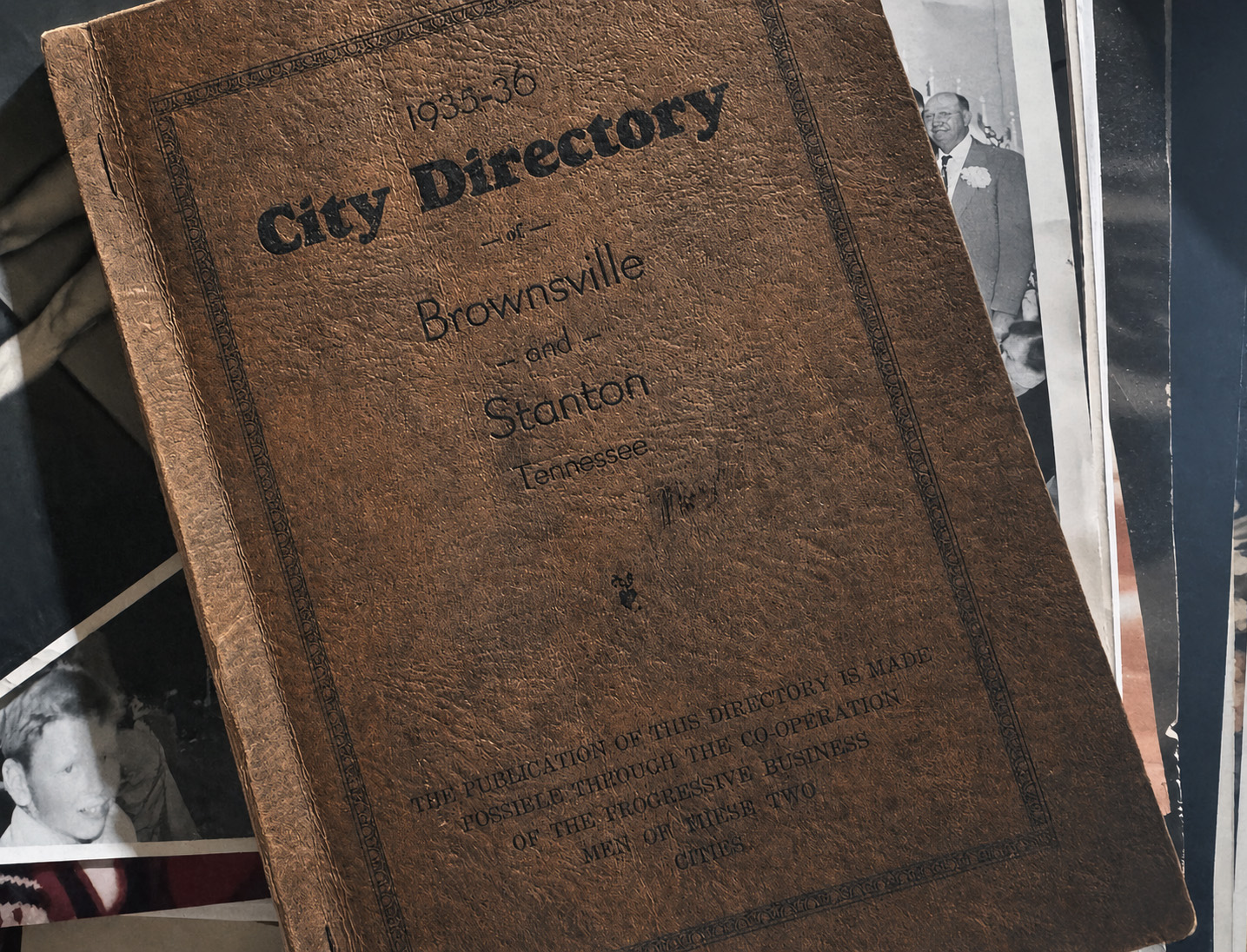
I was going through some old boxes of genealogy research this weekend and came across a copy of the “City Directory of Brownsville and Stanton, Tennessee, 1935-36.” I’ve had it for years and never actually read through it.
This is a softback book that documents the people, businesses and institutions of Haywood County during the mid-1930s. Similar to other city directories created around this time, it includes names and addresses of residents, occupations, business listings, advertisements and information about churches, schools, public officials and civic organizations in Brownsville and Stanton.
Included in the directory is an article written by Charles Wesley Anderson, a Haywood County educator, that tells the story of Brownsville’s development from its earliest settlement through the early 20th century. He begins with local traditions about Brownsville’s founding, then describes the appearance of the town as he remembered it from the 1850s, including muddy streets, plank sidewalks, livestock roaming through town and the businesses, churches, schools and prominent families of the period.
The most fascinating part of the article for me is Anderson’s eyewitness account of the 1878 yellow fever epidemic, which spread to Brownsville from Memphis. He gives readers a first-hand account of the initial shock, the sudden panic when local doctors confirmed the disease, the mass flight of residents into the countryside and the efforts of volunteers who remained behind to care for the sick and bury the dead.
As a whole, the article is a valuable firsthand account of Haywood County’s 19th-century history and a revealing example of how an elderly White resident in the 1930s remembered and wrote about the people, events and social attitudes of an earlier era. For that reason, the language has been kept as it was written.

Brownsville
by Prof. C. W. Anderson, 1935
This paper records personal reminiscences and is not to claim the authority or dignity of a history of Brownsville. Those who are old enough to remember the earlier persons and events of our town are passing away so rapidly that only a short time must elapse until no one of them will remain to tell the story. Hence this effort is made to add some few items to the general fund of information that may be interesting to our good people.
Some time quite early in the nineteenth century—about 1810 perhaps, a Mr. Brown built a log cabin store on the present site of The Leader. After a few years he was succeeded by the firm of Bradford and Dobbins. The three members of this firm were Hiram Bradford and his brother, Miles Bradford, and a Mr. Dobbins. Business was good and after a few years they decided to expand to more ambitious efforts. To do so they secured as large a sum of money as they could and sent Mr. Dobbins with this money to Philadelphia to buy goods. Years rolled on and so did Mr. Dobbins. After waiting a reasonable time for his return the firm declared their business bankrupt, and the first important mercantile effort of the new town passed out.
Other business men were not entirely discouraged by this failure and a sufficient number of them opened stores and shops to justify founding a new town which they named Brownsville for Mr. Brown who had the first store. This tradition is offered by the immediate families of the Bradford brothers, and is no doubt quite correct.
The present town was laid out in 1823. We celebrated the centennial anniversary in 1923, when many of our former citizens who had moved to other localities returned to renew friendly ties and enjoy our hospitality.
The personal recollections of this writer began about 1857. The tide of immigration from the east had filled the town almost to its present population by this time. The surrounding territory had been occupied by sterling families from Virginia, North and South Carolina, and a considerable number from East and Middle Tennessee. Their descendants, with a great influx of foreign elements compose the larger portion of our present fine citizenry.
The geography of the town has remained materially unchanged since that time, but the general appearance is much improved. At that time the streets were entirely devoid of top dressing of any kind, but worked just as the country roads. Plank sidewalks were laid on the more important streets. The square sidewalks were generally bricked in front of the larger business houses. A crossing made of two logs about a foot square connected the middle points of the four sides of the Courthouse yard with the border pavement or walk. In rainy and freezing weather these logs were a sore trial to vehicles of all kinds. As one neared the city limits the concentrated travel churned the roads into loblolly a foot deep, or more, and by the time a vehicle reached the square it was fortunate if it found the mud was not quite up to the hubs. To see a wagon loaded with cotton and stuck in the middle of the square was not an unusual spectacle. In these emergencies the driver generally called for Bob Moses, our recorder’s father, to come and engineer him out. Bob Moses had the deserved reputation of being able to handle a despairing mule with greater efficiency than any one else.
Log crossings also connected the sidewalks of the square across the intervening streets. After long experience and mature consideration these various logs were replaced by sawed blocks sunk in the mud about two feet apart, affording a lucky opportunity to the driver to conduct his wheels into the interstices.
Most of the streets had a ten rail stake and ridered worm fence for a large part of their length. This ingenious artifice kept the perambulating cows out of the yards and gardens and confined them to their proper place in the streets. We now allow our imported civilized stock fewer liberties.
These conditions marked the period between the founding of the town and the war between the States and for a considerable period after the war.
During this pre-war period there was no great increase of population, but the general tone of the business was improving all the time. The houses were substantial and comfortable but with no great effort at ornament. Several of them are still standing. The stores were mostly frame structure. The Methodist, Baptist, Presbyterian, and Cumberland Presbyterian churches were built. The Courthouse and the jail, the Baptist Female College and the old tavern. The L & N Railroad was built by the people of Brownsville and vicinity, and the communities along the line.
Space will not permit the mention of leading citizens and business firms and the lawyers and doctors of the period, in a complete list, and as we lived in the country our youthful horizon was quite limited, but we recall especially some of the old timers. Yate Langley and Phillip Yancey had good dry goods store. Nat Langley and Church Buck did grocery business. Mr. Greenwald occupied the present Ike Felsenthal corner; Mr. Berson had his jewelry store on the present Coppedge Drug Store corner; Mr. Pete Bennett kept his tailor shop on the southwest corner of the square; the Moses family lived on Washington street about where James Moses now lives; the Ware family where John Moses lives; the Sangsters in the corner house now owned by the Stew Plant; General Loving built the show house of the town, which became the Wesleyan Female College; the Seviers lived in a house that occupied the Carnegie Library lot and opened out on the sidewalk; Mr. James Bond lived in a large two story house just opposite Mrs. Emma Bond’s present home. A tall dark lawyer named Strother seemed to be the leader of the bar, while Judge Livingston, Judge Bright, and John and Alf Freeman were young lawyers just building up a practice; Zeb Nolen was sheriff for a long time; Lucian Leonard kept store and lived in the house Roy Moore now occupies. Mrs. Mary Bradford, widow of Miles Bradford, lived in the house now occupied by Dr. Sorrelle. Miles Bradford built this house. He had the brown sandstone that forms the foundation hauled on ox carts from the quarry near Nashville. County Surveyor Spence Thomas lived in the house on West Main Street owned by Mrs. Ruth Hay. Mr. Thomas was Mrs. Gertrude Folk’s grandfather. These are some of the leading people that we now recall.
The old town moved on serenely until the election of 1860, when political affairs became unusually exciting. Abraham Lincoln, Stephen A. Douglas, John Bell and J. C. Breckinridge were presidential candidates. When Lincoln was elected the South rebelled and followed her hot-headed politicians out of the union. When the North determined to force the South back into the Union Brownsville was ready to undertake the war on her own responsibility and “there was hurrying to and fro.” “To Arms!” was the cry. Drilling every Saturday on the fine lot now occupied by the Elcan and Howell and other houses. The young men shouldered their shot guns, the old men their walking canes and the boys anything they could get. Two Cavalry companies, the Haywood Rangers under Capt. Bob Haywood and the Haywood Blues under Capt. Jim Haywood, were formed at once. One Infantry regiment under Col. Alsey Bradford was composed largely of Brownsville and Haywood county men. These all marched north to the firing line and Brownsville lapsed into a brief restless inactivity until the fall of Forts Henry and Donelson. Only the old men, the boys and the women were left to control the darkies and make a living. Soldiers coming home on furlough brought occasional news from the front.
In February 1862 the Northern army under Grant moved southward from Cairo. Fort Henry on the Tennessee river was soon taken and Fort Donelson on the Cumberland was left as the key to the Southern line of defense. All day long Feb. 15, 1862 the battle of Fort Donelson raged. The roar of the guns was distinctly heard here. Early on the morning of the 16th the fort surrendered. In a few days the country was full of Yankees. They came along the roads, through the fields and the woods, and Brownsville surrendered without firing a shot. John Hicks with his company of guerillas was not to be seen. From this time until the fall of the Confederacy in April 1865, Brownsville was a quiet unobtrusive stop-over for any old Yankee company that happened along. Her citizens existed precariously, but they did not suffer for food. There was plenty of wheat and corn, and all kinds of produce. Sugar and coffee were almost unobtainable. Now and then an adventurous farmer would drive his wagon to Fort Pillow and bring home a little to sell at enormous prices. A barrel of salt cost twenty dollars in gold. Calico cost one dollar a yard and the good women did not know that they could make a dress of less than ten yards. Other dry goods and shoes were sold at similar prices. All of the old duds were brought out of the back stairs, closets and for a time fashion was forgotten.
The Confederate soldiers came through and burnt all the cotton so that the Yankees could not get it. It was worth one dollar a pound and could have been an incalculable help to the people and to the Confederacy—but “patriotism!”
Several prominent citizens of Brownsville were very much opposed to the secession of the state and remained “Union Men” during the war, but were not in any way offensive to the Confederate government. They contributed to the needs of the soldiers and responded to the various needs of the town. In some way the Federals knew of their attitude, and through their influence Brownsville was to some extent spared the trouble that might have been. The Yankees really were nice to Brownsville. Capt. Nugent even won the heart and hand of Eliza Scott, a leading belle, daughter of Bob Scott, prominent citizen, and took her as his lawful wedded wife away with him. He was a fine man.
In April ’65 the soldiers came home and Brownsville entered the era of reconstruction. The federal provost read the Emancipation Proclamation to the negroes and all the negroes in the County came to town. The roads, the streets, the fields, the woods were full of them. During the four years of the war they had behaved with marvelous propriety. No epic can ever do full justice to the conduct of the Southern negroes during the Civil War. Perhaps no other class of people in the world would have behaved with the same fidelity and loyalty to their owners and superiors. Now they were free! Who can blame them for taking a day off and expressing their boundless joy? For a day or two they were “all dressed up and nowhere to go,” but to appease the gnawing of a newly experienced hunger they quietly trudged back to their cabins and began a new life, tenants on former masters’ farms.
After the adoption of the fourteenth and fifteenth amendments they began to be exploited by their selfish leaders and have experienced the vicissitudes of the life of a free people. Brownsville has had full share and observation of it all in experiences which it is not necessary here to record.
The Reconstruction Period introduced new life into the old town. The population within the city limits soon received large increase. The result of the war inspired a desperate energy to meet the emergency and retrieve the great losses in all departments. The sudden complete change in agricultural conditions was a problem too complex for many farmers. A considerable number who felt able to do so moved to town and engaged in some kind of business. They bought or built homes in town. Jonathan Eader, a northern contractor, had come just before the war commenced and had begun work. He enlisted in the Confederate army with the Brownsville men and fought with them during the entire four years of the conflict. His conduct had endeared him to his comrades and his business efficiency soon gave him a monopoly of the building boom. Business houses and homes sprang up all over town. Well to do farmers formed business firms and became interested in the general improvement. New men, attracted by the promising outlook, moved in and joined the business and professional circles and Brownsville launched into Big Business.
Buck, the Langleys, Yancey, Berson, and several others of the old set held on in their lines. To give some idea of the boom that struck the town it may be interesting to recall briefly our business conditions immediately after the war. The leading dry goods stores were owned by Phillip Yancey, Bradford Bros., Felsenthal Bros., R. G. Thomas & Co., Malone & Winston, Bishop, Burton, Hiram Mann, W. B. Booker. Grocers were Taylor, Wood & Co., Bond Bros. and Harbert, Sternberger Bros., Wilder & Hotchkiss, J. R. Dance, R. G. Thomas & Co., Levy & Bro., Nat Langley, Church Buck.
Drug Stores: T. L. Webb, Howell & Scott, J. W. Hughes. Hardware: T. B. King; Anderson Bros.; Gordon. Industrial firms: Eader’s Planing Mill; Crowley’s Marble Works; Dickson Bros. Planing Mill; Brownsville Cotton Factory; A. J. Klyce Wagon and Buggy Shop; Bradford Flouring Mill; Cowen Flouring Mill; August Pracht Wagon and Buggy Shop; Lord’s Black Smith Shop. Reads Hotel; The Brownsville Bank; The Haywood County Bank began business.
The Baptist College; Crawford Institute which became the Wesleyan Female College; Cuthbert Boys School; Neblett Boy School; Peabody School were the educational institutions.
The leading lawyers were H. J. Livingston; A. D. Bright; B. J. Lea; Tom Freeman; Alf Freeman; R. W. Haywood; B. P. Boyd; W. P. Bond.
Bill Vaughan and D. A. Nunn were representatives in Congress in this period.
Bob Medlin and Charles Taliaferro county court clerks for different terms.
The Brownsville Bee was published by Ivie Westbrook. The Brownsville Democrat was edited by R. W. Haywood and Wills Haywood in succession.
John Clinton was postmaster.
The doctors were Howell; Charles Sevier; Edmund Taylor; James Haywood; John Ware; T. I. Webb; T. D. Cooper; John Allen; W. D. Moore.
This list doesn’t claim to be complete, but fairly represents the business personnel of that period—the thirteen years between the war and the Yellow fever.
In 1873 yellow fever appeared in Memphis and became quite serious. After an interim of five years it came again in midsummer 1878. It soon assumed the form of a dreadful epidemic. The doctors advised the people who could to seek refuge in other places. This procedure caused some alarm in the immediate vicinity of the stricken city.
Sanitary conditions in Brownsville were not commendable. For about six weeks the temperature had ranged around 95 degrees. Many vacant lots were overgrown with high weeds and the sewerage facilities were almost entirely neglected. At night the odors of various kinds and intensity were offensive. This caused the more thoughtful citizens considerable uneasiness for the idea obtained that Yellow Fever was a filth disease.
At night the odors of various kinds and intensity were offensive. This caused the more thoughtful citizens considerable uneasiness for the idea obtained that Yellow Fever was a filth disease.
Nobody thought of a mosquito in connection with the plague. Hardly a dwelling in town was screened. Those who couldn’t endure the mosquitoes had mosquito bars at night. By Thursday, Aug. 29, the quiet uneasiness had assumed sufficient effect to prompt the young men to hold a council in the Chancery Court room about taking measures for the common safety. About twenty-five were present. They planned to picket the town day and night so as to establish quarantine against immigrants, but finding sentiment opposed to immediate action concluded to await further developments. One of the local editors made a very enthusiastic speech about the folly of the proceedings and publicly opened the city as an asylum for Memphians, and declared that he would publish in his paper a cordial invitation to all the people of Memphis who had relatives or could find lodging to come to the great health resort of Brownsville and enjoy the cordial hospitality of her broadminded, greathearted people. He did so. As we went down on the square one prominent doctor asked us if we knew the elevation of Brownsville above sea level. He said that by the L. & N. survey it was “590 feet — 90 ft. above any yellow fever possibility.” So the young men reluctantly abandoned their precautionary measures, but they were not convinced.
Sunday morning, September 1, 1878 dawned bright, clear, and warm. The meeting at Tabernacle commenced that day. After Sunday School in the various churches the men drifted to the square, as usual, and found the men gathering around rather excitedly discussing the death of a young woman on Saturday night, who came from Memphis Thursday night to her relatives in the quaint little two story frame house just south of the R. R. track on the west side of depot street. They had heard also that three negroes were sick in the two cabins just across on the east side of the street. Several doctors stood on the southeast corner of the square, discussing the matter and decided to go down together and see what it was all about. When they returned to the square Dr. Howell approached Dr. Sevier and said, “Charlie, what do you think of those cases?” Dr. Sevier thought they were “cases of malarial fever with some symptoms of yellow fever”. Dr. Howell replied very emphatically that he was in the Memphis epidemic of 1873 and saw hundreds of yellow fever patients and if he ever saw a yellow fever patient “those cases were yellow fever.”
The explosion of a lethal bomb could not have been more startling. There was an instant scattering of the groups of men all along the sidewalks and out in the open square. All struck a bee line for home, many of them began to make immediate arrangements for moving their families to the country.
About noon, A. J. Klyce came home on the “Narrow Guage” from his mill at Forked Deer and died of black vomit in a few hours. About three p.m., the doctors had a meeting, immediately after which they issued public advice to all who could to leave town because “there were nineteen cases and two deaths of yellow fever in town” at that time.
This bulletin from the physicians at once removed the doubts of those who hesitated after the excitement of the forenoon, and soon every possible conveyance was pressed into service to move people to the country. Nightfall did not check the exodus. All night long the cracking of whips, the rumble of wagons, and the shouts of drivers emphasized the desperate rush to escape the fearful epidemic. About four o’clock Monday morning Frank Hughes, clerk in the Hughes Drug Store, died and several other citizens were reported sick. Still several families determined to stay at home as the safest way to protect themselves. A general impression prevailed that negroes were immune from the fever, so the negroes generally were not seriously alarmed and many families left their cooks and housemaids to take care of the homes. Many of these faithful servants died, and several white families that stayed at home paid dearly for their determination.
A number of men at once formed a Howard society to take care of the situation in town. These good men, some from lack of fear and some from a sense of duty, at once took charge. It is to be regretted that no list of these Howards was preserved. The moral sublimity of their conduct entitled them to a nobler fate. Mike McGrath, an Irish painter, was a prominent member. Mike died of the plague. The Rev. S. W. Province, pastor of the Baptist Church, was the leading spirit of the devoted band. He remained at his post during the two months of the scourge, visited the sick, gave spiritual consolation, conducted the brief informal funeral services for the dead and came out safe.
One who has never experienced such an ordeal cannot realize the effect of it. The haunting dread of the unseen enemy, invisible, lurking ever near, instilling a weird, indescribable, restless, perturbed condition of the soul, paralysing the senses with a feeling of utter helplessness, is an unforgettable thing. As the days dragged on those who had escaped to the country watched the road to learn from casual passers-by about the condition in town. Generally the news would be that such a one was dead. Each morning the report of some who were stricken at night and died about noon the next day or the day after. “The pestilence that walketh in darkness and the destruction that wasteth at noonday!”
As the beautiful autumn weather lengthened into Indian summer and yet another week was added to the exile, the refugees could only hope for a return to their homes. They awoke on the morning of Nov. 18th to find a gleaming white frost spread like a spotless mantle over the earth. It was a frost that melted their hearts in thankful realization that the crisis had passed. And every obtainable vehicle at once began to move toward town. The lime-covered mounds in the cemetery reminded them of what had occurred there. It is said that three hundred and seventy-five new graves were left as the footprints of the pestilence.
They awoke on the morning of Nov. 18th to find a gleaming white frost spread like a spotless mantle over the earth. It was a frost that melted their hearts in thankful realization that the crisis had passed. And every obtainable vehicle at once began to move toward town.
No material change was made in the general condition of the town on the return home of the citizens. The same firms resumed business at the same places and only a few of the leading business men had passed out. One can hardly realize that all this occurred fifty-seven years ago—ancient history to many of our people.
Several large business houses in time were added to the list, and several old firms reorganized on a change of partners. The firm of Malone & Winston became Wilder & Winston; Wilder & Hotchkiss became Hotchkiss & Lyle; T. I. Webb became Webb and Lord; August Pracht became C. W. Pracht; J. B. Phillips had a large dry goods house; Collins & Ragland came in from Dancyville; and more recently many of these firms have changed or passed away. Time and space forbid an exhaustive account of the various other changes that have caused the business of Brownsville to present not even a faint resemblance of its former self. As an example of changes that have occurred in some firms during the fifty-seven years, the original Cowen & Webb drug store became in succession Webb Drug Store, Webb & Lord, Lord & Glass, T. E. Glass, Glass & Davis, Glass Drug Co. Only a few have retained an unbroken family succession. Of these we have Felsenthal Department Store; Emil Tamm Sons; J. Levy & Bro.; Rothschild Co.
The personnel of the place has suffered even more radical change. Whole families in some instances have passed away and other families are now represented by their grandchildren. The unkempt appearance of those early days has given place to attractive homes and the streets are gradually assuming a pleasing regularity and presentable appearance. One needs only to turn to the partial roll of residents given on previous page and count the missing to realize how the scythe of time has been fulfilling its mission. To note the changes of social customs, or to contrast the manner of life of those former days with that of the present might be only provocative of adverse criticism, but we may with becoming modesty at least say that it is different. Lapses and reforms have marked the program of every age and will continue to do so. New advantages and new luxuries drag new burdens and new abominations in their train. Regrets for the vanished charms of the past are lost in the roseate expectancy of a happy future. The people of Brownsville will ever cherish the culture, refinement and sterling worth of their ancestors and will continue to merit their enviable reputation for courtesy and hospitality.
Vivia Brownsville!
| About Charles Wesley Anderson Prof. Charles Wesley Anderson (1851–1943) was one of Brownsville’s best-known educators and, late in life, an important chronicler of the town he had known since childhood. Born March 10, 1851, in the Lebanon community of Haywood County, Anderson was the son of the Rev. Thomas Priot Anderson and Elizabeth Lucy Carlton Anderson. He received his early education at the Jim Neblett School in Lebanon before attending Washington and Lee University in Lexington, Virginia, where he was a member of Chi Phi fraternity. Anderson devoted more than half a century to education. Early in his career, he organized and taught a boys’ school in Brownsville. He later moved to Meridian, Mississippi, where he served for several years as president of East Mississippi Female College. After returning to Brownsville, he became superintendent of the city schools and principal of the elementary school. His influence on generations of Brownsville students was substantial enough that Anderson Grammar School was later named in his honor. In 1879, Anderson married Iowa Scott Bradford (1858–1941), and they became the parents of six children. The marriage also connected Anderson directly to one of Brownsville’s pioneering families. Iowa was a granddaughter of Hiram Bradford (1797–1862), an early Brownsville merchant and one of the Bradford brothers discussed in Anderson’s history. That family connection is especially interesting because, when recounting traditions about Brownsville’s beginnings, Anderson specifically wrote that his information came from the “immediate families of the Bradford brothers.” He may therefore have been preserving stories shared with him by his wife. Anderson was 84 years old when he contributed his history of Brownsville to the directory. Anderson wrote that his own memories began about 1857. He was a boy during the Civil War, a young man as Brownsville rebuilt during Reconstruction and 27 years old during the devastating yellow fever epidemic of 1878. His description of that epidemic in particular reads as a personal account. By 1935, Anderson had watched Brownsville change for nearly eight decades. He was there as it transitioned from the muddy streets, wagons, livestock and frame buildings of his childhood to a more modern town. His article reflects both the strengths and prejudices of the era in which he lived. Some of its language and interpretations, particularly concerning race, slavery, emancipation and Reconstruction, are clearly from a white Southern perspective. Nevertheless, the article remains valuable as a firsthand record of how an elderly Brownsville resident remembered the town, its people and some of the major events that shaped it. Anderson died at Haywood Memorial Hospital on Dec. 6, 1943, at age 92. His death certificate listed his occupation simply as “Retired, School Teacher.” He was buried two days later at Oakwood Cemetery in Brownsville, beside members of the family and community to which he had devoted most of his long life. |


Leave a Reply