
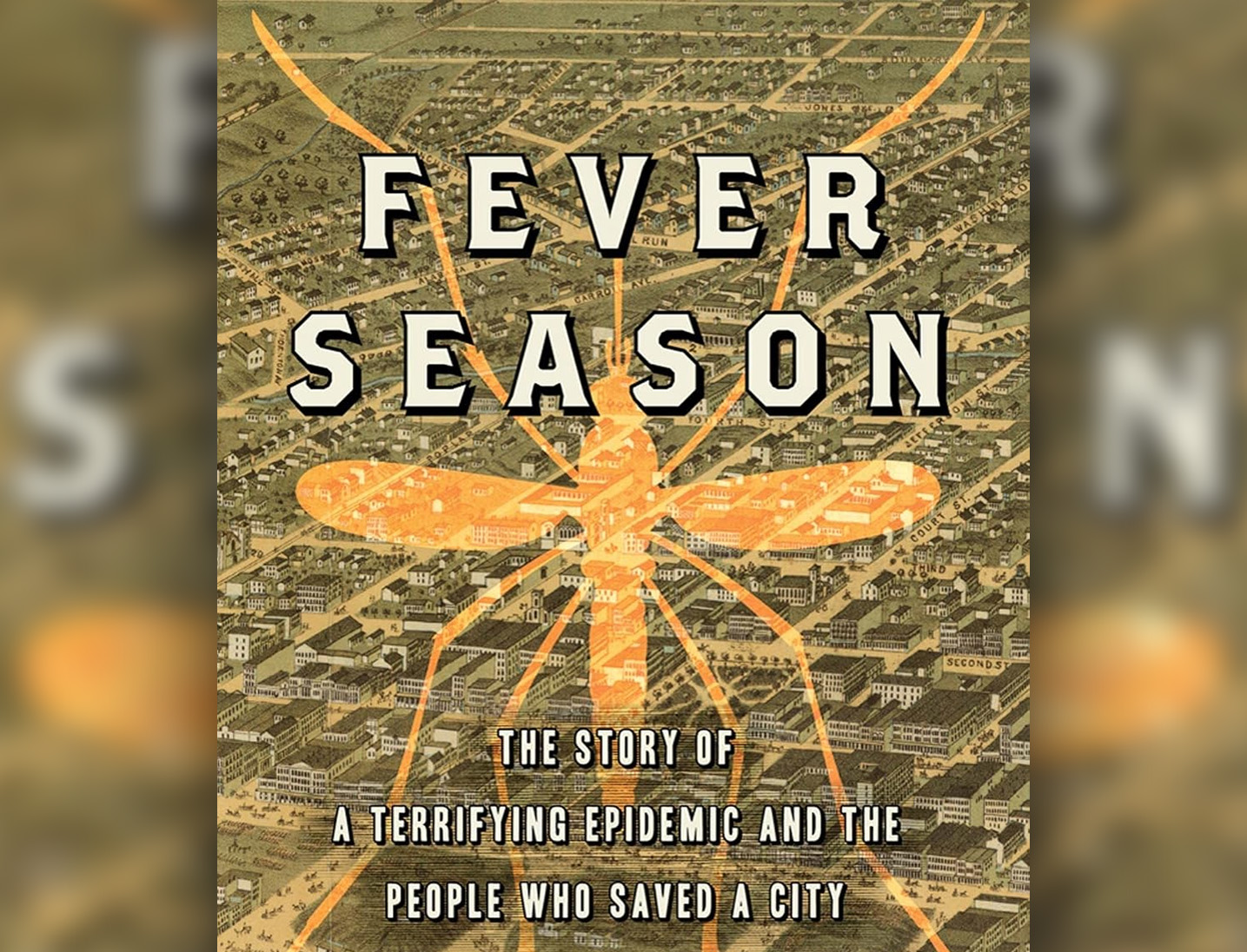
I recently finished Jeanette Keith’s 2012 book, “Fever Season: The Story of a Terrifying Epidemic and the People Who Saved a City.” The timing was fitting: 2018 marked the 140th anniversary of the devastating yellow fever epidemic of 1878. Anyone interested in Memphis, West Tennessee or Mississippi River Valley history will find Keith’s account especially compelling.1
Across the Mississippi River Valley, yellow fever killed more than 18,000 people in a matter of months. Memphis had a population of roughly 47,000 before the epidemic. As panic spread, approximately 25,000 people fled within days. By the height of the crisis, only about 20,000 remained. An estimated 17,000 of them contracted yellow fever, and 5,150 died.
Anyone who has spent a summer in the Delta knows the sound of mosquitoes dive bombing around your ears. Today, that familiar buzz usually means a temporary annoyance. In 1878, however, the bite of an infected mosquito could be a death sentence. And the disease produced an especially horrifying death. In severe cases, patients developed jaundice, internal bleeding, shock and organ failure. Blood accumulating in the stomach produced the dreaded “black vomit,” one of the most recognizable signs that death might be near. The yellowing of the skin and eyes gave the disease its name.

A Howard Physician on His Rounds, Memphis, Tennessee, 1873. Photo credit: Tennessee State Library and Archives, Manuscript Collection
The cause of yellow fever
Yellow fever spreads through the bite of an infected mosquito. A mosquito acquires the virus by feeding on an infected person while the virus is circulating in that person’s blood. It can then transmit the virus to others through subsequent bites.
Memphians in 1878 did not know that mosquitoes were carrying the disease from person to person. That connection was not conclusively demonstrated until 1900, when Walter Reed (1851-1902) and his colleagues conducted experiments showing that mosquitoes transmitted yellow fever.2
Keith describes how an early heat wave, heavy rains, standing water and inadequate sanitation created ideal conditions for mosquitoes. Memphis’ cisterns, gutters, barrels and pools of stagnant water provided countless breeding places. Once yellow fever entered the city, the conditions allowed it to spread with terrifying speed.
Some of the people who fled Memphis carried the virus in their blood to other communities, where local mosquitoes could acquire it and continue the cycle. Towns along the railroad lines suffered devastating outbreaks of their own.
Brownsville, about 50 miles from Memphis, was among them.
Yellow Fever in Brownsville
A. D. Langstaff, president of the Memphis Howard Association, a private, volunteer relief organization that cared for people during yellow fever epidemics, traveled to Brownsville in early October. Langstaff was a prominent Memphis businessman who helped direct the Howard Association’s massive relief operation.
Langstaff found that many country doctors had remained at their posts, but some had died. His account, published by John M. Keating (1830-1906), described the conditions along the railroad: “Persons were dying — had died, and remained unburied.” Langstaff arranged for relief trains to travel from town to town carrying physicians, nurses, medicine, food and other supplies.3

Report on conditions in Brownsville during the yellow fever epidemic of 1878. The Memphis Howard Association was a volunteer relief organization that coordinated physicians, nurses, supplies and financial assistance. Memphis Daily Appeal, Oct. 17, 1878.
An article that appeared in the October 17, 1878 edition of the Memphis Appeal describes the devastating yellow fever outbreak in Brownsville. Because the town’s newspaper had stopped publishing, C. W. Wade, also with the Howard Association sent the Memphis Daily Appeal a long list of sick residents so that family members and others who had left town could learn about conditions at home.
A second report, written by R. S. Russell to Langstaff, reported yellow fever was still spreading. Brownsville had recorded 19 new cases and seven deaths one day, followed by 22 new cases and three deaths the next. Business had been suspended for 43 days. Of the town’s estimated 4,000 residents, about 3,000 had fled, leaving roughly 1,000 people, most of them poor or otherwise dependent on relief. About 300 had been moved into camps.
The Brownsville Howard Association was spending about $350 a day to feed residents, care for the sick and bury the dead. Although it had received more than $8,500 in cash contributions, 5,000 federal rations and additional supplies from Tennessee and neighboring communities, its food was nearly exhausted and its remaining money would soon be consumed by unpaid bills. Russell praised the nurses and relief workers sent from Memphis, as well as local officials and businesses that continued supporting Brownsville during the crisis. As the epidemic progressed, the number of dead overwhelmed those who remained. Bodies deteriorated in houses before they could be removed. Coffins accumulated faster than graves could be dug. Undertakers, gravediggers and wagon drivers worked until they became sick, collapsed from exhaustion or died.

Open letter from the superintendent of Elmwood Cemetery requesting help identifying the locations of yellow fever victims’ graves. Memphis Daily Appeal, November 29, 1878.
Yellow fever at Elmwood Cemetery
Before I left Tennessee for Washington, D.C., for more than 15 years, Elmwood Cemetery was part of one of my regular bicycle routes. It is a beautiful, historic cemetery filled with old trees, elaborate monuments and reminders of nearly every chapter of Memphis history.
During the yellow fever epidemics, however, Elmwood’s serenity disappeared. At the height of the crisis, the cemetery sometimes received dozens of bodies in a single day. There were too few men left to dig graves, and many victims arrived without relatives or even reliable identification.
Four public burial lots at Elmwood became collectively known as “No Man’s Land.” At least 1,400 victims of the yellow fever epidemics of 1873, 1878 and 1879 were buried there, many without individual markers. In death, wealthy Memphians, laborers, immigrants, formerly enslaved people and strangers who had only recently arrived in the city rested beside one another.

My daughter Alex during a school field trip to Elmwood Cemetery
No visit to Elmwood is complete without stopping to pay respects at the grave of Annie Cook (c. 1840-1878), a Memphis madam who remained in the city and converted the Mansion House, her brothel, into a hospital.
Cook had also cared for yellow fever victims during the smaller epidemic of 1873. When the disease returned in 1878, she again opened her doors to the sick and used her own money to provide food, medicine and nursing care. After weeks of tending to others, Cook contracted yellow fever and died Sept. 11, 1878.
A granite marker placed near her grave a century later describes her as “a 19th-century Mary Magdalene who gave her life to save the lives of others.”
Martyrs Park

Memorial at Martyrs Park honoring those who sacrificed their lives while caring for Memphis’ yellow fever victims.
I also have a personal connection to another memorial honoring Cook and the other yellow fever martyrs.
Martyrs Park sits directly in front of my in-laws’ house on one of the bluffs overlooking the Mississippi River. The park was dedicated in 1971 to the people who remained in Memphis or came to the city to care for yellow fever victims.
Its centerpiece is the Yellow Fever Memorial, designed by Memphis artist Harris McLean Sorrelle (1929-1997). The monument’s inscription begins:
“In grateful memory of the sacrifice of the heroes and heroines of Memphis … who gave their lives serving the victims of yellow fever.”
It concludes with John 15:13: “Greater love than this no one has, that one lay down his life for his friends.”
One of Keith’s most powerful observations is that heroism could not be predicted by a person’s race, sex, religion, occupation or social standing. Some prominent citizens abandoned their families and public responsibilities. Meanwhile, prostitutes, gamblers and others whom respectable society had often dismissed stepped forward to nurse the sick.
White elected officials deserted their posts, while Black militiamen remained to guard the nearly abandoned city. Catholic priests and nuns, Protestant ministers, Jewish volunteers, physicians, nurses, merchants, laborers and ordinary citizens entered infected homes, distributed food, transported patients and buried the dead. Many knowingly placed themselves in danger to help people they did not know.
“Fever Season” is more than the story of a terrifying epidemic. It is a study of civic collapse, inequality, courage and sacrifice. Yellow fever devastated Memphis in 1878 and permanently altered the fabric of the city. It also produced an extraordinary generation of martyrs whose acts of compassion deserve to be remembered.
- Jeanette Keith, Fever Season: The Story of a Terrifying Epidemic and the People Who Saved a City (New York: Bloomsbury Press, 2012). ↩︎
- Michael G. Schultz, “Henry Rose Carter,” Emerging Infectious Diseases 15, no. 10 (October 2009). ↩︎
- John McLeod Keating, A History of the Yellow Fever: The Yellow Fever Epidemic of 1878, in Memphis, Tenn. (Memphis: Howard Association, 1879), 333. ↩︎


Leave a Reply