
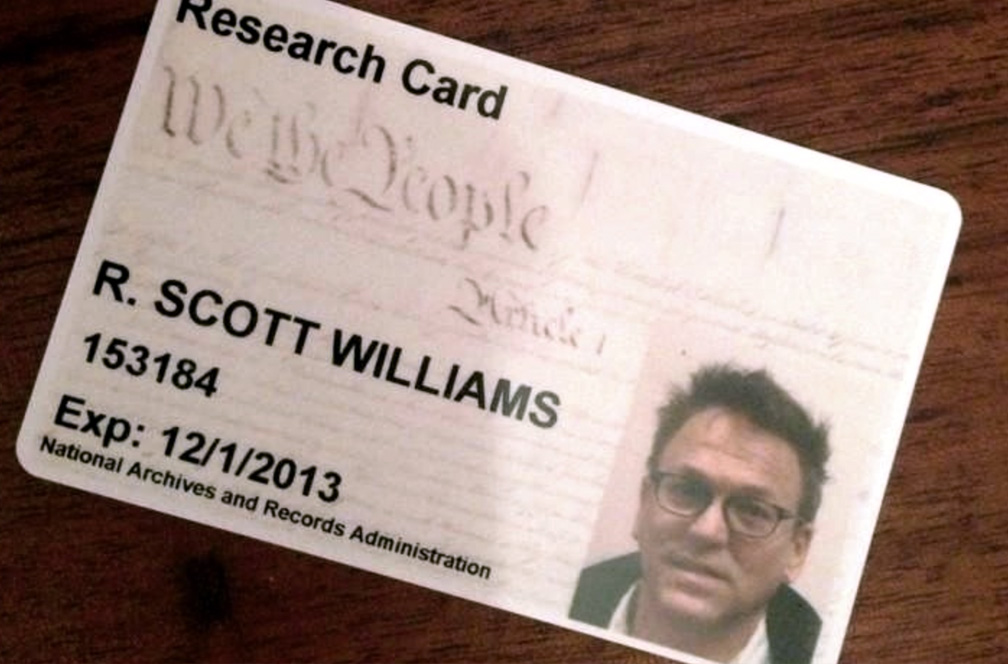
Since moving to Washington, D.C., a research trip to the National Archives has been near the top of my list. A recent Saturday morning with nothing planned gave me the chance to check it out. I had time that day for only a few quick searches in the Civil War database, but in a matter of minutes I found family. As is usually the case when I research Haywood County, Tennessee, the Castellaws quickly rose to the surface.
The National Archives was established in 1934 after President Franklin D. Roosevelt signed legislation creating a federal home for the records of the U.S. government. Before that, individual agencies kept their own records, many of which were disorganized, insecure or damaged because of poor storage.
The National Archives is housed in a beautiful building that I am fortunate to pass each day on my way to work.
In addition to the Declaration of Independence, the Constitution and the Bill of Rights, the National Archives now holds 13.5 billion pieces of paper, more than 725,000 artifacts, more than 450 million feet of film, 41 million photographs, 40 million aerial images, 10 million maps, charts and architectural and engineering drawings, and more than 33 billion electronic records.
In other words, a lot for a genealogy fan to explore.
For me, even the registration process to enter the research area was fun. The National Archives also has produced a helpful video about using the facility.
One of the first documents I found brought together several people who show up in my genealogy and represent both sides of my family. The document involves Thomas Jefferson Castellaw (1808–1878), his son George W. D. Castellaw (about 1846–1918), John H. Hicks (dates not confirmed), Union Col. Edward H. Wolfe (1834–1916) and John Hardy “Jacky” Cobb (1798–1880). From the “Unfiled Papers and Slips Belonging in Confederate Compiled Service Records,” I located Archives record No. 2133276.

Unfiled Civil War document No. 2133276
State of Tennessee
Haywood County
Personally appeared before me Thomas J. Castellaw and made oath in due form of law that George W. D. Castellaw is his son, about 18 years old, and was taken from my house as a conscript by [?] John H. Hicks’ men under guard by them, and in a very few days was captured in Ripley, Lauderdale County, by Col. Wolfe’s command.
Sworn to before me this 10th day of March 1864, John H. Cobb, justice of the peace in and for Haywood County.
Signature: Thomas J. Castellaw
The document suggests that George Castellaw’s Civil War experience began not with enlistment, but with coercion. His father, Thomas Jefferson Castellaw, swore that George was taken from the family home as a conscript by men under John H. Hicks, held under guard and captured within days by Union troops near Ripley. The affidavit shows how the war reached into homes in Haywood County and pulled young men into service whether they were wanted to serve or not.
It’s interesting how many individuals one document can include.
Jacky, the justice of the peace and one of Haywood County’s original settlers, wrote the legal document for Thomas Jefferson Castellaw.
Jacky and his wife, Harriet Warren Castellaw Cobb (1804–1869), are of particular interest to me because their son, William Thomas Cobb (1833–1898), is my maternal third-great-grandfather, while their daughter, Mourning Adeline Cobb Watridge (1838–1876), is my paternal second-great-grandmother. That makes Jacky and Harriet both my third- and fourth-great-grandparents.
Jacky and Harriet’s son, William Thomas Cobb, was the father of Mary Etta Cobb Brantley (1871–1935), who was the mother of William “Willie” Day Brantley (1897–1969), who was the father of Virginia Brantley Lovelace (1917–2007), who was the mother of Shirley Lovelace Williams, my mother.
Jacky and Harriet’s daughter, Mourning Adeline Cobb Watridge, was the mother of Zula Zera Watridge Castellaw (1875–1940), who was the mother of Elizabeth Castellaw Williams (1915–1998), who was the mother of Robert Lafayette “Bob” Williams, my father.
Henry Day Brantley (1845–1918), my third-great-grandfather, described Jacky Cobb to his grandson, Lawrence A. Cobb (1904-1989):
“I remember your grandfather as being short in stature. His physique was of the roly-poly type. I remember him driving up to sales in a two-wheel ox cart.”1
T. J. Castellaw, who initiated the document, was the brother of Harriet Warren Castellaw Cobb and my third-great-grandfather on the other side of my family.
Thomas Jefferson “Tom” Castellaw and Harriet were children of John Dawson Castellaw (dates not confirmed) and Zilpha Spruill Castellaw (dates not fully confirmed; died 1842).
John Castellaw is said to have led many wagon trains from Bertie County, North Carolina, to Haywood County in the early 1830s, finally settling in the area with his wife and adult children in 1834.

Grave of Thomas Jefferson Castellaw Jr. (1841–1879) and his wife, Nancy Miranda Johnson Castellaw (1844–1921) in Haywood County.
Eventually, T.J. had seven children with two wives. His oldest son with his second wife, Mary Elizabeth Cole Castellaw (1809–1875), was Thomas Jefferson Castellaw Jr., my second great-grandfather.
The document I found at the National Archives shows that T. J.’s son George was about 18 and at his parents’ home near the present site of Holly Grove Baptist Church when men under John H. Hicks forced him into Civil War service as a conscript. Within a few days, he was captured in Ripley, in Lauderdale County, by Col. Wolfe’s command. I assume he became a prisoner of war, but confirming that is now on my research list.
The document does not indicate whether George had returned home by the time it was written, but I know he was back in Haywood County by Nov. 25, 1866, when he married Mary Emily Watridge Castellaw (1848–1910).
It gives me more to add to my list of things to find out.
At the end of his life, T.J. suffered from what some thought was Parkinson’s disease and lived with George and Mary. His obituary says:
“Brother T. J. Castellaw Sr. died the 23rd December 1878 at the residence of his son, G. W. Castellaw, near Jones Station. T. J. Castellaw Sr. died in the 71st year of his age. He was born in Bertie County, North Carolina, on the 15th September 1808. He moved to Haywood County, Tennessee, while young. He married Mary Cole at age of thirty-one years. He professed religion about 1839 and joined Zion. He was a sufferer for many years before died.”
I have one additional connection to George and Mary Castellaw.
The 1900 census indicates their nephew, 12-year-old William Lafayette “Will” Williams (1888–1962), was living in their home.

Will Williams with his wife, Eva Iris Overton Williams (1896–1970).
Will was my paternal great-grandfather. No one in my family is aware of many details of Will’s childhood, so the reason he was not living with his parents remains uncertain. His mother, Martha Jane Watridge Williams (1852–1888), died when he was less than a year old, and his father, George Dempsey Williams (1847–1919), later remarried. That may help explain why Will appears in George and Mary Castellaw’s household in 1900, but I have not found a record that explains exactly when or why he moved there.
It’s fortunate I now work right across the street from the National Archive and can start working on solving some of these mysteries.
For more of my genealogy research, visit rscottwilliams.info.
- Cobb, Joe H. Nicholas Cobb: Descendants, Neighbors and Relatives, 1613-1983. Nashville: M.L.W. Publishing Co., 1984. ↩︎


Leave a Reply