
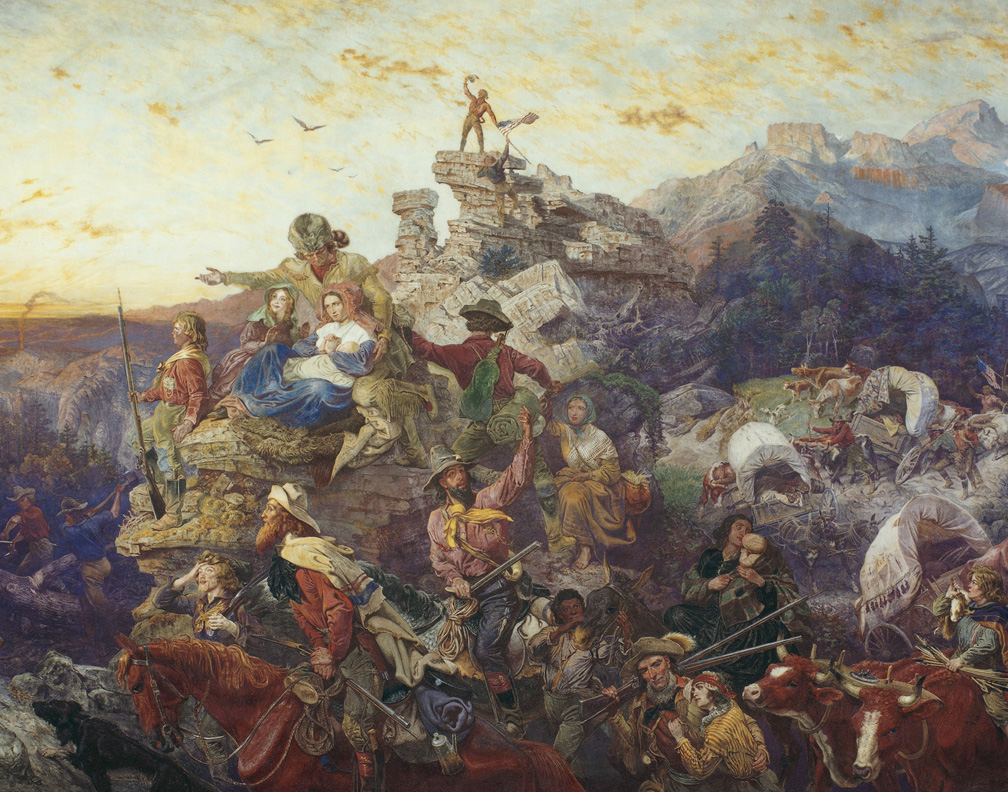
Photo: A section of “Westward the Course of Empire Takes Its Way” by Emanuel Leutze /
As I continue to research my family tree, one question keept coming up: Why did so many of my Bertie County, North Carolina, ancestors load their wagons in the early 1830s and head west to Haywood County, Tennessee?
The more I study them, the more I think the answer was not one thing. It was land, cotton, opportunity, kinship, church, timing and the powerful pull of people they already knew.
Settling a new area was not new to them. Many had parents and grandparents who had fought in the Revolutionary War. They likely grew up hearing stories about earlier generations who traveled into eastern North Carolina, built churches and schools, cleared trees, planted crops and created the farms and plantations that, by the 1830s, could be seen all over Bertie County.
My Bertie County lines were deeply connected to one another long before they reached Tennessee. The Williams, Cobb, Steele, Dempsey, Castellaw, Capehart and Butterton families, all in my ancestry line, joined with other Bertie County families to help found Capeharts Baptist Church in Merry Hill, North Carolina, in 1824. They worshipped together, married into one another’s families, witnessed one another’s deeds and wills and knew one another well.
Most of my ancestors farmed cotton, corn and tobacco. Many also enslaved a small number of people. By the 1830s, cotton had become the crop that drove much of the agricultural economy in both eastern North Carolina and West Tennessee. Cotton required land and labor. In Bertie County, land that had once seemed abundant had grown tighter with each generation. Fathers divided farms among children. Families grew. Landholdings shrank. Younger sons and sons-in-law began looking west.
Haywood County offered what Bertie County no longer could: newly available land, a new county seat, a growing cotton economy and room for families to recreate the community they were leaving behind.
That opportunity came at a cost. West Tennessee opened to white settlement after the Chickasaw cession of 1818. The land my ancestors saw as opportunity had first been Chickasaw hunting land. Their move west was part of a larger story of American expansion, Native dispossession, cotton agriculture and slavery.
No doubt they received reports about how well two of their own had done in Haywood County.

Col. Richard Nixon (1769-1831) had migrated to the area in 1821 to settle 3,600 acres his father, Thomas Nixon, had received for service in the Revolutionary War. Nixon had lived in Bertie County before moving west and settled along the creek that would take his name.
Old accounts describe Nixon cutting his own road to the place where he pitched his tent on Nixon’s Creek, about three miles east of Brownsville. The first Haywood County courts met in his home. He helped lay the foundation for the county’s civic and religious life and became one of the most important early figures in the settlement of Brownsville.
Nixon quickly convinced his nephew, Jonathan T. Jacocks (dates not confirmed), to join him. Both men prospered, so it’ is not difficult’s easy to imagine letters making their way back to Bertie County where relatives, church members and neighbors began weighing their own futures.
A move from Bertie County to Haywood County took courage. Families had to sell or leave land, pack wagons, gather children and household goods, move enslaved people, travel for weeks and begin again in a place still taking shape.
By the early 1830s, a steady stream of my family began moving west. Below are 10 heads of households in my direct ancestral line who made the journey from Bertie County, North Carolina, to Haywood County, Tennessee.
John Dawson Castellaw (1780-1859)
John Dawson Castellaw (1780-1859), my fourth great-grandfather, was 55 when he settled in Haywood County. He descended from one of Bertie County’s old families.
Castellaw married Zilpha Spruill (1778-1842) in North Carolina on Jan. 21, 1804. She was the daughter of Simeon Spruill (1747-1796), a high-status planter and enslaver of many from Tyrrell County, North Carolina.

Me at Capeharts Baptist Church in Bertie County, North Carolina
John and Zilpha Castellaw were among the early members of Capeharts Baptist Church. The church began with 74 charter members who had received letters of dismissal from older Baptist churches in the area so they could form the new congregation at Capeharts Meeting House. They held their first service Dec. 10, 1824. John appears frequently in the church minutes.
According to family history, Castellaw began leading wagon trains to Haywood County before he finally stayed there himself. In February 1834, the Capeharts Baptist Church minutes recorded that Brother and Sister Castellaw petitioned for letters of dismissal.
That same year, Castellaw settled in Haywood County with his wife, their daughter Harriet Warren Castellaw Cobb (1804-1869), their son Thomas Jefferson “T. J.” Castellaw Sr. (1808-1878) and their families.
When Zilpha died in Haywood County on April 27, 1842, family tradition says she became the first person buried in the Cobb Family Cemetery.
William Steele Jr. (1795-1834)
William Steele Jr. (1795-1834), my fifth great-grandfather, was among the first in my line to load his wagons and head west. He married his second wife, Frances “Fannie” Cobb Steele (1796-1846), on Dec. 12, 1822, at Eden House in Bertie County.
William, Frances and their 4-year-old son, Andrew Patterson Steele (1827-1861), were living in Haywood County by 1831.

My third great-grandparents Henry Day Brantley and Margaret Rebecca Steele Brantley
Unfortunately, William died only a few years later. Andrew later married Sarah Elizabeth Butterton (1833-1906), and they became active members of Zion Baptist Church. Their daughter, Margaret Rebecca Steele Brantley (1950-1932), later married Henry Day Brantley (1845-1918), the son of Augustus Brantley (1811-1876) and Martha White Brantley (1812-1852).
Dempsey Nowell II (1802-1852)
Dempsey Nowell II (1802-1852), my fourth great-grandfather, came from another family with deep roots in northeastern North Carolina. His grandfather, Martin Nowell (1700-1779), had purchased land in Bertie County by 1736.
Dempsey and his wife, Elizabeth Rawls Nowell (c. 1796-1844), migrated from the Bertie-Hertford County area to Haywood County by March 7, 1833. They had five children when they headed west. Their sixth child was born soon after they arrived.
The Nowells quickly became part of their new community. Dempsey was ordained a deacon at Zion Baptist Church in March 1839. Zion was still a young church, having begun in November 1836. Its first pastor was George S. Williams (1797-1852).
Five years after Dempsey became a deacon, his daughter Catherine Arthur Nowell Williams (1828-1895) married George Solomon “Sol” Williams (1820-1864), the minister’s son.
George S. Williams (1797-1852)
George S. Williams (1797-1852), another fourth great-grandfather, was already a Baptist minister before he reached Haywood County. He appears in the minutes of Holly Grove Baptist Church in Bertie County on Dec. 13, 1828, and he continued to appear in those records before moving west.
By 1836, Williams had become the first minister of the newly formed Zion Baptist Church in Haywood County. He and his wife, Nancy F. Hampton Williams (1795-1850), traveled west with their children, including Sol, who was 16, and Harriett Ann Williams Outlaw (1833-1878), who was 3.
Sol later married Catherion Arthur Nowell Williams. Harriett later married Andrew Jackson “Jack” Outlaw (1825-1903), the son of George Washington Outlaw (1803-1861) and Luday Perry Outlaw (1800-1840).
John Hardy “Jacky” Cobb (1798-1880)
John Hardy “Jacky” Cobb (1798-1880), my third great-grandfather, was 36 when he arrived in Haywood County on April 22, 1834. Jacky, as he was called, is remembered in family stories as being short and very round.
Cobb’s family had lived in Bertie County since the mid-1700s, when his grandparents migrated from Isle of Wight County, Virginia. He and his relatives appear in many Bertie County records.
Jacky married Harriet Warren Castellaw Cobb on April 28, 1820. They already had six children when they headed west with her parents.
According to a family Bible, the trip from Bertie County to Haywood County took 50 days in a covered wagon. The Cobbs did well in Haywood County. Jacky became a town constable and later served as a school commissioner and magistrate.
William M. Watridge (1798-1864)
William M. Watridge (1798-1864), my third great-grandfather, was 38 in 1836 when he migrated from Bertie County to Haywood County. He had married Milly Thompson Watridge (1799-1875) on March 31, 1821.
Milly’s family lived along the Bertie-Hertford County line, and members of the family are buried on the land where she grew up.
William and Milly Watridge traveled to Haywood County with their sons James F. Watridge (1823-1871) and Daniel Washington Watridge (1835-after 1880). Their third son, Dorsey H. Watridge (1840-1890), was born in Haywood County in 1840.
When William and Milly moved to Haywood County, they became active members of Zion Baptist Church. Decades later, Dorsey donated the land for Holly Grove Baptist Church.
Augustus Brantley (1811-1876)
Augustus Brantley (1811-1876), another fourth great-grandfather, was about 26 around the time he loaded his wagon in Bertie County and headed to Haywood County in 1837. His father, Edward Brantley (c. 1760-1837), had been born in Bertie County and died there around the time Augustus moved west.
Augustus’ wife, Martha White Brantley, was the daughter of Solomon White (1770-1854) and Martha Ann Outlaw White (1774-1828). Her brother was John Bembery “Bem” White (1801-1858).
Martha was very likely the great-grandaughter of Henry White, Henry White (1725-1794) — DAR Ancestor No. A124707. Henry White was a lifelong resident of Currituck County, North Carolina, where he became a landowner, public official and Revolutionary-era patriot. Born in 1725, he lived in the Albemarle region during a period when coastal North Carolina families were shaped by farming, maritime trade, county courts and the politics of independence. White represented Currituck County in the North Carolina General Assembly before the Revolution and his civil service helped secure his later recognition by the Daughters of the American Revolution. He died in Currituck County in 1794, leaving estate records that connect him to several prominent local families, including the White, Church, Outlaw and Brantley lines.
His story also includes a difficult but important connection to John Jasper White, known as “Currituck Jack,” an enslaved man whose Revolutionary War heroism eventually led the North Carolina General Assembly to grant him freedom.
The oldest son of Augustus and Martha, Daniel E. Brantley (1833-1864), was born in Bertie County. Their remaining children, including Robert Brantley (dates not confirmed), Mary Brantley (dates not confirmed), Julius Brantley (1842-1863), Henry Day Brantley and Solomon Norman Brantley (1848-death year not confirmed), were born in Haywood County.
The Brantleys became active members of Zion Baptist Church, and Henry Day Brantley later married Margaret Rebecca Steele Brantley.
John Bembery “Bem” White (1801-1858)
I’ve always liked the name Bembery. John Bembery “Bem” White (1801-1858), my fourth great-uncle, was about 32 when he traveled the road from Bertie County to Haywood County. He likely helped draw his sister, Martha White Brantley, and her husband, Augustus Brantley, to the area.
White married Penelope Penninah Trottman White (1801-1875) in Bertie County. They had young children when they migrated. One of their daughters, Penelope Trottman White Cobb (1831-1880), later married John Charles Warren Cobb (1830-1914), one of the sons of John Hardy “Jacky” Cobb and Harriet Warren Castellaw Cobb.
George Washington Outlaw (1803-1861)
George Washington Outlaw (1803-1861), another fourth great-grandfather, was around 30 when he and his wife, Luday Perry Outlaw, left North Carolina and headed west. According to an Outlaw family Bible, George and Luday left North Carolina in 1831 and settled in Madison County, Tennessee, in 1832.
They had a son and daughters when they made the trip. Their daughter Elizabeth Temperance “Bet” Outlaw Cobb (1836-1925), my third great-grandmother, was born Nov. 5, 1836.
Sadly, not everyone who started the journey survived long after the move. George’s father, Jacob Outlaw (1757-1832), died Jan. 21, 1832. One family account says he died during the trip and was buried in Knoxville, Tennessee. .
George and Luday became very active at Zion Baptist Church. When the new church voted to call George S. Williams as its first pastor, George Outlaw wrote the letter letting him know.
George and Luday’s oldest son, Andrew Jackson “Jack” Outlaw, was just 8 when he migrated with his family to West Tennessee. He later married Harriett Ann Williams Outlaw, George S. Williams’ daughter.
Charles Butterton (1805-1847)
Charles Butterton (1805-1847), my fifth great-grandfather, married Elizabeth Thomas (1792-1881) in Bertie County on Jan. 1, 1833. They departed for Haywood County in 1835, when Charles was about 30.
Their daughter, Sarah Elizabeth Butterton Steele, married Andrew Patterson Steele. Like so many of the other Bertie County families who made the journey, the Buttertons became active members of Zion Baptist Church.
When I look at these families together, the migration begins to make sense. They were not random families moving independently into the unknown. They were a connected network of relatives, neighbors and church members. They had worshipped together in Bertie County. They married into one another’s families. They trusted one another. Then they recreated much of that same community in Haywood County.
They brought their faith, family networks, farming habits, ambitions and contradictions. They brought courage and loss. They brought young and old, tools and household goods, hopes and worries. Some brought enslaved people whose own forced journey should also be remembered as part of this story. Those enslaved men, women and children left behind friends and family they would never see again.
As the families reached Haywood County, they were not just starting farms. They were building a new version of the world they had known.
And the more I research them, the more I believe the road from Bertie County to Haywood County was not just a road west.
It was my family line.
For more of my genealogy research, visit rscottwilliams.info.


Leave a Reply