
I saw a plaque on the wall during my visit to the Haywood County History Museum, and it made me want to dive in and see if there was more about The Bridge Company. C.S.A. to discover.
There is little research on the company as it was an independent group of older, established Haywood County residents who came together to defend the Memphis and Ohio Railroad bridge over the Big Hatchie River in 1861. Once the bridge was destroyed in June 1862, the group disbanded.
its story helps explain Brownsville ‘s importance during the war and the plaque is a good example of how most Southerners later positioned the “Confederate cause.”
That bridge was important because it stood on the Memphis and Ohio Railroad, which connected Haywood County to Memphis and, by extension, to one of the most important cotton and supply markets in the South. The railroad had helped transform Brownsville before the war. Construction began in the 1850s, and the line and depot were completed by 1860.1
During the early part of the Civil War, that same railroad carried men and supplies between Memphis and Confederate forces at Columbus and Bowling Green. For the Confederacy, the bridge over the Hatchie River was not just a local crossing. It was part of a transportation system that helped move troops, military equipment, food, messages and cotton through West Tennessee.
The Bridge Company was commanded by Capt. N. J. Anderson. Its officers included Jasper N. Carlton, Philip Yancey and Daniel Barcroft. The company included around 60 men, many of them married and older than the first volunteers who left Haywood County to fight in the war. They furnished their own horses, uniforms and food, suggesting this was a group of local men with a direct interest in protecting a significant part of the county’s transportation infrastructure.
Many of the men had likely assumed the war would be over quickly, and they could not have imagined the loss and devestation they would experience in the coming years. As recently as February 1861, Tennessee voters heavily rejected a proposal to even hold a secession convention. Most citizens preferred to find a peaceful compromise to keep the United States together and avoid a war.
As in other states, public opinion changed for many after the Confederate attack on Fort Sumter in April 1861. When President Abraham Lincoln called for 75,000 troops to suppress the Southern rebellion, many Tennesseans viewed it as a military invasion of the slave-holding states and refused to cooperate.
On June 8, 1861, as the Civil War entered its third month, Tennessee voted 102,172-47,328 to secede from the Union and join the Confederacy.
One year later, in June 1862, the men of the Bridge Compny resorted to burning the bridge down as Federal troops neared Haywood County. Suddenly, men who had supported the Confederacy had to reckon with defeat, occupation and the collapse of the world they had tried to defend as Haywood County was occupied by the Union.
Around the turn of the 20th century, the Hiram Bradford Bivouac, a Confederate veterans’ organization in Brownsville, printed an article about the company for an upcoming reunion.
The article ended with this line: “They were well worthy of the honor and respect accorded to veterans of the Lost Cause.”
| Who was Hiram Bradford? The Hiram Bradford Bivouac, the Brownsville camp of Confederate veterans, was named for Maj. Hiram Scott Bradford (1830-1873), a Haywood County Confederate officer and son of early Brownsville merchant Hiram Bradford. Before the Civil War, he represented Haywood County in the Tennessee House of Representatives. During the war, he served in the Confederate military structure as an assistant adjutant general and later became closely associated with the memory of the Confederacy in Brownsville. After his death, the local United Confederate Veterans organization took his name as the Hiram S. Bradford Bivouac, the group that later helped preserve and promote stories like that of the Bridge Company. |

By the early 1900s, remembering the Civil War in places like Brownsville was not just about recalling who served in the Confederacy. It was about shaping how the war would be justified. The “Lost Cause” language presented Confederate soldiers as honorable defenders of home and community while minimizing or avoiding the central role slavery played in the conflict. Of course, not every man in the Bridge Company thought about the war in exactly the same way, but it does mean the reunion and statue culture that later celebrated soldiers across the South framed their actions inside a story of sacrifice, bravery and regional pride instead of rebellion in defense of a slaveholding society.2

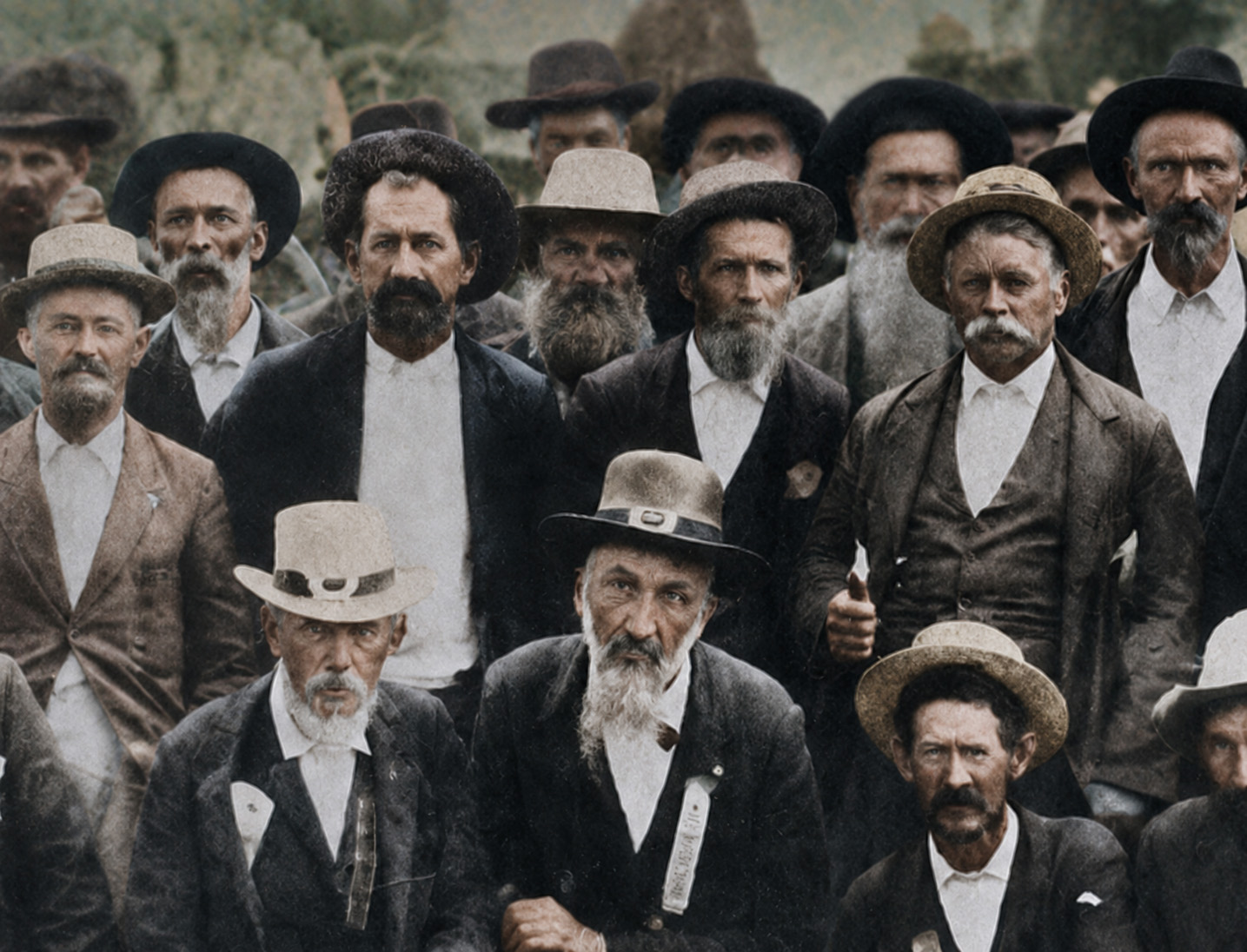
Members of the Hiram Bradford Bivouac of the United Confederate Veterans (UCV) at a reunion on the Robert Johnson farm near Brownsville. Photo credit: Haywood County Museum
Decades after the M & O Railroad bridge was destroyed, members who were still alive, descendants and fellow veterans positioned that brief moment as an act worth of honor.
This article, reprinted on the plaque in the museum, was originally printed somewhere around the turn of the century by the Hiram Bradford Bivouac on the occasion of a reunion. It concluded with these lines: “They were well worthy of the honor and respect accorded to veterans of the Lost Cause.”

| THE BRIDGE COMPANY, C. S. A. From Plaque In the latter half of the year 1861, while the War Between the States was raging, a company of men was raised in this county to guard the railroad bridge over Big Hatchie River near Brownsville; this was a very important bridge in view of the fact that it was on the main line of communication between Memphis and Columbus and Bowling Green where the Confederate Armies were then located. Large numbers of men and large quantities of supplies for the troops on the front were shipped over this line. Hence, the importance of keeping the Hatchie and other bridges intact, so long as the Confederates remained north of this section, these bridges were vital to the Cause. To the very important duties of protecting this bridge, a company was raised, under authority of the Confederate government, and did most valuable service for several months. It was composed of some 60 or more men and commanded by N. J. Anderson, captain; J. N. Carlton, 1st lieutenant; Philip Yancy, 2nd lieutenant; Daniel Barcroft, 3rd lieutenant. This company continued to do their duty until after the Confederates fell back from points north of here making it necessary to burn the bridge. This was done about June 1, 1862, whereupon the company was disbanded. The men composing this company were married, and were mostly advanced in years. They were among the very best citizens of this section and furnished their own horses, military outfits and rations. They were true men, and as brave and patriotic as any. Many of them, subsequently, joined the regular Confederate forces, and did gallant service until the war closed. A partial list is all that is available of this company: |
Bridge Company
N. J. Anderson, Captain
Jasper N. Carlton, 1st Lieut.
Philip Yancey, 2nd Lieut.
Dan Barcroft, 3rd Lieut.
Thomas J. Harbert
James R. Taylor
W. L. Taylor
H. L. Taylor
Samuel Gill
W. P. Harvey
Thomas Orgain
Frank Merriweather
William Palmer
S. P. Read
Samuel Humphreys
M. Cox, Sr.
J. M. Brooks
C. F. Read
M. Boyd
H. C. Sangster
B. Whitehurst
Louis Hawkins
L. E. Taylor
J. L. Weaver
R. W. Tucker
W. B. Taylor
W. B. Booker
Pros. Oclman
W. A. Tanner
Dr. E. A. Taylor, Surg.
J. R. Wilson
John A. Cole
B. L. Taliaferro
James Evans
Joe Blackwell
John O. Davis
W. W. Womble
W. M. Strayhorn
John L. Read
A. D. Stainback
Rev. William Shelton, Chap.
R. L. Hotchkiss
Isidore Solomon
- Tennessee Historical Commission, “Historic Resources of Brownsville, Tennessee (1823-1964),” National Register of Historic Places Multiple Property Documentation Form, 2019, sec. E, 12-13. ↩︎
- Caroline E. Janney, “The Lost Cause,” Encyclopedia Virginia, Virginia Humanities; National Park Service, “History of Memory, Tourism, and the Lost Cause at Fort Pulaski.” ↩︎


Leave a Reply