
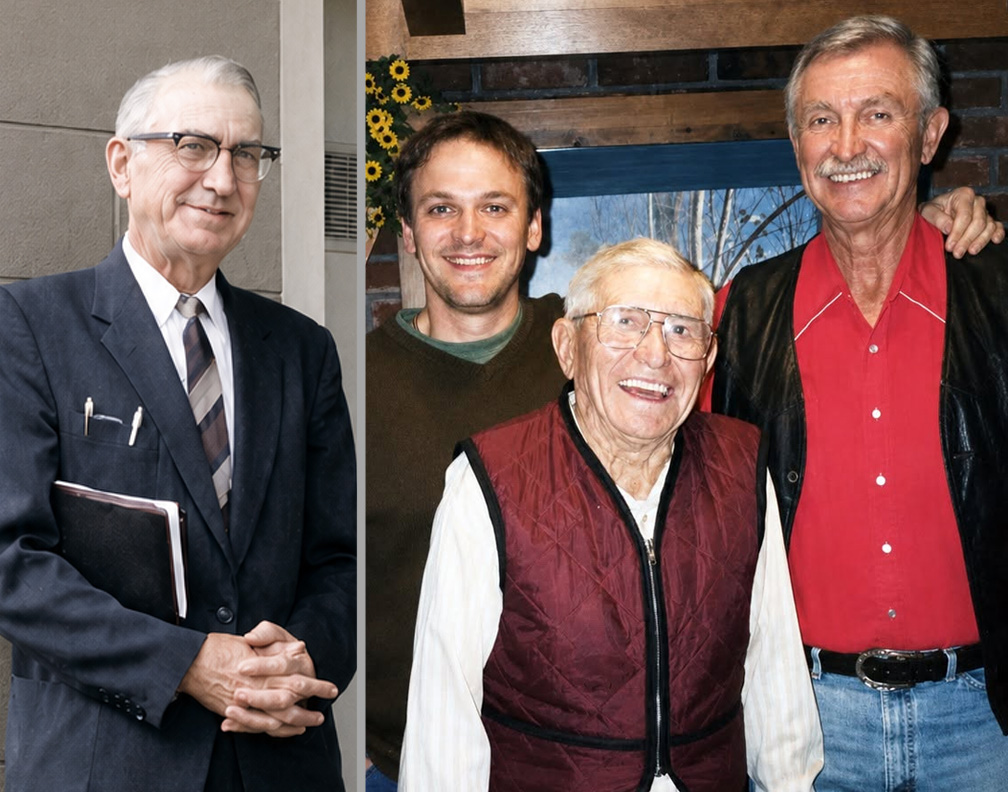
Photo of four generations: From left: Will, Scott, Bo and Bob Williams
For years, I have been able to trace many of my ancestral lines back 10 or more generations. But my Williams line, the one that gave me my last name, has stopped at my fourth great-grandfather, George S. “Brother George” Williams (1797–1852).
George is the earliest confirmed ancestor in my direct Williams line. He was born in 1797, likely in Bertie County, North Carolina, and died Oct. 3, 1852, in West Tennessee. He married Nancy F. Williams (about 1795–after 1852), who may have been Nancy F. Hampton, though I have not yet proven her maiden name.
The confirmed Williams line from me back to Brother George is:
Robert Lafayette “Bob” Williams (1940-present), my father, was the son of Jesse Lloyd “Bo” Williams (1910–2008). Bo was the son of William Lafayette “Will” Williams (1888–1962). Will was the son of George D. Williams (about 1847–1919), whose middle name may have been Dempsey. George D. was the son of George Solomon “Sol” Williams (1820–1864). Sol was the son of George S. “Brother George” Williams (1797–1852).¹ Brother George’s middle name may have been Sydney.
That much is solid.
What remains uncertain is whether I can connect Brother George to earlier Williams families in Bertie County. After digging deeper, I now believe there is a strong possibility that my Williams line continues back through a Revolutionary War soldier named George Williams (1756–1836), a native of Bertie County who later lived in Chatham County, North Carolina. That connection is not proven, but the circumstantial evidence is strong enough to make it likely.
George S. “Brother George” Williams
Brother George appears in the minutes of Holly Grove Baptist Church in Bertie County on Dec. 13, 1828, when he was identified as “Brother George Williams.” In January 1829, he was referred to as an elder. On March 9, 1833, the church unanimously chose him as pastor for one year. He accepted later that month, provided the church changed its meeting time from the second Sunday of the month to the first.
Holly Grove itself gives the story more meaning. The church was organized in 1804 as Outlaw’s Chapel, named for Ralph Outlaw, and became Holly Grove Baptist Church around 1825. That places Brother George inside the same Bertie County Baptist community that included the Outlaws, Castellaws, Nowells, Watridges and other families who later moved to West Tennessee.
In the early 1830s, many families from Bertie County began moving west to Haywood County, Tennessee. According to family tradition, John Dawson Castellaw (1788–1852), another of my fourth great-grandfathers, led a group of families from Bertie County to Haywood County to settle on land made available through North Carolina’s Revolutionary War military land grants. Many of those families had ties to Capeharts Baptist Church in Bertie County. One of the first things they did after arriving in West Tennessee was organize Zion Baptist Church. 1
When Zion needed a pastor, the congregation sent back to Bertie County for Brother George.
That detail may be one of the most important clues in my Williams research. George was someone the Bertie County families knew, trusted and considered part of their church and community.
The Castellaw-Williams Clue
Another important clue comes from my Castellaw line.
The earliest known connection between the Williams and Castellaw families in my ancestry appears in the marriage of James Castellaw (1685–1749) and Sarah Williams Castellaw (1698–1770), my sixth great-grandparents. James was born in Scotland and migrated to America in his 30s. He settled on land in Chowan and Bertie counties, became active in local politics and married Sarah no later than 1724.
Sarah was the daughter of John Williams (about 1672–1757) and Ann Moore Williams. In research by Ben Williams, John is refered to “John Williams the Younger” to distinguish him from his father, “John Williams the Emigrant.”2
John Williams the Younger was born about 1672, most likely in Lawnes Parish in Surry County, Virginia Colony. His father had come to Virginia in 1666 from the port of Bristol, England, as an indentured servant with John Moor, a Shoemaker.⁹
There is no proof that Brother George descended from John Williams the Younger. Still, the repeated connections between the Williams and Castellaw families in Bertie County are noteable. James Castellaw and Sarah Williams Castellaw had two sons at the time of James’ death in 1749. Their son Thomas Castellaw settled on his father’s land in Duplin County, North Carolina. Their son John Castellaw settled on the family land in Bertie County.
That John Castellaw was the grandfather of John Dawson Castellaw, who later helped lead the Bertie County families to Haywood County. Those same families then called Brother George from Bertie County to pastor Zion Baptist Church.
This does not prove a direct Williams connection. But it shows that my confirmed Williams ancestor lived inside a much older Bertie County network where Williamses and Castellaws had been connected for generations.
A Likely Path Back to the Revolutionary War
The most promising candidate I have found for Brother George’s father is George Williams (1756–1836), a Revolutionary War soldier born in Bertie County.
According to his pension file, this particular George Williams Sr. was living in Chatham County, North Carolina, when he gave a sworn statement in 1833 about his Revolutionary War service. He said he had served in the militia from Bertie County in 1778 or 1779 under Capt. Charles Rhodes, Col. Jonas Johnston and Gen. John Butler. He marched into South Carolina and Georgia and was near Camden, South Carolina, when he suffered a severe leg wound after jumping from a cart. The wound disabled him for years, and he said it often kept him from work.3
A supporting statement from John Rhodes described George as a native of Bertie County who had served in a militia tour that marched through South Carolina into Georgia, then back into the Carolinas.4

Battle of Brier Creek mural dedication in October 2019 in Sylvania, Georgia
Source
There is no mention of specific battle in which he fought, but the strongest match, all things considered, would be the Battle of Brier Creek, fought in Georgia on March 3, 1779. Bertie County militia companies are listed among North Carolina units engaged there, and the battle involved North Carolina and Georgia militia during the British Southern Campaign. The next strong possibility is the Battle of Stono Ferry, fought near Charleston, South Carolina, on June 20, 1779. John Butler was a North Carolina militia brigadier general, and one account places about 700 North Carolina militiamen under Butler in the Stono Ferry campaign.
George later married Delpha (about 1774–after 1842), also recorded as Delphia. She testified in 1842 that she married him Dec. 10, 1792, and that he died Sept. 16, 1836. She also stated that a family record attached to her application was the original family record left by her husband.5
That family Bible record is the reason this man is so important to my search. It lists the children of George Williams, including a son named George Williams, born Nov. 3, 1798.6
That date does not match Brother George’s reported 1797 birth year exactly, but it is close enough to be plausible. Census ages were often off by a year or two, and family dates sometimes shifted in later records. If the George Williams born Nov. 3, 1798, was the same man later known as Brother George Williams of Holly Grove Baptist Church, then my Williams line likely extends one generation further back to a proven Revolutionary War soldier from Bertie County.
At this point, I cannot say that with certainty. I have not found a document that directly identifies Brother George as the son of the Revolutionary War soldier. The missing proof would be a marriage bond, church record, deed, estate file or family Bible entry that connects George S. Williams of Holly Grove and West Tennessee to George and Delpha Williams of Bertie and Chatham counties.
Still, the connection is compelling. The Revolutionary War soldier was a native of Bertie County. He had a son named George born in 1798. Brother George was born about 1797, likely in Bertie County. Brother George appears as a Baptist elder and pastor in Bertie County in the 1820s and 1830s. He then moved west with the same Bertie County network that included the Castellaws, Outlaws and other families connected to my ancestry.
For now, I would call George Williams (1756–1836) my most likely fifth great-grandfather in the Williams line, but not yet a proven one.
The Possible Line Before the Soldier
If the Revolutionary War soldier is the father of my Brother George, the line may extend farther back into one of the early Williams families of Bertie County.
The best candidate appears to be the family of George Williams Sr. (about 1681–1738), who came from Surry County, Virginia, into Chowan and Bertie counties, North Carolina. Records compiled by Cecilie Gaziano distinguish this Surry-to-Bertie George Williams from another George Williams line that moved from Isle of Wight County, Virginia, into Northampton County, North Carolina. That distinction matters because there were several men named George Williams in the region.7
The Surry County George Williams married Joanna. By 1721, George and Joanna were described in a deed as formerly of Southwarke Parish in Surry County but then living in North Carolina. In the 1720s, George bought and patented land in Chowan and Bertie counties, including land on the Morattock, or Roanoke, River, near Benjamin Foreman and Richard Milton.
George’s estate was proved in Bertie County in 1738. His widow was Joanna, and Richard Williams (about 1695–1761) and Thomas Williams were identified in the estate papers as orphans of George Williams, deceased. Joanna’s will, probated in 1756, named sons Richard and Thomas, daughter Eliza Smith and several grandchildren.
Richard Williams’ will was probated in Bertie County in 1761 and named seven children: Martha, Elizabeth, Richard, Mary, Reuben, Benjamin and George.
That son George may be the same George Williams born Feb. 9, 1756, who later served in the Revolutionary War from Bertie County and died in Chatham County in 1836. If so, the likely line would be:
- George Williams Sr. (about 1681–1738)
- Richard Williams (about 1695–1761)
- George Williams (1756–1836), Revolutionary War soldier
- George S. “Brother George” Williams (1797–1852)
- George Solomon “Sol” Williams (1820–1864)
- George D. Williams (about 1847–1919)
- William Lafayette “Will” Williams (1888–1962)
- Jesse Lloyd “Bo” Williams (1910–2008)
- Robert Lafayette “Bob” Williams (1940-present)
- Me
Where the Trail Stands Now
For now, my confirmed Williams line still stops with George S. “Brother George” Williams.
But the trail no longer feels like it hits a solid brick wall. A few bricks are chipped away and a little light is shining through.
For more of my genealogy research, visit rscottwilliams.info.
Endnotes
- Bernie Cobb, A History of Zion Baptist Church (Brownsville, Tenn.: self-published), 23. ↩︎
- Ben Williams, “About John Williams the Younger,” My Williams Southern Roots, April 13, 2015. ↩︎
- George Williams, Revolutionary War pension application R11573, transcribed by Will Graves, Southern Campaigns Revolutionary War Pension Statements and Rosters. ↩︎
- John Rhodes affidavit in George Williams, Revolutionary War pension application R11573. ↩︎
- Delpha Williams declaration, Jan. 19, 1842, in George Williams, Revolutionary War pension application R11573. ↩︎
- Williams family Bible record, enclosed in George Williams, Revolutionary War pension application R11573. ↩︎
- Cecilie Gaziano, “Timelines for George Williams of Isle of Wight Co., VA, and George Williams of Surry Co., VA,” revised Oct. 1, 2017. ↩︎


Leave a Reply