
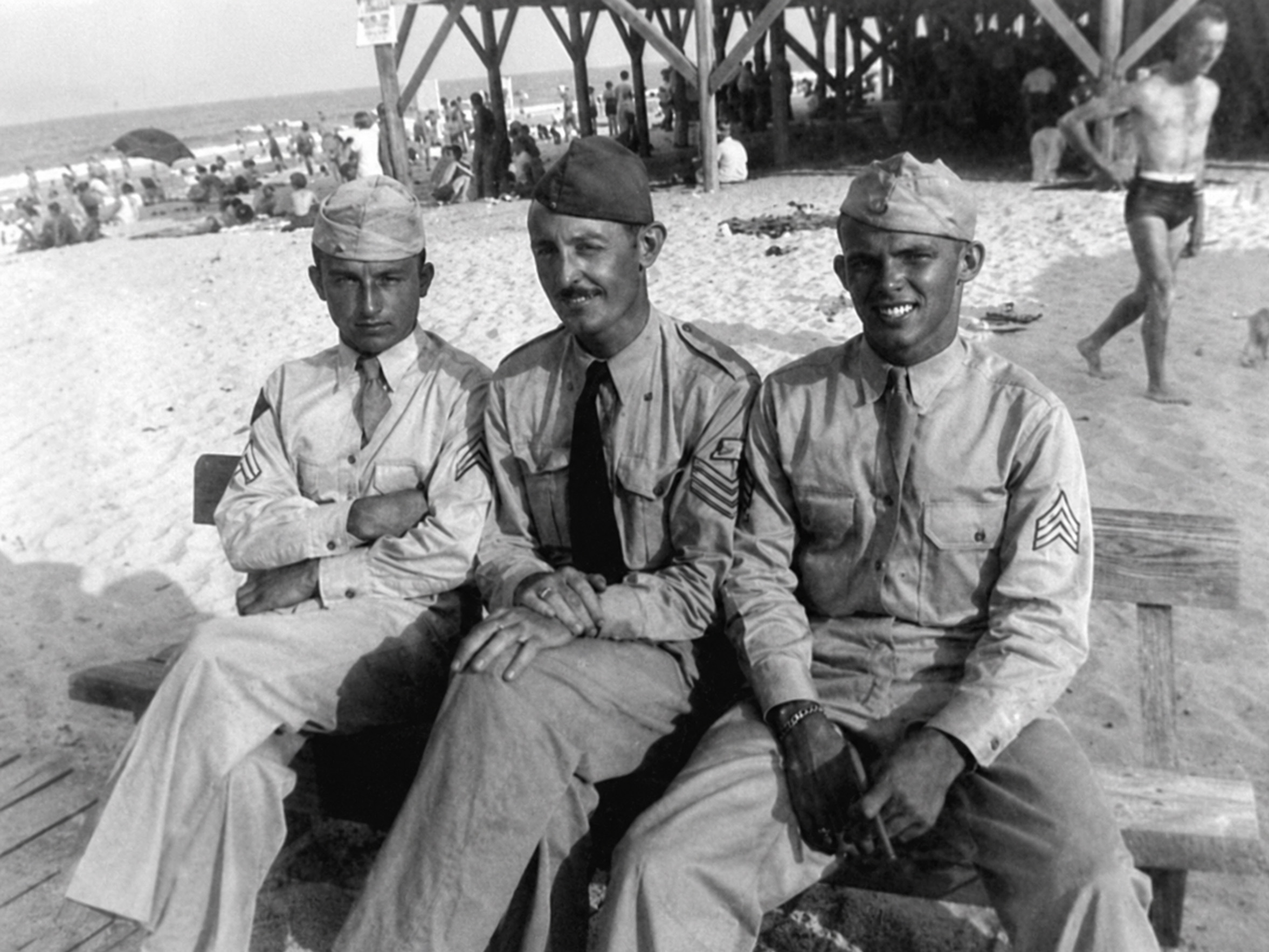
Photo: Johnny Lee Williams, right /

My wife, Michelle, with her grandfather, Johnny Lee Williams
Michelle’s paternal grandfather, Johnny Lee Williams (1925-2006), was only 15 when he enlisted in the U.S. Army in 1940. By the time he left the Army five years later, he had crossed much of Europe with the 83rd Infantry Division, been wounded three times, lost his right arm in combat and, according to his obituary, received decorations that included the Silver Star and three Purple Hearts.1
The prestigious Silver Star is the United States military’s third-highest award for valor in combat. It is given only for extreme bravery and fearless action while facing an enemy.
Nearly 60 years later, France remembered what he had done. On Feb. 18, 2005, Williams’ 80th birthday, representatives of the French government gathered with his family and friends at the Omni Bayfront Hotel in Corpus Christi, Texas. There, Williams was named a chevalier, or knight, of the French Legion of Honor for his role in the liberation of France during World War II.2
You can read more about that here.
It was a remarkable moment in a story that had begun eight decades earlier and includes a small contribution to Texas’ early country music scene.
From Texas to the Army
Williams was born Feb. 18, 1925, to Ivy Lee Williams (1898-1976) and Hattie Schaffer Williams (1903-1933). His 2006 obituary identifies his birthplace as Hallsville, Texas, although the Williams family spent considerable time in Oregon and elsewhere in the Pacific Northwest during Johnny’s childhood. His parents moved frequently in search of work. Hattie died of tuberculosis in 1933, when Johnny was only 8. He and his father continued moving before eventually returning to Texas.

In 1940, Williams, then just 15, enlisted in the U.S. Army. The United States was still more than a year away from entering World War II. He eventually became part of the 83rd Infantry Division, the unit with which he would fight across Europe.
The 83rd Infantry Division Goes to War
The 83rd Infantry Division arrived in Normandy shortly after the Allied invasion. The division landed on Omaha Beach on June 18, 1944, 12 days after D-Day, and began advancing into France.
The Germans still held much of Normandy, where sunken roads, thick hedgerows and fortified villages provided formidable defensive positions. The 83rd soon found itself in sustained combat as Allied forces fought their way out of the Normandy beachhead. Williams saw heavy fighting almost immediately. A wartime newspaper account reported that he was wounded twice on July 25 in Normandy, accounting for two of the three wounds he suffered during the war.
Williams fought in Normandy, northern France, Belgium and Germany and spent time in St. Malo, Cherbourg and Brest, France, among other places. The 83rd Division took part in the fighting around the heavily fortified port of St. Malo before eventually joining the Allied advance east across Europe.
By the winter of 1944-45, Williams had risen to technical sergeant and was serving as a platoon leader, an unusual level of responsibility for a noncommissioned officer. A contemporary newspaper account later reported that his leadership during the advance from France toward the German border earned him a battlefield promotion to second lieutenant.3
The Battle of the Bulge
By late December 1944, the 83rd Infantry Division had been thrown into another of the war’s most desperate battles. On Dec. 16, Adolf Hitler (1889-1945) launched a massive surprise offensive through the Ardennes. German forces drove into Belgium and Luxembourg, creating the great bulge in the Allied lines that gave the Battle of the Bulge its name.
The 83rd joined the Allied effort to halt the German offensive in late December. During the winter fighting that followed, Williams and his platoon endured one of the most remarkable episodes of his military service.
Williams’ battalion made a five-day stand in early January at a German border village identified in an article as Straub. Williams and his men were assigned defensive positions at the northern end of the village, which was surrounded by German forces on the first day and subjected to repeated attacks.
The fighting became so desperate that Williams’ men exhausted their American ammunition and began using captured German weapons and equipment. When their K rations ran out, they survived by foraging for food. After the German forces were finally repulsed, Williams’ platoon was credited with capturing 28 of the 90 German prisoners taken by the battalion.
Williams was seriously wounded during the fighting near the German border. A 2005 Corpus Christi Caller-Times account of his Legion of Honor ceremony provided additional detail about the wound that changed the rest of his life. Williams saw his men moving toward a minefield and raised his right arm to warn them to stop. His arm was struck and effectively shot off, but the newspaper credited his action with preventing his men from continuing into the minefield.
While recovering at Bushnell General Hospital in Brigham City, Utah, Williams received the lieutenant’s bars recognizing his battlefield promotion from technical sergeant to second lieutenant. A newspaper account specifically attributed the promotion to his leadership of an infantry platoon during the advance from France to the German border.

The Oregon Daily Journal, February 11, 1945, 10.
Williams received an honorable discharge in April 1945 when he was 20 years old.
Building a Life After the War
In the mid-1940s, Williams married Rose Lethie Hash, whose family lived in Oregon. They had two children: Sherry Williams (1946-present) and David Robert Williams (1948-present), Michelle’s father.
The marriage lasted only a short time, and on July 6, 1950, Williams married Ruby Hampton in Nueces County, Texas. Ruby had two children, Debbie and Cecil, from a previous marriage. Johnny and Ruby remained married until her death on March 13, 1982.

Johnny Williams with wife Ruby, Dave and his sister Sherry and Ruby’s daughter Debbie at the entrance of his business Superior Finance
The same year he married Ruby, Williams opened Superior Finance in Corpus Christi. He operated the company for more than half a century, from 1950 until retiring in 2003.

Williams also became part of South Texas’ growing country music scene when he purchased the Maverick Club on Corpus Christi’s North Beach at 5017 Timon Blvd.
Newspaper ads from the late 1950s and early 1960s for the club promoted dancing and live country and western music. The Maverick also attracted nationally known performers. Tex Ritter (1905-1974), one of country music’s great singing cowboys; Ernest Tubb (1914-1984), the pioneering honky-tonk star known as the “Texas Troubadour”; Ray Price (1926-2013), whose distinctive shuffle beat helped modernize country music; Buck Owens (1929-2006), who helped define the influential Bakersfield sound; and celebrated western swing steel guitarist Leon McAuliffe (1917-1988) all made frequent appearances at the club.
The Maverick also played a small but intriguing role in the development of the Bakersfield sound when 17-year-old Corpus Christi drummer Willie Cantu (1946-present) went to the Maverick to hear Buck Owens (1929-2006) and the Buckaroos. Cantu’s own band had been scheduled to alternate sets with Owens, but Owens decided the Buckaroos would play the entire evening.
“Hearing Buck, even though the club was pretty empty (no more than fifty people showed up), was a great experience for me because I did not know that country music could sound that good.”
Cantu later recalled, “Hearing Buck, even though the club was pretty empty (no more than fifty people showed up), was a great experience for me because I did not know that country music could sound that good.”4
Cantu had performed at the Maverick the previous night, when Buckaroos bassist Doyle Holly (1936-2007) and guitarist Don Rich heard him play. Holly got Cantu’s phone number and asked whether he might be interested in moving to California if an opportunity arose. A few months later, Cantu joined Owens and the Buckaroos, becoming part of the group most associated with the birth of the Bakersfield sound.

This past February, Omnivore Recordings released a vinyl version of “The Exciting Sounds of Buck Owens And His Buckaroos Live From Richmon, Virgina, 1964,” Buck Owens and the Buckaroos’ earliest known full concert recording. Willie Cantu is pictured in the center.
The Maverick continued attracting important performers. Less than a month after the Owens appearance, “Billboard” reported that steel guitarist Leon McAuliffe (1917-1988) and his Swingin’ Western Band were scheduled to play the Maverick on Dec. 13, 1963. McAuliffe had previously played with Bob Wills (1905-1975) and His Texas Playboys and was one of the best-known steel guitarists of the western swing era.

Johnny Williams in front of The Maverick Club after a flood; In 1959, the owner then complained to the Corpus Christi City Council that The Maverick Club was “nearly underwater.” She added that because there is no drainage, “the high tides and rain make the club nearly inaccessible.”5
Taken together, those connections prove that Williams’ club was more than a neighborhood bar. The Maverick was part of Corpus Christi’s active country music scene and a stage where local musicians and nationally known performers crossed paths.
Williams later sold the club, and it was destroyed by fire in April 1964.

Johnny Williams with Dolph Briscoe Jr. (1923-2010), the 41st governor of Texas. Briscoe won the governorship in 1972 and was reelected in 1974.
Many of Williams’ Superior Finance customers and employees, along with musicians and patrons he met through the Maverick, became lifelong friends. Around Corpus Christi, he was instantly recognizable by two trademarks: his Stetson hat and his ever-present cigar.

Johnny Williams in the office of Superior Finance with children Sherry and Dave
Jeannette Williams
Williams met Jeannette Queffelec Williams (1925-2020) in 1965 when she was working as a hostess at the Driscoll Hotel.
Her own story carried an interesting connection to his wartime past. Jeannette was born in Paris and grew up in Neuilly-sur-Seine, outside the city. She moved to the United States in 1956, became an American citizen in 1959 and settled in Corpus Christi in 1962.
Johnny and Jeannette married April 9, 1995, and remained together until his death.
Forty years after they first met, Jeannette would sit beside him as the country of her birth formally thanked him for helping liberate it.
France Remembers
In 2004, as France prepared to commemorate the 60th anniversary of D-Day, Williams was among 100 American World War II veterans invited to France to be honored. His health prevented him from making the trip. His great-nephew, Alain Havage, who lived in Geneva, Switzerland, was determined that his great-uncle’s service not be forgotten. Havage contacted the French government and asked that Williams receive recognition.
France agreed.
On Feb. 18, 2005, Denis Simonneau, France’s consul general in Houston, presented Williams with the insignia of a chevalier of the Légion d’honneur before his family, friends and local dignitaries at the Omni Bayfront Hotel.

The Legion of Honor was established in 1802 by Napoleon Bonaparte (1769-1821) and remains France’s highest decoration, recognizing distinguished military and civilian service. Simonneau told Williams that he had fought for values shared by France and the United States and assured him that France had not forgotten the Americans who fought for its liberation.
“I want to thank you and the people of France and Corpus Christi for such a wonderful thing,” Williams told those gathered as tears filled his eyes, according to the new coverage that day.
Jeannette’s reaction may have summed up the occasion best. She had been born in the country that her husband and millions of other Allied soldiers had fought to free.
“They saved France,” she said. “That is why we are all alive today.”
The honor placed Williams among an estimated 10,000 Americans who have received France’s Legion of Honor since its creation in 1802. Williams was appointed a chevalier, or knight, the first of the order’s five ranks. France bestowed the distinction on a select number of American World War II veterans that year in recognition of their role in liberating the country from Nazi occupation.
Johnny Lee Williams, 1925-2006
The Legion of Honor ceremony turned out to be one of the final great celebrations of Williams’ life.
Almost exactly a year later, on Feb. 23, 2006, Johnny Lee Williams died at his Corpus Christi home with his family beside him. He was 81.

Johnny Lee Williams was buried at Seaside Memorial Park in Corpus Christi
His obituary remembered the businessman, husband, father and friend. It mentioned the Stetson and cigar. It recalled Superior Finance and the customers and employees who became lifelong friends.
But it also preserved the story of a 15-year-old boy who entered the Army and returned home five years later having experienced more than most people encounter in a lifetime.
Johnny Williams landed at Omaha Beach with the 83rd Infantry Division. He fought across Europe. He was wounded three times. He lost his right arm trying to stop other soldiers from walking into a minefield. He came home, raised a family, built successful businesses and became a fixture in the community where he spent much of his adult life.
And six decades after the war, France made sure he knew that what he had done as a very young American soldier had not been forgotten.
Hopefully, we can remember his contributions as well.

Johnny Williams with son Dave and granddaughters Michelle (back row) and Trish
For more of my genealogy research, visit rscottwilliams.info.
- “Johnny Lee Williams,” obituary, Corpus Christi Caller-Times, February 26, 2006. ↩︎
- Sara Lee Fernandez, “French Honor Service of Local WWII Veteran,” Corpus Christi Caller-Times, February 2005, 14. ↩︎
- “Sargeant Given Lieutenant Bar,” The Sunday Oregonian, April 29, 1945, 16. ↩︎
- Sheree Homer and Jay McDowell, Dig That Beat! Interviews with Musicians at the Root of Rock ’n’ Roll (Jefferson, NC: McFarland & Company, 2015), 110–11. ↩︎
- “Operator of Maverick Club Complains Water Up Again,” Corpus Christi Caller-Times, September 24, 1959, 21. ↩︎


Leave a Reply