
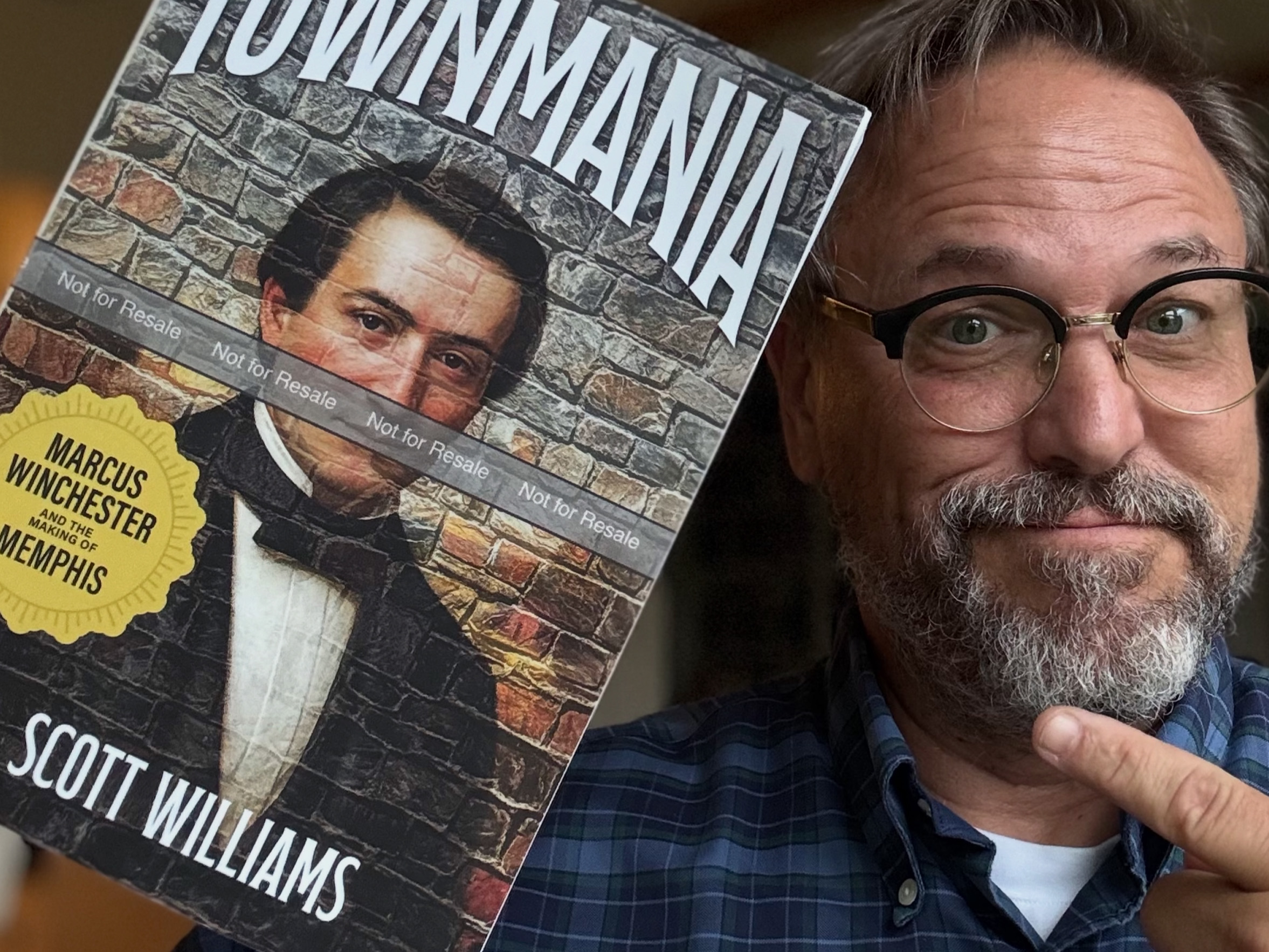
After three years of work, countless early mornings and late nights in front of my laptop and many weekends at numerous libraries, my biography of Marcus Winchester will soon be available on Amazon and in bookstores.

Memphis and Shelby County Room at the Mempis Public Library
For a man who played such an important role in the creation of Memphis, Marcus Brutus Winchester became surprisingly easy for the generations that came after him to overlook.

Portraits of early Memphis mayors at Memphis City Hall
His portrait hangs today with those of other former mayors in the Hall of Mayors at Memphis City Hall. But even that portrait is a reminder of how thoroughly Winchester has faded from public memory. When former Mayor James H. Malone led an effort in 1909 to assemble portraits of all the city’s previous mayors, no portrait of Winchester could be found. Artist S.D. Rogers of Walter Gray’s Studio in Memphis had to create one decades after Winchester’s death.

Winchester was buried in the Winchester Burying Ground in Memphis. In later years, a horse stable was reportedly built over the site of his grave, followed by a bus garage as the property was redeveloped. Over time, the cemetery itself fell into ruin. Today, no headstones or grave markers remain to identify Winchester or the others once buried there.
That obscurity was one of the things that inspired me to discover more about him.
The book is about Winchester, but it is also about beginnings — the beginning of Memphis, the beginning of West Tennessee as we know it and, in many ways, the beginning of a distinctly American city built around commerce, transportation, ambition and the Mississippi River.
Finding “Townmania”
The title, “Townmania: Marcus Winchester and the Making of Memphis,” came almost by accident.
I was at the Tennessee State Library and Archives going through microfilm of letters written by Winchester’s father, James Winchester, to his longtime business partner John Overton.
In an 1818 letter, James Winchester wrote, “I am satisfied the effects of townmania will not last always, and perhaps not long.”
I stopped when I saw the word.
“Townmania.”
It perfectly described what was happening across the young United States at the time and, in large part, what the book is about. Land speculators and entrepreneurs were laying out towns, advertising lots and trying to determine which tiny settlement might become the next great commercial center.

The founders of Memphis were caught up in that fever.
They knew opportunity would not wait forever. Other communities along the Mississippi River were competing for settlers, merchants and commerce. Memphis had to establish itself quickly.

Catching the Overton vibe at his home, Travellers Rest, in Nashville
John Overton became one of its great promoters. Reading his advertisements today, I was struck by how modern they sound. He sold Memphis using many of the same arguments economic development professionals use today: location, transportation, opportunity, quality of life and the potential for prosperity.
He wasn’t simply selling real estate. He was selling a dream.
A young man at a city’s beginning
One reason I wanted to write this book was that Winchester’s life allows us to experience Memphis when practically everything about the city was new.

Marcus Winchester and surveyor William Lawrence arrived by flatboat in 1819 and encountered a place that bore little resemblance to the city we know today. There were flatboat pilots, Native Americans, fur traders, merchants and settlers moving through a landscape that was still largely wilderness.
Travel itself was difficult and sometimes dangerous.
I have always been fascinated by that aspect of the early South partly because my own ancestors made the difficult journey from Bertie County, North Carolina, to Haywood County, Tennessee, in the early 1830s.
What was that actually like?

Researching Winchester gave me an opportunity to explore that question through firsthand accounts. Travelers described miserable roads, river journeys, stagecoaches bouncing over tree stumps and communities separated by miles of forest and swamp.
Against that backdrop, Winchester and the other early Memphians were trying to create a functioning city.
And Winchester seems to have understood very early that Memphis would succeed only if people and goods could get in and out of it.
He promoted roads, ferry crossings, steamboats and eventually railroads. That part of his story particularly fascinates me because it connects directly to modern Memphis. Today, Memphis is one of the world’s great logistics centers. The technology has changed dramatically, but the underlying advantage Winchester recognized more than 200 years ago remains the same: location.
The Memphis he lived to see
Somethng that seems to resonate with early readers is that each chapter begins with an advertisement from “Rainey’s Memphis City Directory” of 1855-56. The advertisements show just how far Memphis had come.
Less than 40 years after Winchester first arrived, the little settlement on the Fourth Chickasaw Bluff had become a bustling commercial city filled with businesses selling goods, feeding travelers, providing lodging and facilitating the enormous trade flowing through Memphis by river and road.
Winchester died in 1856.
Those advertisements seemed to me almost like evidence presented at the end of his life: The city he and others had imagined had become real.
The chapter titles also reflect another Memphis tradition. Each is named for a song.
Memphis has always told its story to the world through music. W.C. Handy, Elvis Presley, Al Green, The Staple Singers and countless others created music that crossed racial, cultural and geographic boundaries. Using songs as chapter titles allowed me to connect the Memphis of Winchester’s era with the city that emerged long after his death.
Slavery in Memphis
The deeper I got into Winchester’s life, however, the less interested I became in writing a conventional story about the heroic founders of a city.

Ad in “Rainey’s Memphis City Directory,” 1855-56
The real story was much more complicated.
Winchester moved comfortably among some of the most powerful White men in early Tennessee. His father was an influential military and political leader. Marcus was associated with men such as John Overton and Andrew Jackson and formed close friendships with figures including David Crockett, businessman Isaac Rawlings and reformer Frances Wright.

Visiting Craigfont, the home in middle Tennessee where Marcus Winchester was raised and where members of his family are buried
But his life also crossed boundaries that early Southern society was increasingly determined to enforce.
His first wife, Amarante Loiselle, was a free woman of color from St. Louis.
Amarante’s precise racial ancestry has not been established, but evidence and logic suggest her heritage included French, African and possibly Native American ancestry. But there is no question that Memphis society did not consider her White. And for that, Marcus and Amarante would pay a price.
That made their relationship extraordinary, especially for that time and place. Marcus publicly treated her as his wife. He transferred property to her, and together they raised eight mixed-race children.
For a time, they were apparently accepted as an influential Memphis family.
Then Memphis changed.
As the battle over slavery intensified and racial restrictions hardened across Tennessee, the Winchester family became increasingly vulnerable. In 1837, Memphis adopted an ordinance prohibiting a White man from “keeping” a woman of color as his wife. Winchester eventually moved his family outside the city limits to property known as Camp Muscogee, probably somewhere near what is now the Madison Avenue and Claybrook Street area in Midtown Memphis.
Amarante could be free, educated, financially secure and connected to one of the most influential families in Tennessee and still live in a society in which she and her children could never take their freedom entirely for granted.
Free Black and mixed-race people could be kidnapped and sold into slavery. Freedom existed, but it could be frighteningly fragile.
Why now?
I wanted “Townmania” published in time for an extraordinary series of anniversaries.

Poster celebrating Tennessee America 250.
May 28, 2026, marks the 230th anniversary of Marcus Winchester’s birth. June 1 marks 230 years since Tennessee became the 16th state. On Dec. 19, Memphis will mark 200 years since its incorporation.
And across the country, Americans will be commemorating the 250th anniversary of the Declaration of Independence.
Commemorative anniversaries give us the opportunity to examine what people built, what they destroyed, what they dreamed about, what they feared and what happened because of the choices they made.
Marcus Winchester helped build a river city.
He promoted transportation and commerce. He entered politics. He helped establish institutions. He befriended some of the most fascinating figures of his age. He built a family that challenged the racial boundaries of antebellum Tennessee. He experienced enormous success and equally remarkable reversals.
And then Memphis forgot him.
“Townmania: Marcus Winchester and the Making of Memphis” is my attempt to remember him — not as a statue or a civic hero, but as a complicated human being living through an extraordinary period of American history.
You can discover more about Marcus Winchester and the making of Memphis at the link below.
For more of my genealogy research, visit rscottwilliams.info.


Leave a Reply