
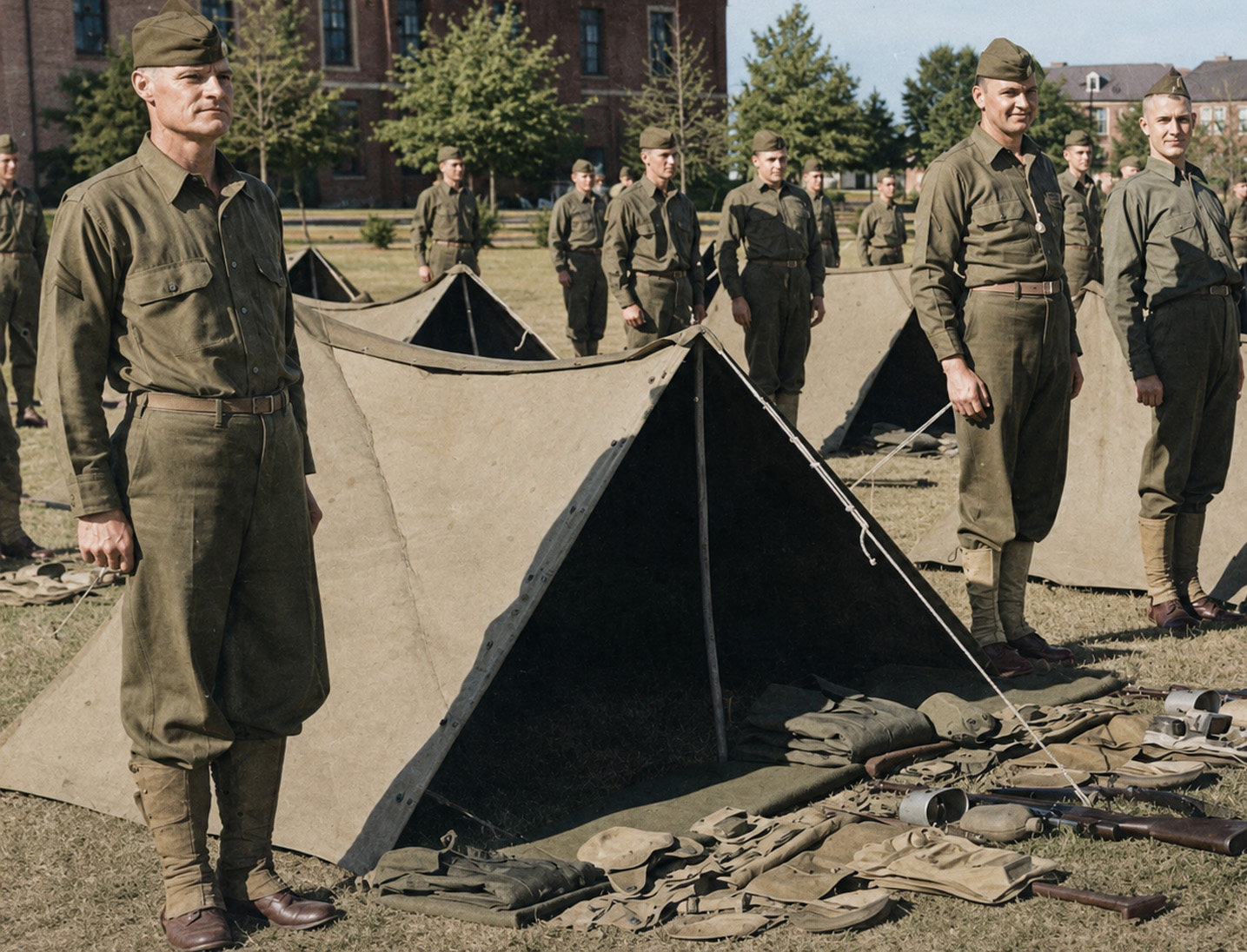
Photo: Aaron Samuel “Sammy” Castellaw, far left /
When I was a boy, my paternal grandmother, Elizabeth Castellaw Williams (1915-1998), often took me to cemeteries around Haywood County, Tennessee. As we walked among the headstones, she shared stories about our ancestors and helped me understand who they were and how they connected to me.

The headstone of Aaron Samuel “Sammy” Castellaw (1914-1945) always captured my attention. My grandmother did not remember much about him, but she knew he had been killed in action during World War II. Something about his story registered with me as a young man, and I often thought of Sammy when I ran across something relating to that war.

Haywood County Judge Roland Reid, and me.
Haywood County Judge Roland Reid and I share numerous ancestors, including Sammy Castellaw. Judge Reid recently allowed me to scan a collection of photographs, letters and documents about Sammy that had been preserved by a family member. He also gave me permission to share them here.
You can find a gallery of everything I scanned here.
Together, those materials tell a much fuller story about Sammy, his military service and the circumstances of his death.

Aaron Samuel “Sammy” Castellaw
Sammy was born Dec. 6, 1914, in Haywood County to John Frank Castellaw (1872-1941) and Martha Agnes Parlow Castellaw (1873-1961). John Frank was a brother of my great-grandfather, Robert Edward “Bob” Castellaw (1868-1954). That means Sammy and I were first cousins twice removed. I recently shared a little about the contentious divorce and custody battle of Sammy’s parents.

Aaron Samuel “Sammy” Castellaw; Photo credit: Sarah Jackson Conley
Sammy enlisted in the U.S. Army on Dec. 2, 1939, more than two years before the Japanese attack on Pearl Harbor brought the United States into World War II. He was stationed at Fort Benning, Georgia, where he helped train soldiers for infantry duty.1
On Feb. 8, 1941, Aaron married Vela Mae Goodson Castellaw (1912-1984) in Russell County, Alabama, across the Chattahoochee River from Columbus, Georgia. Vela had a daughter from an earlier marriage, Emma Geraldine Toler (1930-2003).
Aaron eventually became a technical sergeant and operations sergeant in Headquarters Company, 2nd Battalion, 7th Infantry Regiment, 3rd Infantry Division. The 7th Infantry, one of the Army’s oldest infantry regiments, was traditionally known as the “Cottonbalers.”
Sammy departed for France around July 1944 and was killed in action Jan. 30, 1945. He died exactly three months before Adolf Hitler (1889-1945) died by suicide and slightly more than three months before Germany’s surrender ended World War II in Europe on May 8, 1945.
The Colmar Pocket
Sammy was killed during the Battle of the Colmar Pocket, a brutal winter campaign fought in Alsace in northeastern France. The German-held pocket around Colmar represented one of the last substantial German positions west of the Rhine. American and French forces fought through snow, ice, flooded ground and heavily defended villages to eliminate it.
During the evening of Jan. 29, 1945, Aaron’s 2nd Battalion crossed the Colmar Canal and advanced toward the village of Wihr-en-Plaine as part of an assault sometimes identified as “Operation Krautbuster.” The Americans lacked immediate armored support because engineers had not yet completed a bridge capable of carrying tanks across the canal.
The men moved through snow-covered fields under moonlight, some wearing white sheets, blankets or mattress covers as makeshift camouflage. The apparent lack of German resistance made battalion officers uneasy. Their concern proved justified. One private later wrote:
“As the men moved cautiously, everything seemed uneasy. … There was an eerie silence, broken only by the crunching of boots on the snow and the whispering American shells overhead.’ Maj. Jack Duncan, the 2nd Battalion commander, also experienced apprehension. ‘It was too easy,’ he said. ‘I felt like we were walking into something.’”2
Near Wihr-en-Plaine, German infantry and armored vehicles opened fire on the exposed Americans. Later accounts describe German Jagdpanther tank destroyers firing high-explosive shells and machine guns into the advancing infantry and the battalion headquarters group. Soldiers trying to take cover found the frozen earth nearly impossible to dig.3
Sammy, as operations sergeant, was in charge of the battalion’s Observation Post Group. According to a surviving account, the group consisted of a wire team, a radio team and three bazooka teams, the personnel and equipment necessary to maintain communications and direct battlefield observation.4

Sammy’s wife, Vela, later wrote to the Army seeking more information about her husband’s death. Battalion clerk Peter S. Stavros (1924-2012), who had been near Aaron during the fighting, answered her in a letter dated May 29, 1945.
Stavros explained:
“While leading the Observation Post Group across an open field towards the town, three German tanks outflanked them and cut off the Observation Post Group from the rest of the battalion. Direct enemy tank and machine gun fire caused many casualties and one shell exploded very near to Sgt. Castellaw.”
Stavros assured Vela that Aaron’s death had been “instantaneous and without pain.”
He continued:
“Being in the wire section at the time, I came to know Sgt. Castellaw quite well. He was always cheerful and well-liked by all the members of this organization. I am sure T. Sgt. Castellaw will long be remembered for his spirit, courage and devotion to duty. His loss was keenly felt by all of us.”⁸
Stavros described three German tanks, while later battle histories generally refer to two Jagdpanther tank destroyers in the initial attack near Wihr-en-Plaine. The accounts may describe different phases of a confused engagement or reflect the difficulty soldiers had identifying enemy vehicles in darkness, snow and heavy fire. Both accounts agree on the essential facts: German armored vehicles struck Aaron’s exposed group, causing numerous casualties, and an exploding shell killed him.
I was curious about what became of Stavros after the war. He had joined the Army in 1943 at 19 and served with the 2nd Battalion, 7th Infantry Regiment, in North Africa, Italy, France, Germany and Austria.
Stavros received two Bronze Star medals, a Purple Heart, five campaign stars, two Presidential Unit Citations and the French Fourragère for the regiment’s service with the French First Army. After returning home, he owned and operated the Redwood Restaurant in Rockford, Illinois, and served as president of the Rockford Restaurant Association. He died May 9, 2012, at 88.5
His letter could not erase the Castellaw family’s grief, but his description of Aaron as cheerful, courageous and devoted to duty must have provided some comfort. It also preserved something that an official casualty notice or cemetery marker could never communicate: a fellow soldier’s memory of the kind of man Aaron had been.
A letter home

Among the documents Roland shared was a heartbreaking letter to Aaron from his mother. Agnes Castellaw had written it without knowing that her son had already been killed. The letter was returned undelivered.
| To: T/Sgt. A. S. Castellaw Hq. 2nd Bn., 7th Inf. Regt. APO 3, P.M. New York, N.Y. From: Mrs. Agnes Castellaw R-3, Bells, Tenn. Jan. 28, 1945 Dear darling sweet boy, As I am thinking of you so much of late, will write you a few lines. I am well. I am at home, and Mary Grace is staying with me tonight, and Ethel is not at home. I do hope you are well. I got your letter of 12th of Dec., but I am still writing to you. Have written to you several times since I got your last letter. Hope you get all of my letters. Charles Ray, I heard, is in the hospital. Mag Watridge and Champ have moved close to Holly Grove. All of the family are well. I got a letter from Billie. I was so glad to get it. Guess you hear from her often. I told you Tommy is going to move out near Centerville schoolhouse. Well, your letter was sweet to me, but sad to know you are fighting, or in the fighting. I wish I could help you in some way. I can only pray and trust in God to care for you. May He take care of you, for He is all that can. You are a sweet darling good boy, and was so good at home. I will be writing to you again. Write when you can. Love, Mother |
She filled it with ordinary family and neighborhood news — the kind of news a mother hoped would briefly carry her son home from a battlefield thousands of miles away. Among the updates, she wrote, “Mag Watridge and Champ have moved close to Holly Grove.”
She was referring to Maggie Noel Castellaw Watridge (1880-1969) and her husband, Champ Conner Watridge (1875-1959). A few years later, my paternal grandparents purchased that very house on Poplar Corner Road from Champ. My father grew up there, and my grandparents continued living in the house until their deaths.
Returned to Haywood County
Sammy’s remains were eventually returned to Tennessee and taken to the home of his brother, James Francis Castellaw (1908-1989), before the funeral. Military services were conducted at Zion Baptist Church, and Aaron was buried at Holly Grove Baptist Church Cemetery.
The obituary reads as follows. I have retained the names and wording from the historical transcription while making only minor corrections to spacing and punctuation:
| Tech. Sgt. Aaron Sammy Castellaw Obituary Military services for Sgt. Aaron S. Castellaw were held at Zion Baptist Church near Brownsville Sept. 16 at 2 o’clock. Sgt. Castellaw was killed overseas Jan. 30 after nine years’ service in the Army. He had been overseas six months at the time of his death. Sgt. Castellaw was born Dec. 6, 1914. He is survived by his wife; mother, Mrs. Agnes Castellaw of Bells; four sisters, Mrs. W.C. Bailey, Mercer; Mrs. Jack Stewart, Bells; Mrs. George Yearwood, Alamo; Mrs. Finis Watridge of Brownsville; three brothers, Tommy and J.F. of near Brownsville and Malcolm Castellaw of Bells; and other relatives. Burial was at Holly Grove in Haywood County. |
I found no evidence that Vela remarried after Aaron’s death. Available records continued to identify her by the Castellaw surname. She died Oct. 16, 1984, in Muscogee County, Georgia, at 72 and was buried in Parkhill Cemetery in Columbus.6

The Columbus Ledger, April 20, 1945, 10.
Sammy was only 30 when he died in a frozen field outside a small French village. For most people, his life is now represented by an inscription on a stone in rural Haywood County.
But the photographs and letters preserved by his family reveal more. He was a son whose mother wrote to him about the neighbors. He was a husband whose wife needed to know how he died. He was an operations sergeant responsible for the communications and observation teams supporting an infantry battalion. And to the men who served beside him, he was cheerful, well-liked and remembered for his “spirit, courage and devotion to duty.”
That is the Sammy Castellaw I will think about the next time I visit his grave.
- A Tribute to the Veterans of Zion Baptist Church (privately compiled booklet, n.d.), 21-22; War Department, World War II Honor List of Dead and Missing Army and Army Air Forces Personnel from Tennessee (Washington, D.C.: War Department, 1946), Haywood County section. The church booklet confirms Aaron’s birth, death, parents, rank and unit, although it contains several typographical errors elsewhere in the entry. ↩︎
- Clinton W. Thompson, “Hell in the Snow: The U.S. Army in the Colmar Pocket, January 22–February 9, 1945” (master’s thesis, University of Texas at Tyler, 2017), 72–73. ↩︎
- Ibid. ↩︎
- Musée Mémorial des Combats de la Poche de Colmar, “Joseph Louis Bale III, 1924-1945,” digital exhibit, accessed Aug. 6, 2026. The account describes the 2nd Battalion’s canal crossing, advance on Wihr-en-Plaine and encounter with German Jagdpanther tank destroyers on the night of Jan. 29-30, 1945. ↩︎
- “Peter S. Stavros, 88,” obituary, Asbury Park Press, May 12-14, 2012. ↩︎
- “Vela Mae Castellaw,” obituary, Ledger-Enquirer (Columbus, Georgia), Oct. 18, 1984. ↩︎


Leave a Reply