
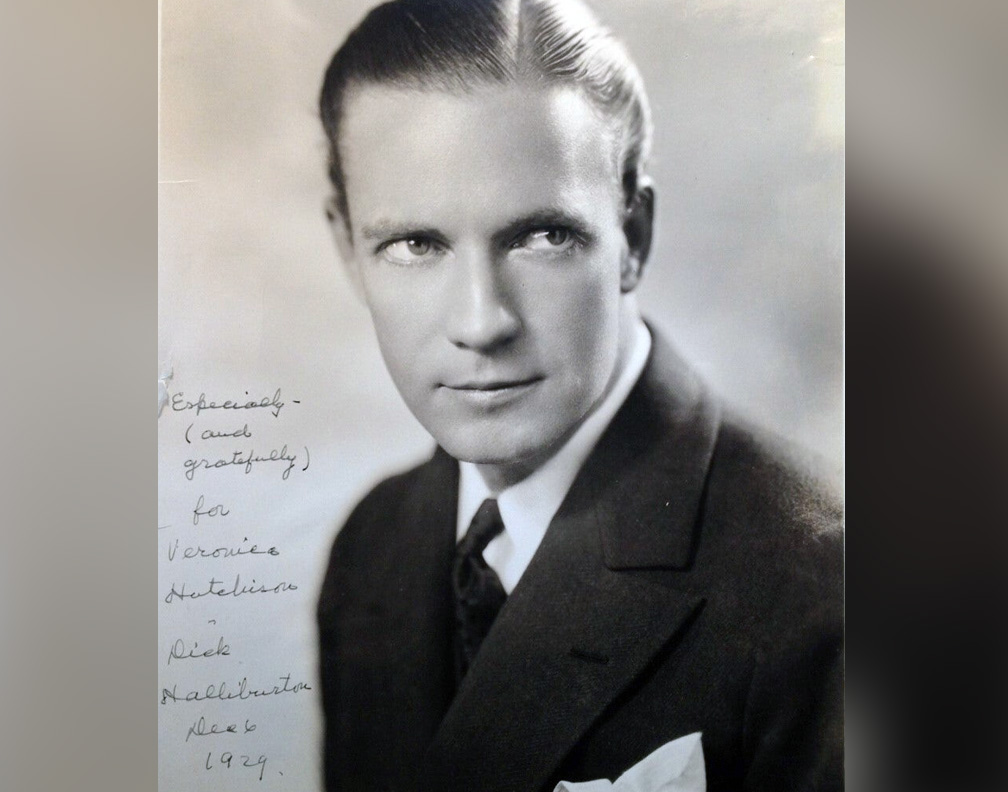
Richard Halliburton (1900-1939) may be the most famous person born in Haywood County, Tennessee, whom almost no one remembers.

For a brief, bright stretch during the Jazz Age and the years that followed, Halliburton ranked among the best-known adventurers in the world. He swam the Panama Canal, slept on top of the Great Pyramid of Giza, followed the path of Odysseus around the Mediterranean, dove into the “Mayan Well of Death” at Chichen Itza, crossed the Alps on an elephant and climbed Mount Fuji. His books sold widely, his lectures drew crowds and his name appeared in newspapers around the world. Then, less than a century later, he had nearly vanished from public memory.
That makes his Haywood County connection especially interesting to me.
In the 1900 Haywood County census, all eight of my great-grandparents were living in the county. William Lafayette “Will” Williams (1888-1962) appears to have been living with his aunt and uncle, while his future wife, Janie Elizabeth Williamson Williams (1887-1914), was 13 and living with her family in the Providence community. William Day “Willie” Brantley (1897-1969) was 3, and his future wife, Allie Ern Marbury Brantley (1898-1995), was only 2. James Luther “Jim” Lovelace (1885-1968) was a young teenager at 15, while his future bride, Ruby Fowler Lovelace (1887-1952), was 13. Robert Edward “Bob” Castellaw (1868-1954) and Zula Zera Watridge Castellaw (1875-1940) were already in their early 30s and had recently buried an infant daughter.
A few miles away, in Brownsville, the county seat, Wesley Halliburton (1870-1965) and Nelle Nance Halliburton (1869-1955) were boarding in the home of Richard G. Thomas. With them was their infant son, Richard, born Jan. 9, 1900. A historical marker in Brownsville now notes his birthplace and the worldwide reach of his short, spectacular life.
According to Carolyn Crum’s 2005 article in “MUS Today,” Wesley Halliburton moved the family from Brownsville to Memphis after hoping to profit from buying and selling land in Arkansas. The gamble nearly ruined the family before the sale of timber on some of Wesley’s land changed their fortunes and made them wealthy.
By 1910, the Halliburtons had added a second son, Wesley Halliburton Jr. (1903-1918), and were living in Memphis. Richard was 11. His brother was 7. The boys received some of their earliest teaching from Mary Grimes Hutchison (1872-1962), founder of Miss Hutchison’s School for Girls, who lived with the family and remained close enough to the Halliburtons that she was buried in the family plot at Forest Hill Cemetery.

Richard Halliburton paid the lowest ever Panama Canal transit fee: 38 cents to swim the length and locks in 1928.
Richard attended Memphis University School, but illness interrupted his schooling when he was 15. He later finished prep school at Lawrenceville in New Jersey and enrolled at Princeton University. While still a student, he ran away to Europe. He told his parents he was going to Brownsville, went to New Orleans instead, sent them a telegram telling them not to worry, worked his way across the Atlantic as an ordinary seaman and spent the next six months wandering through Europe. He returned to Princeton, finished his studies and discovered what he intended to do with his life. He would travel, take risks and write about it.

After much editing, Halliburton’s first book, “The Royal Road to Romance,” appeared in 1925. It became a huge bestseller and turned him into a celebrity. More adventures followed. So did more books, magazine articles, radio appearances and lectures. At the height of his fame, Halliburton moved through the same cultural world as movie stars, writers and aviators. He belonged to an age that celebrated daring, speed, youth, glamour and publicity. He understood all of it.
His later books turned travel into performance. In “The Glorious Adventure,” he followed the Mediterranean route of Odysseus. In “The Flying Carpet,” he and pilot Moye W. Stephens, circled the world in an open-cockpit biplane. In “Seven League Boots,” Halliburton described dining with Emperor Haile Selassie in Ethiopia, interviewing one of the men connected to the death of Czar Nicholas II, trying to enter the forbidden city of Mecca and riding an elephant across the Alps in imitation of Hannibal.
Halliburton also wanted the kind of fame enjoyed by movie stars such as Rudolph Valentino (1895-1926), Douglas Fairbanks Sr. (1883-1939) and Ramon Novarro (1899-1968). That ambition led him into the film “India Speaks.” The project did not help his reputation. The film mixed actual travel footage from India with staged scenes shot in Hollywood, and reviewers found the combination awkward. No complete print of the film is known to survive.
Although Halliburton made a great deal of money, he spent just as freely. Travel, publicity, entertaining and his bohemian lifestyle all cost more than even a successful writer and lecturer could comfortably support.

Near the end of his life, he commissioned architect William Alexander Levy (1909-1997) to design a modernist house in South Laguna, California. The house became known as Hangover House, partly because it stood dramatically on the edge of a cliff. The building remains one of the most unusual physical reminders of Halliburton’s taste for spectacle, risk and theatrical living.
By 1939, Halliburton needed money and attention. He planned one more grand adventure. He would sail with his partner, Paul Mooney and a number of young men who had paid for the privilege, from Hong Kong to San Francisco in a Chinese junk called the Sea Dragon. The plan was to arrive during the Golden Gate International Exposition. He had the vessel built for the trip, gathered a crew and set out across the Pacific.
The voyage soon became desperate. In late March 1939, after nearly three weeks at sea, the Sea Dragon encountered a typhoon. On March 24, the vessel sent a final radio message to the SS President Coolidge. The message ended with the words, “having wonderful time. Wish you were here instead of me.” No one ever heard from Halliburton or the crew again. In October 1939, a Tennessee chancery court declared him legally dead.

Halliburton’s grave at Forest Hill Cemetery in Memphis is empty. The family plot includes Wesley, Nelle, Wesley Jr., Richard and Mary Hutchison. Nearby, a plain marker identifies Richard Halliburton as lost at sea.

Rhodes College also preserves his memory. The Richard Halliburton Memorial Tower, given by his parents, was dedicated Oct. 17, 1962. The tower is listed on the National Register of Historic Places, and the campus remains one of the best places in Memphis to encounter the name of the once-famous adventurer from Brownsville.

In Brownsville, the historical marker does what good markers should do. It stops us long enough to remember that someone who began life in a small West Tennessee town once became one of the most famous travelers on earth.
Richard Halliburton chased horizons for a living. He turned travel into theater, risk into literature and himself into a brand before most people understood what that meant. He flew too close to the sun, as the Rhodes plaque suggests, but for a little while, the whole world watched him burn bright.
For more of my genealogy research, visit rscottwilliams.info.
| UPDATE: Inspired by this blog post, I wrote a biography of Richard Halliburton—my first book—that was published by The History Press in 2014. More about “The Forgotten Adventures of Richard Halliburton: A High-Flying Life from Tennessee to Timbuktu.” |


Leave a Reply