
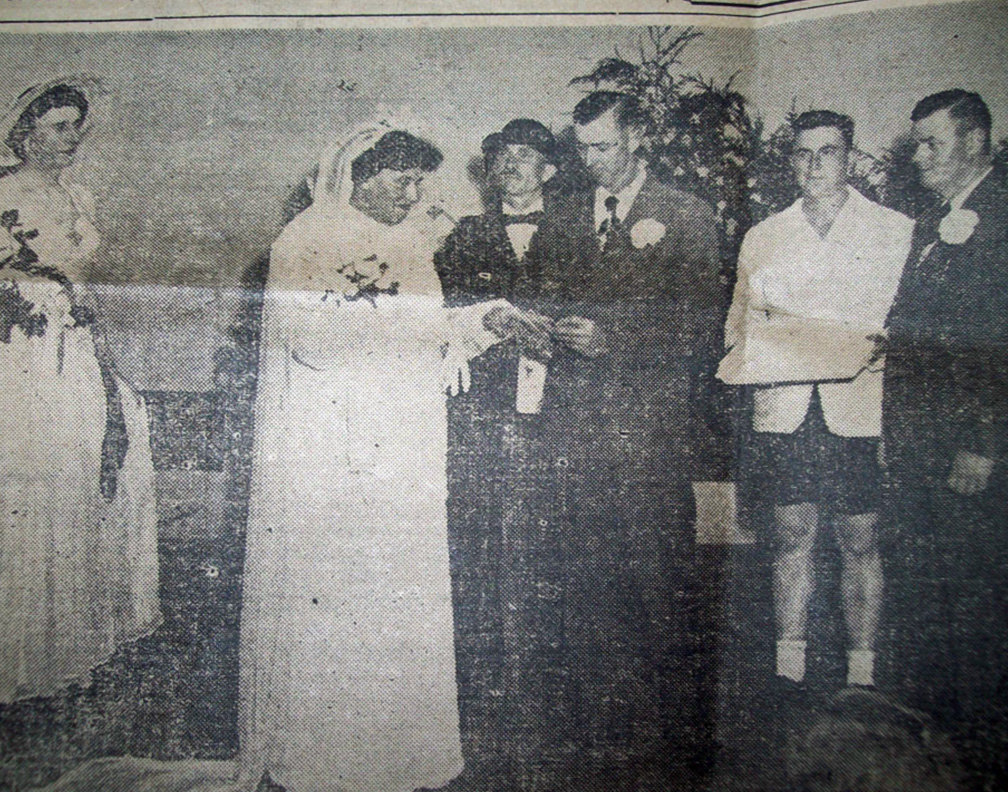
My cousin Sandra sent me this photo from The Brownsville States-Graphic. It shows my grandfather, Jesse Lloyd “Bo” Williams (1910-2008), dressed as a minister and looking a bit like Charlie Chaplin. Her grandfather, Bear Mann (1902-1966), was the bride in the wedding.
The caption under the photo is: Nuptial Headliners – Playing top roles in the femaleless nuptial ceremony performed at Holly Grove Consolidated School Friday night. left to right, were Carlyle Williams, bridesmaid; Abner “Bear” Mann, bride; Everett Wateridge, groom; Curtis Williams, ringbearer; “Sonny Boy” Williams best man; and Lloyd “Bo” Williams, officiating minister. (Photo by Charles Worley).
I remember exactly where the photo from that day hung in my grandparents house.

At first glance, the photograph of the event itself looks like nothing more than small-town play. But the more I looked into it, the more I discovered this was part of a once-common American tradition known as a “womanless wedding.”
These mock weddings, often performed by men dressed as brides, bridesmaids, mothers of the bride and other female characters, became popular in the late 19th and early 20th centuries as fundraisers for churches, schools, civic clubs and community causes. This particular event was a fundraiser for the Holly Grove School.

Many of those in the photo are from my family tree.
You can tell from the faces of the children in the audience they find the whole thing hilarious. The humor came from the perceived juxtaposition. Men who normally performed authority, respectability and masculinity in public suddenly appeared in wedding dresses, veils, makeup and exaggerated feminine roles. NPR described the old photographs as scenes of “bearded brides and deep-voiced flower girls,” and historian Craig Thompson Friend called the womanless wedding a “ritual of inversion.” 1 These events temporarily turned community rules upside down, but they usually did so in a way that made the rules feel safe again. As Friend put it, “even as it reversed and violated the ideal, the womanless wedding replicated and buttressed reality.”
That is the part that makes this photograph more interesting than it first appears. A man in a dress did not necessarily challenge the social order in these performances. In many cases, it reinforced it. The joke worked because everyone knew the men would return to their expected roles when the curtain came down. North Carolina State University’s “The State of History” project argues that womanless weddings let leading male figures parody women and heterosexual norms because white men held so much cultural authority in the early South that “since they set the rules, there was no harm in their playing with them.” 2
That does not make the photograph less funny. It makes it more revealing.
A womanless wedding gave rural and small-town communities a chance to laugh at gender expectations, courtship, marriage, class, respectability and the public behavior expected of men and women. The events also raised money and brought people together. A century ago, people would often pay admission just to watch prominent local men make fools of themselves and each other. One 1936 script quoted by Orleans County Historian Matthew Ballard has the minister charging extra “for having to look at the bride all during the ceremony.” 3
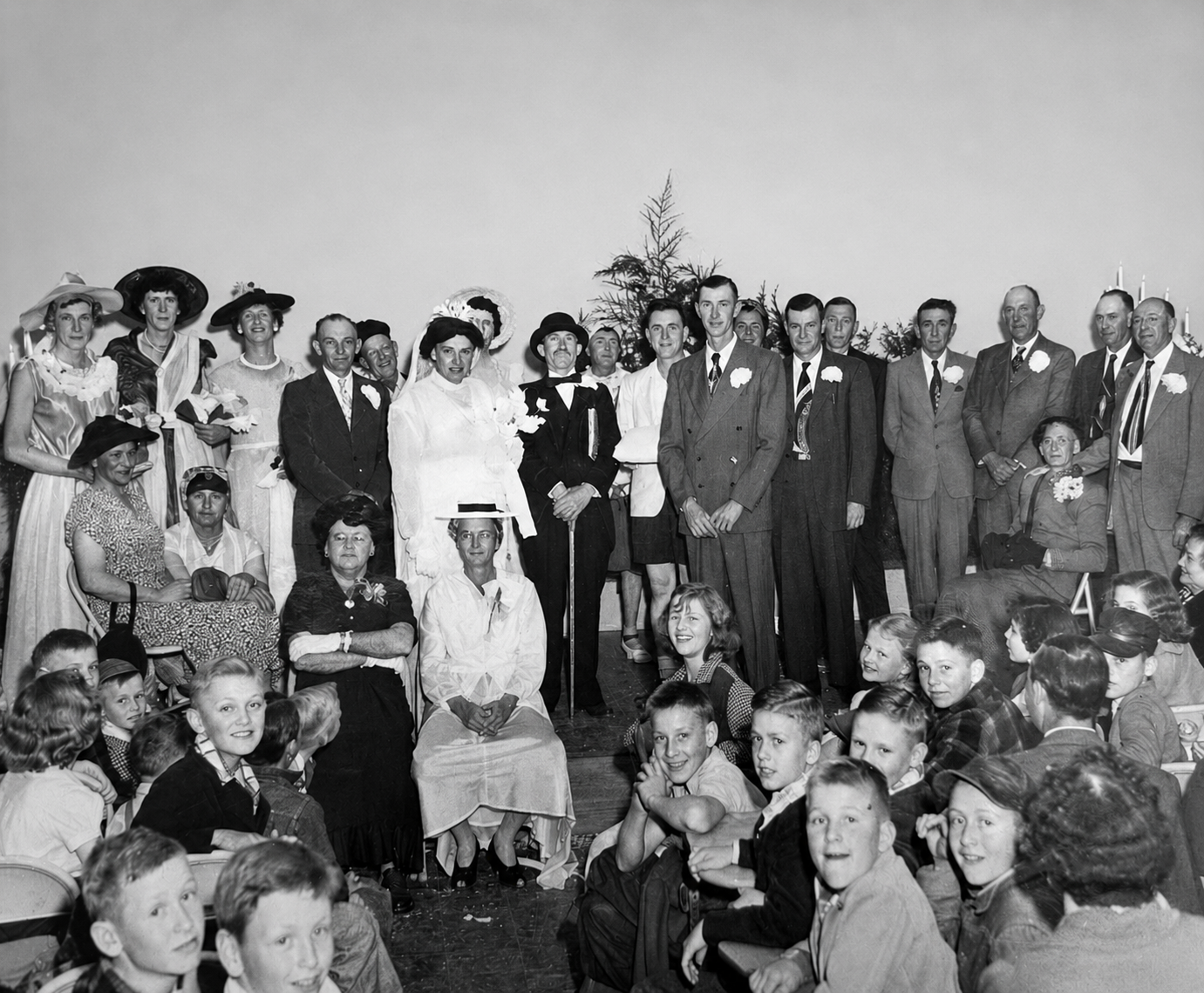
The large version of this photo is even more interesting to me. In addition to showing a group of Haywood County men dressed as women in a school lunchroom, it is also the first photo I have of my parents together.
My father is the boy in the lower left wearing a black shirt and looking at the camera. My mother is sitting next to him.
That was more than 62 years ago.
What looked at first like a funny old newspaper clipping turned out to be a record of how people gathered, laughed, raised money, tested boundaries and still managed, unknowingly, to leave behind the first image of two people whose lives would later become my own family history.
For more of my genealogy research, visit rscottwilliams.info.
- Linton Weeks, “When ‘Womanless Weddings’ Were Trendy,” NPR, June 16, 2015. ↩︎
- “Playing with Gender: Cross-dressing and the Womanless Wedding,” The State of History, North Carolina State University, accessed May 24, 2026. ↩︎
- Matthew Ballard, “Men Dressed Up as Brides in Popular Fundraisers a Century Ago,” Orleans Hub, May 30, 2020. ↩︎


Leave a Reply