
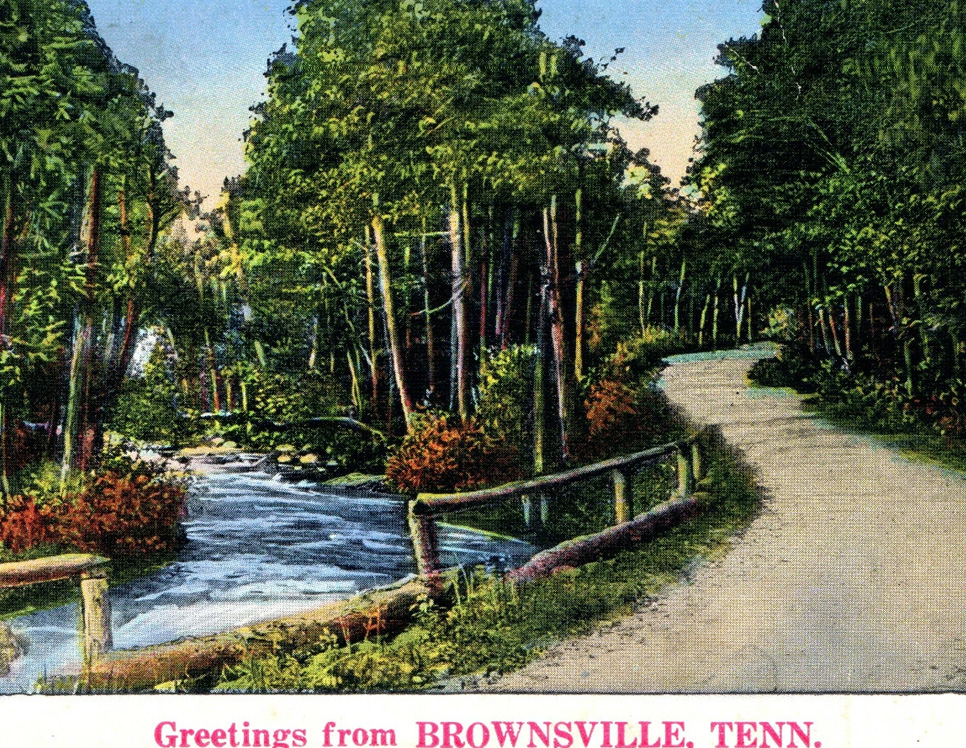
I have driven along Poplar Corner Road east of Brownsville many more times than I can count. Until I began researching the earliest history of Haywood County, I never paid much attention to the narrow stream passing beneath the road near the house of my late grandparents Guy and Virginia Lovelace.

View of Nixon Creek from Poplar Corner Rd. today
Today, Nixon Creek is little more than a narrow stream, marked only by a small, rusted sign beside the road. Before widespread clearing, ditching and agricultural drainage reshaped the landscape, tributaries such as Nixon Creek carried more water, especially during wet seasons, and played a far more important role in the region’s transportation, settlement and daily life.
Somewhere along the creek, Col. Richard Nixon (1769-1831) built the log house where Haywood County’s first government met. Nixon had arrived to his new home in West Tennessee in 1821, only three years after the Chickasaw Nation ceded the region to the United States. He settled along the creek and opened his home to travelers and other settlers. When Tennessee created Haywood County in 1823, Nixon’s house became its first courthouse.
Early life in North Carolina
Richard Nixon was born Jan. 26, 1769, in New Hanover County, North Carolina, to Capt. Thomas Nixon Sr. (1746-1782) and Christian Williams Nixon (1746-1831).
Thomas Nixon served as a captain in the 8th North Carolina Regiment of the Continental Army during the Revolutionary War. He received his commission Nov. 28, 1776, and resigned Sept. 20, 1777. He died July 2, 1782, in New Hanover County, leaving Richard without his father at age 13.1
Records connect the Nixon family’s West Tennessee property to Thomas Nixon’s Revolutionary War service. The principal tract was granted to the heirs of Thomas Nixon and divided among several family members.
On May 24, 1793, Richard Nixon married Ann Worth Jacocks Nixon (1775-1810) in Bertie County, North Carolina.2

James Alonzo Jacocks (1864-1941) and his wife, Mary Jennie Castellaw Jacocks (1866-1946), with their children, about 1894. James’ grandfather, Jonathan Thomas Jacocks, followed his uncle by marriage, Richard Nixon, to Haywood County in 1823. The Jacocks family remained in the county, where James was born in 1864. Mary Jennie was a sister of my great grandfather, Robert “Bob” Castellaw (1868-1954).
Ann was a daughter of Jonathan Jacocks (1718-1787) and Elizabeth Hill Jacocks (1719-1785), members of an established Bertie County planter family. You can find my blog about Jacocks here. The marriage is likely what led a large number of the Jacocks family to migrate to West Tennessee. Correspondence preserved in the Jonathan Jacocks Papers at the University of North Carolina documents continuing relationships between family members in Bertie County and Haywood County.
Ann died March 18, 1810 at age 35, leaving Nixon with several children. He later married Mary Whitmell Pugh.
The identities of all Nixon’s children are difficult to determine. A sheriff’s sale published in 1833 names Richard Williams Nixon (1799-1881), Thomas S. Nixon, Jonathan Nixon (1802-1835), Eliza Perkins, John P. Perkins, John Nixon, William Nixon, James Nixon and Jane Nixon among those who inherited interests in his property. Of course, not everyone named was a child, spouse or descendant of Nixon.³
One well-documented son, the Rev. Richard W. Nixon (1799-1881), later became a Baptist minister in Middle Tennessee. A late 19th-century biography said Richard worked in his father’s mercantile business after coming west in 1821 before returning to Montgomery County, Tennessee.3
Legislator and militia officer
Before moving to Tennessee, Nixon was active in North Carolina politics. Documents place him in the House of Commons in 1801 and serving as a representative from New Hanover County in 1805 and 1806. He represented the county in the North Carolina Senate in 1816.⁵
Nixon also served during the War of 1812. Muster rolls identify him as a lieutenant colonel in the Third Regiment of North Carolina’s detached militia. The regiment drew men from New Hanover, Brunswick, Bladen, Onslow, Columbus and surrounding counties.
The opening of West Tennessee
The land Nixon entered in 1821 was part of the Chickasaw homeland. Chickasaw people had hunted, traveled, traded and maintained communities throughout the region for generations.
Under the 1818 treaty that came to be called the Jackson Purchase, the Chickasaw Nation ceded nearly 6 million acres in present-day West Tennessee and western Kentucky. The United States agreed to pay $20,000 a year for 15 years, totaling $300,000. The agreement was negotiated under intense pressure from future president Andrew Jackson who made it clear to the Chicaksaw leaders who were negociating the treaty that white settlement would continue regardless of Chickasaw objections.4
Three years later, Nixon traveled from North Carolina into the newly opened Western District of Tennessee.
Author Joseph S. Williams (1815-after 1878) described the journey in his 1873 book, “Old Times in West Tennessee:”
“Col. Richard Nixon blazed out his course and cut his own road from the settled vicinity of Jackson, to where he pitched his tent, on the creek which took his name, three miles east of Brownsville. The red men of the woods were encamped on the same creek—the noble Chickasaws—with whom he cultivated kindly relations, and for many weeks shared with them the hospitalities of their camp.”5
Williams published his account in 1873, more than 50 years after Nixon’s arrival, and described his book as “semi-historic.” I look at his accounts as a combination of history, oral tradition and entertainment rather than fact.
Nevertheless, the principal elements of his account are consistent with other sources. Nixon arrived in 1821, settled along the creek 3 to 4 miles east of present-day Brownsville and established his new home and farm.
Because hunters, traders and Native Americans had entered the region before him, Nixon is best described as the first documented permanent settler in what became Haywood County. He did not enter completely unoccupied land; members of the Chickasaw tribe, fur traders and others were still traveling through the region, especially along the waterways.

Historic marker located on Brownsville’s Court Square
Nixon’s home and plantation
Nixon established his residence along what became known as Nixon Creek. Later histories frequently describe the dwelling as a log cabin. One historical study described it as a 28-by-33-foot log house.
His obituary, however, called it a “hospitable mansion.” The description suggests that Nixon’s home became more substantial than the primitive cabin I think of when researching my ancestors. The residence had to accommodate Nixon’s large family, travelers, business associates and meetings of county officials. The estate sale notice published after his death also referred to it as “a plantation with multiple outbuildings.”
The Tennessee General Assembly established Haywood County on Nov. 3, 1823. The county was named for Judge John Haywood (1762-1826), a North Carolina-born jurist who became an important Tennessee judge and historian.
The act establishing the county directed that its courts meet at Richard Nixon’s house until a permanent location could be provided.6
The first Haywood County Court of Pleas and Quarter Sessions assembled at Nixon’s residence March 8, 1824. The date was the second Monday in March, the day designated in the act creating the county. County histories identify Nixon as chairman of the court. Brittain H. Sanders served as clerk, John G. Caruthers served as sheriff and Jonathan Thomas Jacocks served as ranger.
The court continued meeting there while Brownsville was laid out and a courthouse was constructed. Nixon also participated in the planning of the new county seat and became one of the community’s principal civic leaders. At an Independence Day observance around 1830, one official reportedly offered a toast to Nixon as “President of the Day, first settler and most prominent citizen.”
Merchant and river landing operator
Nixon became one of the region’s earliest merchants. He established a store and landing on the Hatchie River, several miles from his home on Nixon Creek.
The business placed Nixon in a strong position as settlers poured into West Tennessee. Newcomers needed livestock, tools, seed, food, cloth and household supplies. Farmers needed warehouses and river landings where cotton and other products could be loaded onto boats for transportation to larger markets.
Herndon Haralson observation

Herndon Haralson (1757-1847), a Revolutionary War veteran, planter and politician, described Nixon’s landing in an April 12, 1825, letter.7 He said it was on the Flowers tract, about 3½ to 4 miles from Brownsville, and he praised both the road and the site’s potential for steamboat navigation. The development of river transportation helped connect the new settlement to Memphis and New Orleans by navigating a flatboat down the Hatchie River to the Mississippi River.

Approximate location of Richard Nixon’s store and landing
Where exactly was the store and landing? They appear to have stood at or near the site later known as Brownsville Landing on the north bank of the Hatchie River. A Tennessee historical marker identifies Brownsville Landing as 10 river miles upstream from Bradford’s Landing. That distance, combined with an 1877 county map and local accounts of an old roadbed and ferry site, places Brownsville Landing near the Highway 76 crossing. Local accounts place the site near an old sunken roadbed, a broad river bend and a high bluff immediately downstream.
Death at Nixon Creek

Richard Nixon’s obituary in the Jackson, Tennessee Southern Statesman on March 12, 1831
Richard Nixon died at his home near Brownsville on Feb. 25, 1831. His obituary appeared in the Southern Statesman on March 12, 1831, and reported that he had died “on the 25th ultimo.” “Ultimo” meant the previous month. The obituary said Nixon died “in the 63d year of his age.”
The obituary described him as “liberal and humane” and as possessing “the manners and heart of a gentleman and a christian.” It said Nixon and his “numerous and amiable family” were “among the first settlers who entered Haywood County while Native people still lived nearby.”
The obituary also confirms offices that later biographies sometimes overlooked. Nixon had served as chairman of the bench of magistrates and as county trustee. The writer credited his public spirit and “dignified and conciliating manners” with advancing public measures and contributing to Haywood County’s prosperity and character.8
The sale of the estate
Surprisingly, it seems Nixon died without leaving a will. The Southern Statesman published an administrator’s sale notice on March 26, 1831 announcing a sale at Nixon’s late residence beginning March 28. Thomas G. Nixon (1796-1834), the estate administrator, offered Nixon’s livestock, crops, farming equipment and household property for sale. The inventory described:
- Horses, cattle, sheep and hogs
- Corn, fodder and oats
- Farming implements
- Household and kitchen furniture
- A 50-saw cotton gin
- A pleasure carriage
- Other personal property
The cotton gin demonstrates that Nixon had invested in processing cotton during the early expansion of the crop in Haywood County. The pleasure carriage, extensive livestock and household furnishings indicate a prosperous planter rather than an isolated frontiersman.
The notice also announced that the administrator would sell “all the slaves belonging to said estate” under an order from the Haywood County Court. Several enslaved people belonging separately to Mary Nixon were to be hired out until Dec. 25. Their names were not included in the newspaper notice.
The plantation where Nixon had lived was to be rented along with its outbuildings. The advertisement described it as containing “one hundred and fifty or sixty acres.”9
The Nixon heirs and additional land
Nixon’s death was followed by years of land divisions, litigation and debt proceedings.
The 1832 partition notice was regarding the 3,800-acre tract on the waters of the Hatchie River where Nixon had lived. A separate sheriff’s sale published in 1833 involved another 1,660 acres on the waters of the Forked Deer River.
Haywood County Sheriff Mansfield Ware offered for sale the interests that Nixon had held in the Forked Deer property and that had descended to his heirs. The notice named Richard W. Nixon, Thomas S. Nixon, Jonathan Nixon, Eliza Perkins, John P. Perkins, John Nixon, William Nixon, James Nixon and Jane Nixon.
The 1,660-acre tract lay in the 10th surveyor’s district, fifth range, eighth and ninth sections and adjoined land belonging to the heirs of Joseph Branch. It was levied on to satisfy a judgment in favor of Pleasant M. Miller.10
Nixon Legacy
Richard Nixon lived in West Tennessee for only about a decade before his untimely death, but he helped establish the civic and commercial foundations of Haywood County.
He built one of its earliest documented permanent homes. His residence became the county’s first courthouse. He served as chairman of its magistrates and as county trustee. He helped plan Brownsville and established a business and river landing that served the region’s growing population.
Like others who entered land that had only recently been ceded by the Chickasaw Nation, his landholdings emerged from the Revolutionary War grant system and were divided among his father’s heirs. Also like others, his success depended on fertile land, cotton production and enslaved labor.
Home Sweet Home

The red map pin marks the probable site of Richard Nixon’s home. Zion Baptist Church is located in the far right of the image.
So where was the Home of Richard Nixon, the first Haywood County settler?Nothing remains of his house to point conclusively to its exact location, but numeroous historical accounts place it “along Nixon Creek, about 3 to 4 miles east of Brownsville.” Nixon Creek crosses Poplar Corner Road approximately four miles from town, near land long associated with Nixon’s relatives and other early settlers.
The available evidence points toward private property south of Poplar Corner Road and immediately east of Nixon Creek. That area can reasonably be identified as the probable location of the home of Richard Nixon.
I will continue searching, and if I find more information, I will share it here.
For more of my genealogy research, visit rscottwilliams.info.
- Charles L. Davis, A Brief History of the North Carolina Troops on the Continental Establishment in the War of the Revolution, With a Register of Officers of the Same (Philadelphia, 1896), 82 ↩︎
- “Bertie County Marriage Index, 1728-1850,” marriage of Richard Nixon and Ann Jacocks, May 24, 1793. ↩︎
- James Ross, Life and Times of Elder Reuben Ross (Philadelphia: Grant, Faires & Rodgers, 1882), biographical sketch of Richard W. Nixon. ↩︎
- “Treaty With the Chickasaw, 1818,” Oct. 19, 1818, in Charles J. Kappler, ed., Indian Affairs: Laws and Treaties, vol. 2 (Washington: Government Printing Office, 1904), 174-77. ↩︎
- Joseph S. Williams, Old Times in West Tennessee: Reminiscences—Semi-Historic—of Pioneer Life and the Early Emigrant Settlers in the Big Hatchie Country (Memphis: W.G. Cheeney, 1873), 237. ↩︎
- Tennessee General Assembly, “An Act to Establish Haywood County,” 1823 Tenn. Private Acts, chap. 145. ↩︎
- Herndon Haralson to Archibald D. Murphey, April 12, 1825, in The Papers of Archibald D. Murphey, ed. William Henry Hoyt, vol. 1 (Raleigh: E. M. Uzzell & Co., State Printers, 1914), 305-7, esp. 306. ↩︎
- “Died [Col. Richard Nixon],” Southern Statesman (Jackson, TN), March 12, 1831, 5. ↩︎
- “Administrator’s Sale,” Southern Statesman (Jackson, TN), March 26, 1831, 4. ↩︎
- “Sheriff’s Sale,” Southern Statesman (Jackson, TN), Aug. 10, 1833, 4. ↩︎


Leave a Reply