
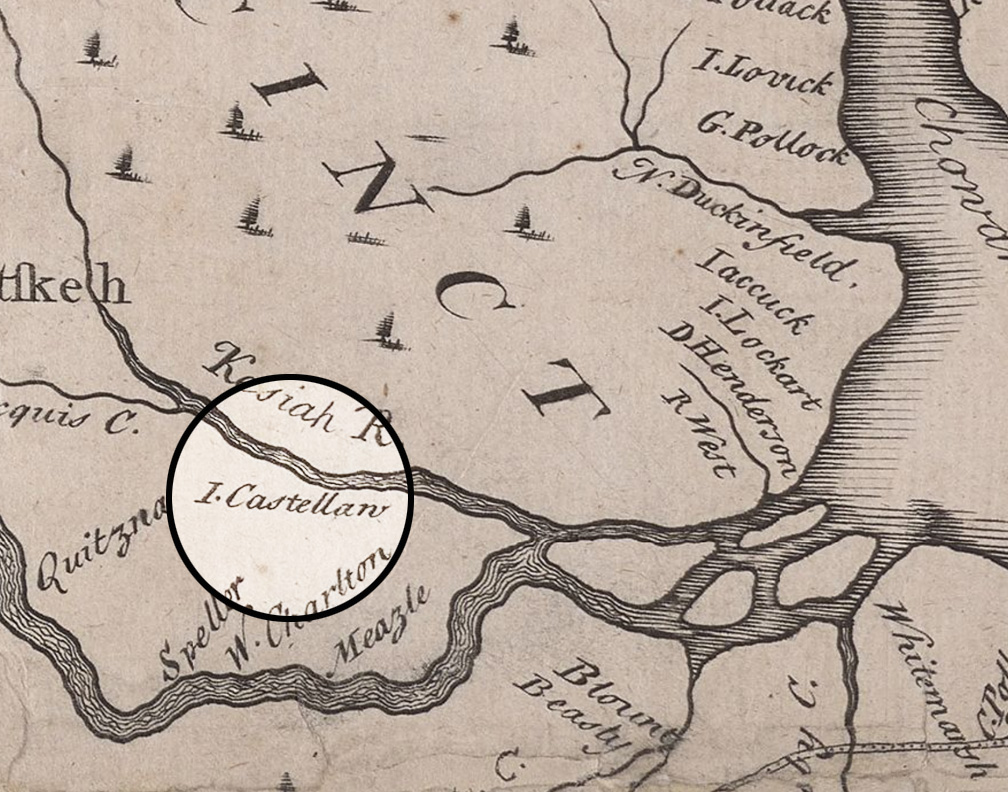
Photo: Edward Moseley 1733 Map of North Carolina featuring Bertie Precinct, including notation of “J. Castellaw” on the Cashie River. This was a notation to James Castellaw. Historically, “I” and “J” were treated as the exact same letter. The letter “J” originated as a decorative flourish for the letter “I.” Source /
I began this particular bit of research with the assumption that my Castellaw family line can be traced back to Eden House and Gabriel Johnston (1699-1752), the royal governor of North Carolina.
That may be possible, but I am finding the dots more difficult to connect than I expected. In a variety of places, it is noted John Castallaw married “a Dawson from Eden House on the Chowan River.”
A Margaret Dawson (1755-1813) was for sure the wife of my fifth-great-grandfather, John Castellaw (1727-1813), of Bertie County, North Carolina. However, was she “a Dawson from Eden House on the Chowan River?”

An artist rendering of the second oldest house in Edenton, North Carolina. Built in 1758 by Francis Corbin, the Cupola House was commissioned by John Carteret, the Earl Granville, who was the only one of the original eight Lords Proprietors who did not return his land to the King. It is renowned as a premier example of colonial architecture in the southern United States and is considered one of North Carolina’s most important early structures.
Eden House was one of the most important places in early North Carolina. It was the home of Charles Eden (1673-1722), a colonial governor of North Carolina. Later, Gabriel Johnston lived there after marrying Penelope Golland Johnston (c. 1695-c. 1751), Eden’s stepdaughter and one of the wealthiest women in the country at that time. She was a widow of William Maule, John Lovick and George Phenney.
There was eventually a Dawson at Eden House. Penelope’s daughter with Gabriel, also Penelope Johnston, married Col. John Dawson, a Virginia lawyer, who came to live with her at Eden House. John Dawson was the son of the Rev. William Dawson of Williamsburg, Virginia and Mary Stith Dawson. William Dawson a president of the College of William and Mary.
If Margaret Dawson Castellaw was truly “a Dawson from Eden House,” it would have likely been through this Dawson family.
The first part of my search begins with John Castellaw. John was the son of James Castellaw (1685-1749), an immigrant from Paisley, Renfrewshire, Scotland, and Sarah Williams Castellaw (1699-c. 1770), whose family had early roots in Isle of Wight County, Virginia.
James Castellaw was one of the most prominent men in Bertie County, so his family certainly ran in the same circles as the Johnsons and Dawsons from Eden House. James served as a justice, treasurer, landowner, mill builder and representative in the colonial Assembly. In 1747, a court was held at the courthouse at Cashie Bridge with James Castellaw, Benjamin Hill and John Harrell present as justices. As noted earlier, his home on the Cashie River was included on Edward Moseley’s 1733 map of North Carolina.
John, James’s son, had a relationship with Martha Butler (c. 1734-after 1820), a free woman of color who appears in Bertie County tax records as a “Free Mulatto Female.” Paul Heinegg, in “Free African Americans of North Carolina, Virginia, and South Carolina,” identifies Martha as John Castellaw’s common-law wife.
Martha was listed in John Castellaw’s household in Bertie County in 1761 and 1763 and again in lists from 1766 through 1772. In 1771, William Castellaw, son of Martha Butler, was taxed as a “free Molattoe.” That same year, John Castellaw made a deed of gift to “William Castellaw son of Martha Butler.”
That deed was recorded in Bertie County Deed Book L, page 283.
That one phrase, “son of Martha Butler,” proves the relationship between Martha, William and John.
Permission from the King of Great Britain for James Castellaw and Nathaniel Hill to build a water grist mill in Bertie Precinct in 1736
Some online accounts say Martha was Indian or Tuscarora. Others describe her as “mulatto.” Heinegg’s broader explanation of these records is helpful because, during this period, tax officials often used racial categories broadly and inconsistently. A person described in a record as “mulatto” could have African ancestry, Native ancestry or both. The law at the time did not distinguish between various races of “not white.”
What is a fact is this: Martha Butler was a free woman of color, she lived in John Castellaw’s household for years and she had at least one son who used the Castellaw surname.
You can find it mentioned various places that “after Martha’s death,” John married “a Dawson from Eden House.”
But Heinegg’s work says Martha Butler was head of a Gates County household of 10 “free colored” people in 1820. If that is the same Martha Butler, she did not die before John married Margaret Dawson. That means the relationship between John Castellaw, Martha Butler and Margaret Dawson was more complicated than the earlier claim suggests.
John could have ended his relationship with Martha before he married Margaret. He also may have continued his relationship with Martha after marrying Margaret. This is a mystery that will likely never be solved.
The date often given for John and Margaret’s marriage is around 1775. That makes sense. Martha appears in John’s household through 1772, and the children attributed to John and Margaret seem to begin appearing in the next few years.
And that brings me back to Margaret Dawson.
My fifth great-grandparents John and Margaret Dawson Castellaw had several children. Those with known birth and death dates were Bartholomew (1778-1845), my fourth great-grandfather John Dawson Castellaw (1780-1859) and Henry David Castellaw (1801-1844). Other children may have included Charlotte, Nancy, Thomas and John William.
Some of those children, or their descendants, eventually migrated from Bertie County, North Carolina, to Haywood County, Tennessee.
So who were Margaret Dawson’s parents and was she connected to Eden House? The known children of Col. John Dawson and Penelope Johnston Dawson of Eden House do not include a daughter named Margaret.
There is, however, one more Bertie County Dawson clue that may provide a lead.
In 1796, a man named Richard Dawson of Bertie County left a will that named several members of what appears to be his close family circle, including William Dawson, George Dawson, Ann Dawson Sebree, Elizabeth Dawson and members of the Evans family connected through Margaret Dawson Evans. Then, near the end of the abstract, Richard also named John Castellaw as one of his “brothers.”
In the language of 18th-century wills, “brother” did not always mean a biological brother. It could also mean a brother-in-law. If Richard Dawson called John Castellaw his brother, the simplest explanation is that John Castellaw had married into this Richard Dawson’s family, possibly by marrying Margaret Dawson who may have been a widow of a man named Evans?
This does not yet prove Margaret’s parents. It also does not prove or disprove the Eden House tradition. But it gives us something solid to work from: John Castellaw was closely connected to a Dawson family in Bertie County, and Richard Dawson’s 1796 will may point us toward Margaret’s real family group.
For now, I would describe Margaret Dawson’s parentage this way: she was almost certainly part of the Bertie County Dawson family circle that included Richard Dawson, William Dawson, George Dawson, Ann Dawson Sebree and Elizabeth Dawson. Whether that family connects directly to the Eden House Dawsons remains an open question to be researched.


Leave a Reply