
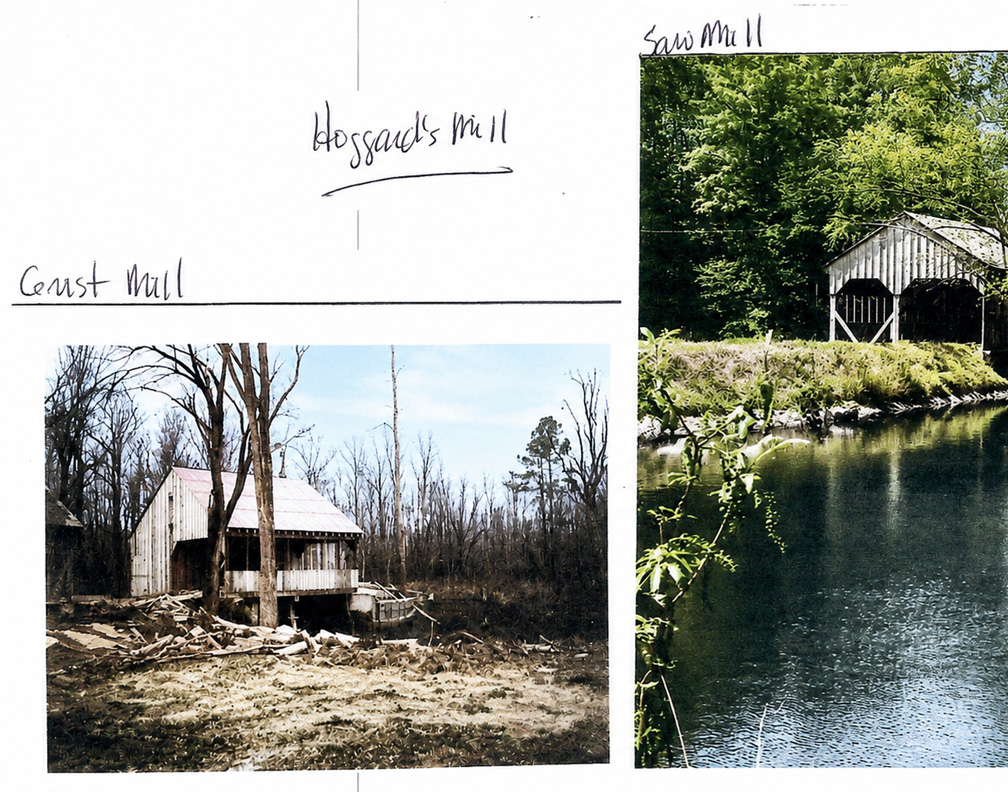
Photo: Hoggard’s Mill was located in an area established in 1736 by James Castellaw. The site was the first Bertie County seat (circa 1722 to 1769) and is known as the “Lost Town of Cashy.” The first courthouse, public warehouses, jail and other various commercial buildings were also located there, making it a historically significant property. In 2025, the Coastal Land Trust in partnership with the Town of Windsor, purchased the 313-acre Hoggard’s Millpond property so it could be conserved.
While researching my Bertie County ancestors, I ran across an article that Joe H. Cobb reprinted in his book “Nicholas Cobb Descendants: Neighbors and Relatives, 1613-1983.”
I am sharing here because it includes a great deal of information about my fifth great-grandfather, James Castellaw (1690-1748) The article was originally printed in the Bertie Ledger-Advance on November 2, 1972 in a column titled “Know Your County” authored by Mary Best Bell.
About Mary Best Bell
Mary Thompson Best Bell (1921-1981) was a Bertie County historian, genealogist and author whose research remains foundational for the study of colonial northeastern North Carolina. Born Dec. 13, 1921, in Goldsboro, North Carolina, she graduated from Salem College in 1943 and married William McGregor “Billy” Bell in 1946. Beginning in 1963, Bell compiled and published the six-volume “Colonial Bertie County, North Carolina, Deed Books A-H, 1720-1757,” meticulously abstracting thousands of early land records that continue to serve as indispensable resources for genealogists, historians and descendants of Bertie County’s earliest families. She also wrote numerous local history articles, including the Bertie Ledger-Advance “Know Your County” feature. Bell died Sept. 16, 1981 at age 59, and is buried in Edgewood Cemetery in Windsor, North Carolina.
Know Your County
By Mary Thompson Best Bell
James Castellaw, treasurer of Bertie Precinct from 1735 until 1748, was a leader in both business and government affairs in early Bertie.
Just when James and Sarah Castellaw came into Bertie Precinct is not too certain. He served as a witness in a case in 1718 but was not listed in the 1717 tax list nor in a list of freeholders in 1719; however, in 1721 he bought land on the Cashie River adjoining Colonel Pollock, Richard Fryer and Martin Gardner. From this date until his death in 1748-49, James Castellaw took an active interest in and assumed leadership for many activities in Bertie.
He served as juror in 1719 and on the Grand Jury in 1722 and 1724. In 1725 he was elected to the lower house of the General Assembly to represent Bertie. He served in the Assembly at least until 1745 if not until his death some three years later. These were difficult times for the North Carolina Assembly. During Governor Burrington’s incumbency the Assembly was dissolved by the governor at the slightest whim. During Governor Johnston’s incumbency rump Assemblies were called by the governor and every effort was made by him to prevent the northern representatives from attending. It will be forever to Castellaw’s credit that he attended sessions in 1733, 1739 and 1744 at New Bern despite the difficulties of travel.
As a member of the Assembly, Castellaw was often on committees and was once nominated for Speaker, although he was defeated by Benjamin Hill. He was very active in introducing bills for the improvement of the Colony, dealing mainly with efforts to obtain sound currency and equitable navigation laws and to set up a system for handling public debt. He also was frequently a courier to the upper house and to the Governor. The General Assembly, then as now, was not without frivolity. In 1743 much time was spent arguing the manner of address each house should use for the other. And, at one point, business came to a complete halt until each house paid the respect which the other considered its due.

Permission from the King of Great Britain for James Castellaw and Nathaniel Hill to build a water grist mill in Bertie Precinct in 1736
| Bertie Precinct } Sc. George the 2d by the Grace of God King of Great Britain &c. To the Surveyor Generall or his Deputy Greeting You are forthwith to admeasure and Lay out unto Nathaniel Hill and James Castellaw Two Acres of Land in the most Convenient place for a Water Grist mill upon Wills Quarter Swamp out of the Lands of the aforesaid Nathaniel Hill Observing that in the Laying out the aforesaid Land No persons Garden or Orchard be Injured thereby And a Platt and Certificate thereof to Return in to Our office at Our next Court and for your so doing this shall be your Warrant Dat at the Clks office this 25th Day of August A.D. 1736 Jno. Wynns |
After Hertford and Northampton were carved from Bertie, the Courthouse site at St. John’s was considered ill-placed. In the early 1740’s another site was selected; however, factions within the precinct argued over the location until, in 1744, the site at Will’s Quarter Swamp on the Cashie was chosen. James Castellaw was instrumental in the selection of the site, and he sold to the Bertie Justices one acre of land necessary for construction of public buildings there. Castellaw and James McDowell had the contract for building the Courthouse and other public buildings. A small town sprang up in the area which became known as “Cashy” — the area now known as Hoggard’s Mill. This community had a post road, a shipping terminal, houses and public buildings.
James Castellaw also served as a Bertie Justice from 1739 until 1746, and frequently acted as attorney for others in court cases.
As a businessman, Castellaw was also an active leader. In 1727 he went into business with Henry Guston and James Millikin “at Cashie and Roanoke.” It is probable that they maintained warehouses on the rivers, although Guston and Millikin were also known as merchants. Sometime prior to 1748 Castellaw built a mill at what is now called “Hoggard’s Mill” which operated for more than 200 years. Castellaw also patented and bought land in Bertie, Hertford, Northampton and Duplin Counties.
In 1735 both James Castellaw and James Lockhart were nominated for the post of treasurer of Bertie, but in 1735 Governor Johnston named Castellaw to the post at which he served ably until his death.
Sometime late in 1748 or early in 1749 James Castellaw died. His holdings were gradually dispersed and the town of “Cashy” gradually died eventually to be replaced both as county seat and business center by Windsor.
***
For more of my genealogy research, visit rscottwilliams.info.


Leave a Reply