
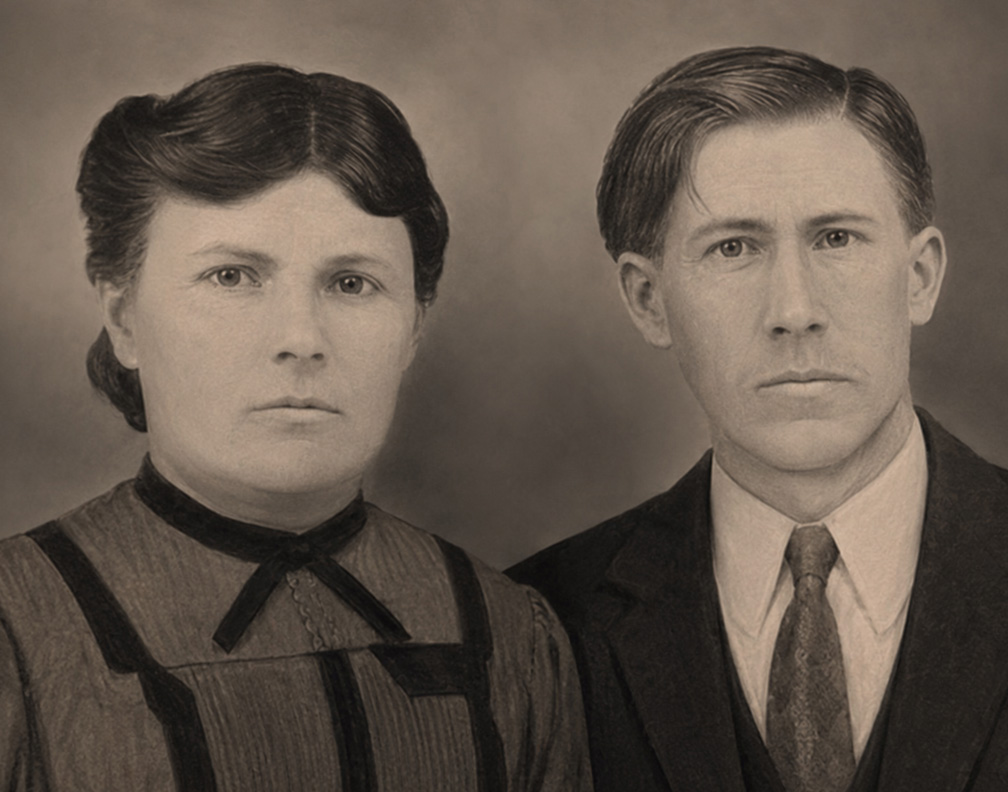
Maggie Williams Sullivan (1881-1921) was my first cousin, three times removed. Her father, Edward Williams (1853-1893), and my second great-grandfather, George D. Williams (1846-1919), were brothers. Her story shines a light on just how powerless many women were against abuse in the era in which she lived.

I knew a little about her tragic life thanks to the research of my cousin Betsy, but while I was at the Tennessee State Library & Archives in Nashville for Statehood Day, I pulled Maggie’s Tennessee Supreme Court case file to learn more.
Maggie was born in Haywood County, Tennessee, on April 21, 1881. She was part of the large Williams family whose lives, marriages, deaths and burials still help tell the story of rural Haywood County. Her father died when she was just 12. Maggie married Ellis B. Sullivan (1878-1917) when she was only 17.

The Tennessean, January 15, 1899, 3.
By 1905, their marriage had fallen apart badly enough that on April 27, 1905, she went to Haywood County Chancery Court seeking a divorce on the grounds of cruel and inhuman treatment. This was an act of desparation at that time. She was granted custody of their three sons. But the story did not end there. On Sept. 14, 1909, Maggie remarried Ellis. In her own words, “we stayed apart two or three years and he pursuaded me to marry him again.” She would leave him from time to time after that but always returned. She later testified:
“At times, I would leave home and stay away for a few weeks, going to my sisters’ or brothers’ houses. He would come and get me to go back. I hoped he would do better and treat me right.
Because we had children, and because I wanted to raise them right and have somebody to help make a living and support them, I would go back to him and do my best to live with him.”
Eight years later, ironically on Independence Day — July 4, 1917 — after an especially violent attack and attempted rape, Maggie loaded a shotgun and blindly fired it into the room where Ellis Sullivan lay sleeping. He would never abuse his wife again.
Maggie did not deny firing the gun. The central question became why she did it and what her mental condition was at the time. The case offers a painful example of how powerless wives could be against the horrors of an abusive husband. Maggie testified that she was sick, weak and menstruating that night. She said she was sleeping on a pallet on the floor in the same room with Ellis and their baby. Ellis, highly intoxicated, came to her wanting sexual intercourse. She said that after she refused because of her condition, he grabbed her, scuffled with her, struck her and choked her. He essentially told her she could run, but she could not hide, and that he would have intercourse with her that night. Maggie said she left the room, later returned with a gun and shot Ellis because she believed she had to stop him. On the stand, she testified, “I found the gun and stayed out a little while and thought he had gone back to bed and carried the gun back with me. He had the quilt across his lap and I shot him, but I didn’t intend to kill him. I was surprised when I did kill him. I just shot and did not know whether I was aiming at him or not. I do not think the gun was to my shoulder.”
When Sheriff W. T. Davis arrived at the house a little after 10 p.m., he found a number of people in the yard and around the house, but Maggie was sitting alone on the porch in a rocking chair with “her babies in her lap.”
Maggie was arrested that night and, two days after Ellis was killed, a proceeding was held in Haywood County to determine her sanity. A physician’s certificate and county-court paperwork declared her insane and ordered her committed to Western State Mental Hospital in Bolivar, Tennessee. However, state prosecutors argued that Maggie had threatened Ellis before the shooting, loaded the gun herself and acted calmly afterward. They claimed this was an intentional killing and decided to prosecute her.
At the trial, Maggie declared herself “not guilty.” The defense presented a picture of a long and miserable marriage. Maggie said Ellis had abused her for years. On the stand, she described beatings, threats, choking, whipping and cruelty in front of their children.
Several defense witnesses, including her young sons, supported her claims. Of course, her friends and family were attempting to have her committed to Western State Mental Hospital in Bolivar, Tennessee, rather than sentenced to prison for the rest of her life for murder.
Cal Sullivan, their 14-year-old son, testified that his mother had behaved strangely before the killing. He said she had hidden in a loft because she feared Ellis was going to have people capture her. He also testified that Ellis had abused Maggie and that he believed his mother was insane. Raymond Sullivan, another child of Maggie and Ellis, also testified about mistreatment. He said he had seen Ellis strike Maggie, slap her, hit her with a board and threaten her. Like Cal, he described Maggie’s odd behavior and said he believed she was “crazy and insane.” Other relatives told similar stories. Maggie’s sister, Nell Thomas, said Maggie had come to her house before because of Ellis’s cruelty. She described one incident when Maggie rode through deep snow at night, nearly frozen, saying she had left home to keep Ellis from killing her or locking her up. Frank Richards testified about an incident when Ellis came after Maggie while she was at the Richards home. According to Richards, Ellis had a board and was threatening to beat her. The defense tried to show a long pattern of fear, violence, instability and desperation.
Dr. J. C. Norvell, the family physician, also testified for the defense. He had treated Maggie for years and described her as nervous, weak and frail. He said her condition worsened around her menstrual periods and gave the opinion that she was of unsound mind at and before the time of the killing.
But at trial, the judge would not allow the jury to hear the county-court record declaring her insane just two dats after the shooting. Maggie’s lawyers also tried to introduce the old 1905 divorce record showing that she had once obtained a divorce from Ellis for cruel and inhuman treatment. The judge would not allow that record either. Those two exclusions would become central issues when Maggie’s case was appealed.
The State called witnesses who helped build the case that Maggie had intended to kill Ellis and was sane at the time. Sheriff W. T. Davis went to the Sullivan home after the shooting and took Maggie into custody. His testimony was complicated. As a State witness, he testified about what he saw and what Maggie said. But he also said Maggie told him Ellis had tried to force himself on her, pulled her hair, struck her, choked her and showed him her bruises. Davis also testified that he believed Maggie was insane at the time of the shooting.
A. A. Briley testified that Maggie appeared calm after the shooting and said, “My trouble is all over.”
The State called other witnesses to testify that they had heard Maggie threaten Ellis before the killing. Dora Jordan Davis, Laviney Shaw, Melissa Batchelor, Tom Hendricks and Robert Lee all gave testimony that the State used to argue Maggie had talked about killing Ellis before July 4.
There was one more irony in Maggie’s case. On Valentine’s Day, Feb. 14, 1919, the jury found Maggie guilty of voluntary manslaughter in the death of her husband. That verdict suggests the jury believed Maggie unlawfully killed Ellis, but did not accept the State’s strongest argument that she was guilty of murder. At the same time, the jury did not fully accept Maggie’s claims of self-defense or insanity. The jury fixed her punishment at the minimum — two years. Under Tennessee’s indeterminate-sentence system, the court entered the sentence as two to 10 years in the state penitentiary.
Maggie’s lawyers asked for a new trial. The judge denied it. They then appealed to the Tennessee Supreme Court at Jackson. On appeal, Maggie’s lawyers argued that serious mistakes had been made during the trial. They argued that the evidence did not support the verdict. They argued that the proof showed self-defense, insanity or at least enough doubt that she should not have been convicted. They also argued that the trial judge wrongly kept important evidence away from the jury. The two most important excluded records were the county-court record showing Maggie had been declared insane two days after the killing and the 1905 Chancery Court divorce record showing Ellis’s history of cruel and inhuman treatment. In the spring of 1920, the Tennessee Supreme Court reversed her voluntary manslaughter conviction and sent the case back to Haywood County for a new trial. The court found that the evidence showed she was insane at the time she killed her husband.

Nashville Banner, May 02, 1920, 14.

I could not find whether a new trial ever occurred. On April 28, 1921, a year after her case was overturned, Maggie Williams Sullivan died at only 40 years old. Her death certificate suggests the cause was likely uterine or cervical cancer, an especially tragic diagnosis considering her circumstances. Her death certificate listed her burial place as “Williams Cemetery,” where my second great-grandfather is buried.
Maggie’s life included the early loss of her father, a teenage marriage, the shame of a divorce, a remarriage, years of domestic violence and verbal abuse, public testimony from her own children, a manslaughter conviction and a painful illness that ended her life before she had much chance to begin again. Reading the record more than a century later does not undo what happened to her Maggie and her children. But it does restore some measure of context to a woman whose life was shaped by grief, fear, illness and a legal system that usually failed women in abusive marriages.
Remembering Maggie and acknowledging the horrible abuse she endured until she couldn’t, places her back into the family history where she belongs. Hopefully, today we listen more carefully when people experience physical and verbal abuse and make decisions that might have saved women of the previous century like Maggie Williams Sullivan.
For more of my genealogy research, visit rscottwilliams.info.


Leave a Reply