
Harry Harrison Kroll (1888-1967) is my “lesser-known Tennessee author from the past” for the summer of 2018, as I wrote in a blog post a few weeks ago.
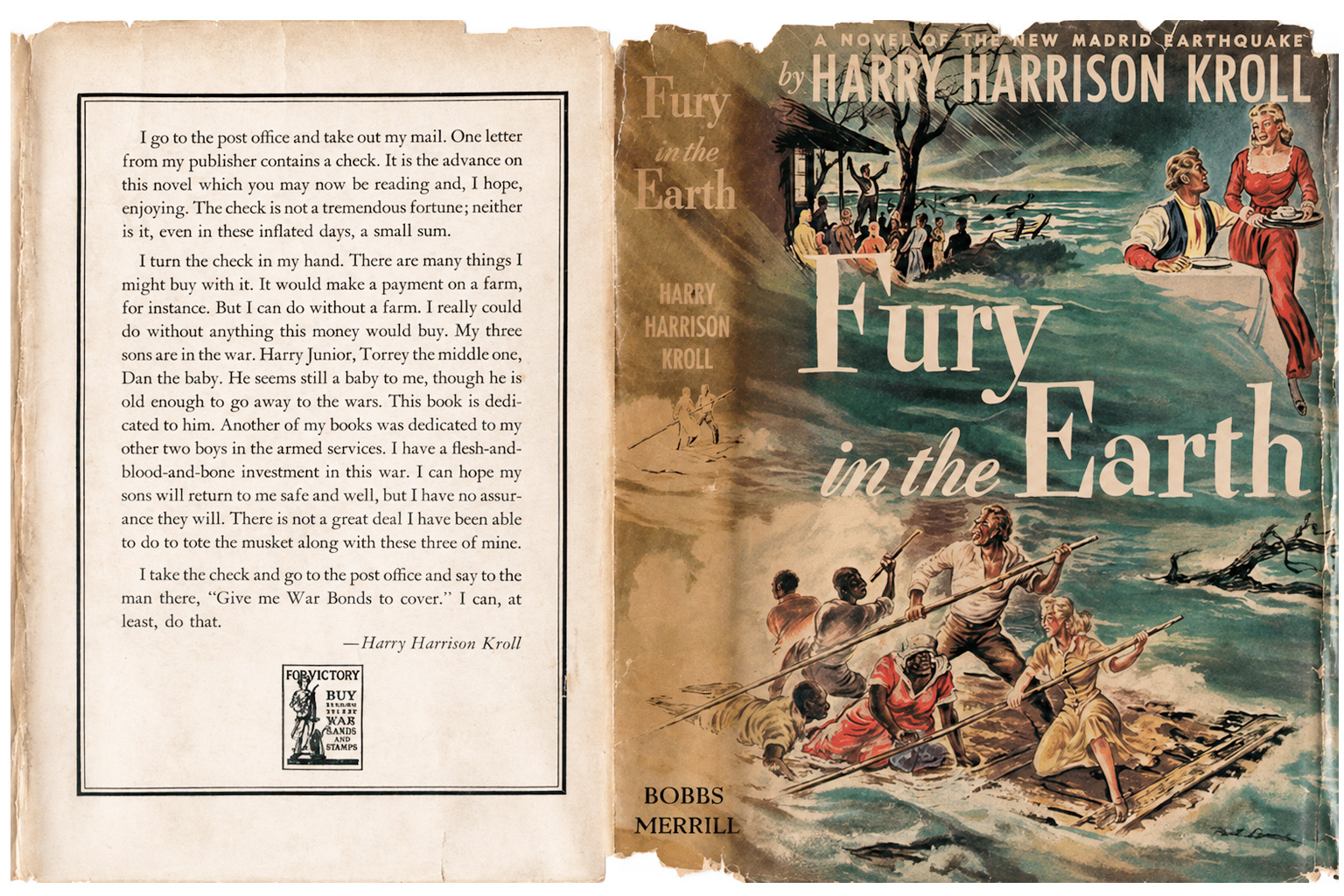
My wife and I recently took a quick trip to Virginia Beach, so I brought along Kroll’s “Fury in the Earth” to keep me company.
Published by the Bobbs-Merrill Co. in 1945, “Fury in the Earth” is short enough to be read in a day. The novel presents a fictionalized account of what might have happened in and around New Madrid, Missouri, when a series of powerful earthquakes and aftershocks struck the central Mississippi River Valley in 1811 and 1812.1
Kroll’s characters and storyline are fictional, but the disaster that surrounds them was very real. The three largest earthquakes in the sequence are now estimated at magnitudes of approximately 7.5, 7.3 and 7.5. The U.S. Geological Survey ranks them among the largest earthquakes in U.S. history and the largest known earthquakes east of the Rocky Mountains since European settlement.
According to the USGS, the area of strong shaking produced by the New Madrid earthquakes was two to three times as large as the area affected by strong shaking during the Alaska earthquake and 10 times as large as the area affected by the San Francisco earthquake.
Because North America had no seismographs in 1811 and the New Madrid region was sparsely populated, scientists cannot calculate the earthquakes’ strength from instrumental recordings. Instead, researchers have estimated their magnitudes by studying newspaper reports, journals, letters and other descriptions of the shaking and damage. Those estimates have changed as scientists have developed better ways of interpreting historical evidence.2
The shaking was felt across a tremendous area. People were awakened in Washington, New York City and other cities far from the Mississippi River Valley. Accounts also claimed that church bells rang as far away as Boston, although some surviving contemporary reports more specifically document bells ringing in Charleston, South Carolina.
The earthquakes toppled trees, opened fissures, triggered landslides and caused large areas of land to rise or sink. The Feb. 7, 1812, earthquake created or greatly enlarged the depression that became Reelfoot Lake in northwestern Tennessee. The USGS estimates that parts of the area subsided from about 5 feet to nearly 20 feet.3
Boatmen also reported that the Mississippi River temporarily flowed backward. Scientists believe several different effects may have created that appearance. Earth movement generated large waves that traveled upstream, while uplift along a fault crossing the river temporarily dammed or redirected the water. The uplift also created short-lived waterfalls at several locations.

Vintage postcard from Reelfoot Lake. Photo courtesy of Mary L. Martin Ltd. The message on the back describes the lake as a 20,000-acre state park formed by the earthquakes of 1811 and 1812 and known as a “Fisherman’s Paradise.”
Reelfoot Lake, located in the northwest corner of Tennessee, has long been known for boating, camping, fishing and bird-watching. Its flooded forests and stands of ancient bald cypress trees give the lake an appearance unlike almost any other place in Tennessee.
Among those trees, which have risen from the water for more than two centuries, Kroll created an entire fictional community for “Fury in the Earth.”
“In ‘Fury in the Earth’ Mr. Kroll’s fertile imagination has re-created New Madrid and peopled it with its few Spanish landed families, its pioneer American settlers and the roistering rivermen who visited it. This is the story of what might have happened to them in the days of the mighty ‘quakes.”
— From the dust jacket of “Fury in the Earth”
Kroll filled the novel with colorful characters, including the “balloon-bosomed” innkeeper Aunt Sook; her “handsome wench” of a daughter, Betsy Lou; the aging Spanish aristocrat Don Carlos; and a riverman named Hogshead Bolivar.
The style and storyline are not ordinarily the kind of thing I would get into. It reads a little like a cross between a 1970s disaster movie and “The Walking Dead.” It is still fun, however, to pay attention to Kroll’s use of regional dialect, one of the features for which his fiction was known.
In one scene, the survivors confront a man named Ad Knox, who is believed to be hoarding food:
| “Come any step farther and I’ll kill the first man that puts his foot on my porch! Don’t ye come up thar!” he repeated, sighting at Hogshead Bolivar, who was pushing through the crowd and came up on the steps. For a little time the nonplussed people stared at this new Ad Knox whom they never before had seen; and Knox gave them look for look. His rifle barrel did not waver. Even when the ground shook he seemed to keep that gun pointed true. “You got ham meat in thar, Ad Knox?” Bolivar finally asked. “He got hoardings,” Jeff replied when Knox did not speak. “Where you got your hoardings, Ad Knox?” Bolivar demanded. Knox did not deign to change his eyes. Jeff said, “He got ’em hid up in the loft, all wropped in buffalo hides to make ’em look like bales.”4 |
Fury in the Earth
In its February-March 2018 issue, “Missouri Life” published a thoroughly researched feature about the New Madrid earthquakes. The article draws from eyewitness accounts, geological evidence and later historical research to describe the terror experienced by the region’s early inhabitants.
The full death toll remains unknown. The USGS reports that only one person was documented as being killed by a collapsing building in New Madrid, but that figure does not include people who may have drowned in the Mississippi River or deaths that were never recorded. Later historical accounts generally conclude that most earthquake-related deaths probably occurred on the river, where boats were overturned, damaged or swept into newly formed obstructions.5
Although “Fury in the Earth” is fictional and its principal characters came from Kroll’s imagination, he included a bibliography listing books, magazine articles and old newspaper clippings that informed his work.
I suspect, however, that his most important source was personal.
Near the end of his bibliography, Kroll wrote:
| “Newspaper clippings, many very old, from papers in Obion, Weakley, and other counties hereabouts were used, but I still like to think not the least valuable of all were the excited imaginations of a boy who once waded Reelfoot Lake at its narrowest place, and climbed a cypress tree to stare into the dark waters which were said to be bottomless in that same sinister and mysterious body — that boy who I was many years ago.”6 |
That passage helps explain why Kroll’s novel works despite its melodrama. He was not simply writing about a distant historical disaster. He was drawing from a landscape he had known since childhood — a place where dead trees still rose from dark water and where stories of the earth splitting open had been passed down for generations.
For more of my genealogy research, visit rscottwilliams.info.
Notes:
- Harry Harrison Kroll, Fury in the Earth: A Novel of the New Madrid Earthquake (Indianapolis: Bobbs-Merrill Co., 1945); Richard L. Saunders, Never Been Rich: The Life and Work of a Southern Ruralist Writer, Harry Harrison Kroll (Knoxville: University of Tennessee Press, 2011), front matter. Saunders’ bibliography lists “Fury in the Earth” among Kroll’s major works and identifies Bobbs-Merrill as its publisher. ↩︎
- U.S. Geological Survey, “Summary of 1811-1812 New Madrid Earthquakes Sequence”; Susan E. Hough, “Scientific Overview and Historical Context of the 1811-1812 New Madrid Earthquake Sequence,” Annals of Geophysics 45, nos. 3-4 (2002). Researchers have published a wide range of estimated magnitudes because the earthquakes predated instrumental measurement. ↩︎
- U.S. Geological Survey, “Summary of 1811-1812 New Madrid Earthquakes Sequence.” The USGS states that subsidence associated with the Feb. 7, 1812, earthquake formed the principal depression occupied by Reelfoot Lake, with documented subsidence generally ranging from 1.5 to 6 meters. Earlier geological research indicates that an existing low area or older lake may have been substantially enlarged by the earthquake. ↩︎
- Kroll, Fury in the Earth, 143. ↩︎
- Ron Soodalter, “The New Madrid Earthquakes of 1811-1812,” Missouri Life, February-March 2018; U.S. Geological Survey, “Summary of 1811-1812 New Madrid Earthquakes Sequence.” The precise number of deaths remains uncertain, particularly among people traveling on the Mississippi River and populations poorly represented in surviving records. ↩︎
- Kroll, Fury in the Earth, 255. ↩︎


Leave a Reply