
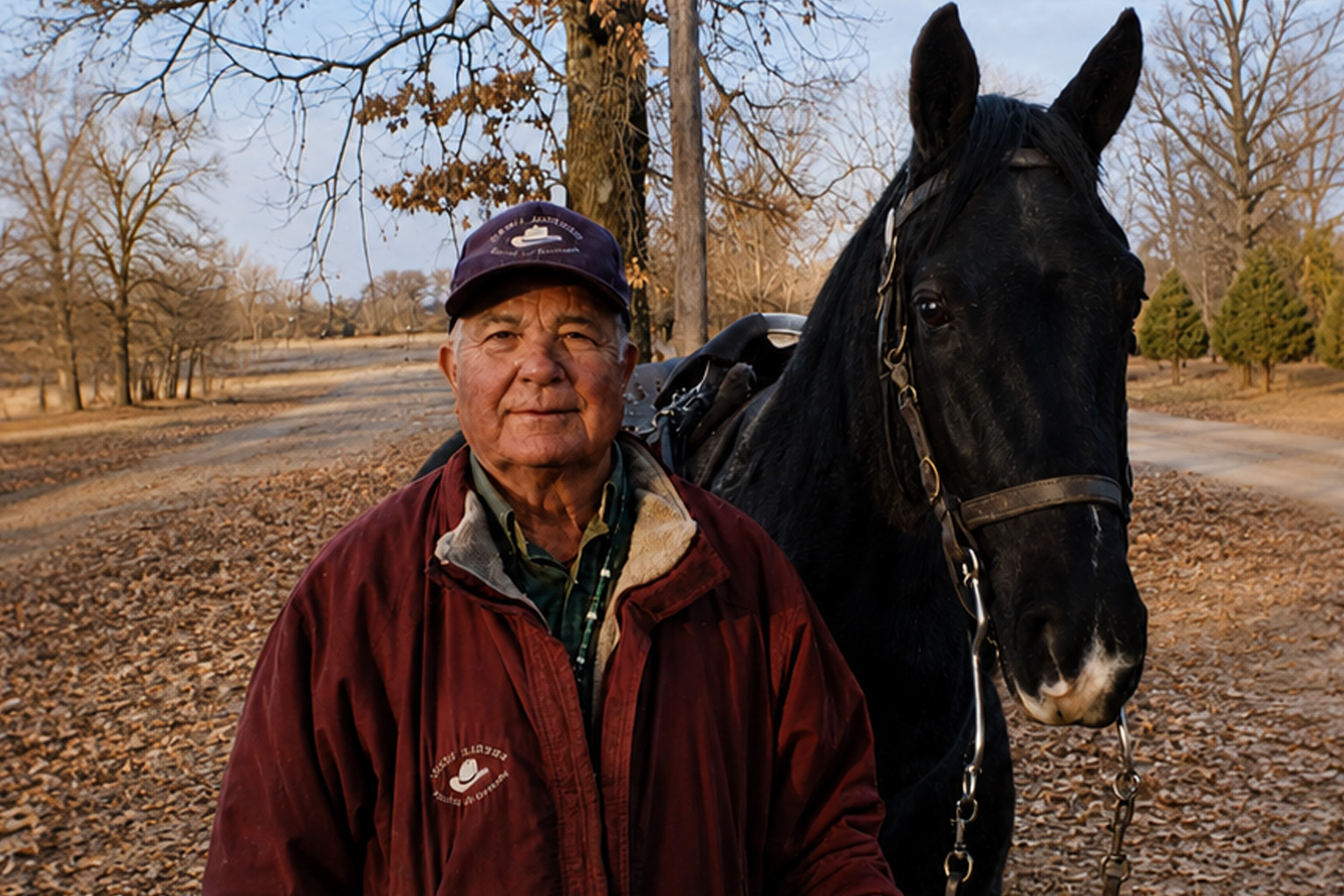
While researching my Williams family genealogy, I came across part of an article in American Field about Dempsey Williams (1929-2014), one of the younger half-brothers of my paternal grandfather, Lloyd “Bo” Williams (1910-2008). I do not believe I ever met him.

Demsey Williams and his brother, my grandfather, Bo Williams far right
Both were sons of my great-grandfather William Lafayette “Will” Williams (1888-1962), but they had different mothers. Bo’s mother was Janie Elizabeth Williamson Williams (1887-1914), who died when he was nearly 4. Will later married Eva Iris Overton Williams (1896-1970), Dempsey’s mother.

Some of the children of Will Williams. Back from left: Bo Williams, Douglas Williams, and twins Bobby and Billy (not sure which is which). Front from left: “Blue Eyes” Hudgings, Betty Williams Robinson and Dempsey Williams.
I didn’t realize when I began looking into Dempsey and bird dog trials what a rabbit (or quail) hole I was going down. Like other sports or hobbies, bird dog trials can be more than just a pastime. For some, like Dempsey, they are a way of life.
A member of the American Field staff was kind enough to send me the complete article, which was published a week after Dempsey died on September 18, 2014. I am sharing it here.
Tennessee Sportsman Dempsey Williams Has Died
By Blake Kukar | Sept. 25, 2014
Tennessee Sportsman Dempsey Williams Has Died
By Blake Kukar | Sep 25, 2014
SOMERVILLE, TENN. — The Tennessee field trial community has lost a longtime stalwart, Dempsey Williams of Toone, Tenn. Dempsey celebrated his 85th birthday September 15. He died three days later, on September 18. He had just moved into a new home he’d built in Toone, north of Bolivar.
I went to Dempsey’s place about a month ago. He called and asked if I’d pick up some dogs. Said it was a bit much taking care of them. When I saw Dempsey, he did not look well and I suggested he go to the doctor. He was hospitalized for three days. The diagnosis was cancer. He was able to return home and he died there.
Dempsey had a long and colorful tenure on the bird dog scene, starting back in the late 1960s and early ’70s. His big winner and producer was Admiral Rex (Ormond Smart Alec-Knight’s Gypsy). Rex was a 21-time winner for the Tennessee votary, and the sire of some 25 winners, among them Rex’s Dandy and High Fidelity, both 19-time winners; Giveaway Penny, which has the singular distinction of winning both the American Field Pheasant and Quail Futurities in 1978; and Bluff City Mike, winner of the 1986 National Championship.
Some of the “oldtimers” here (Bill Hunt, Steve Butler, Joe Walker) said that Dempsey’s Admiral Smartie Gal was better than Rex. She also was sired by Ormond Smart Alec, but out of Knight’s Cindy. Smartie Gal had 23 wins, among them runner-up in the All-America Quail (1976) and Southwestern Championships (1977). Rex sired winners, but Smartie Gal had none, so Rex likely got the “ink.”
Dempsey used the “Admiral” prefix on virtually all of the dogs he owned and registered with the Field Dog Stud Book over a period of 40 years.
Dempsey judged a number of important stakes, among them the American Field Quail and Pheasant Futurities. Interestingly, the Quail Futurity was held on the West Tennessee grounds from 1939 through 1941. Dempsey was literally raised with bird dogs and field trials. Back in the 1990s, Dempsey served a term or two as president of the National Bird Hunters Association and provided a venue near Brownsville, Tenn., for some of the leading NBHA trials.
He was a frequent competitor at the West Tennessee trials — open and amateur — at Dancyville. At the time he lived in Brownsville, a 20-minute drive to the Dancyville grounds. He was accompanied by his grandson Will Moss on occasion. Dempsey is survived by his daughter Rosemary Moss (Skip), grandson Will Moss, and a great grandchild Makya Moss; two brothers and a sister. Field trial friends Weldon Bennett and the writer served as pallbearers. Graveside services were held Saturday, September 20, in Dancyville.
Memorials in Dempsey Williams’ honor may be sent to the Bird Dog Foundation, Grand Junction, Tenn.
Bird dog field trials
Dempsey competed in bird dog field trials, which were contests based on quail hunting. Dogs search fields and woods for birds, then stop and point when they find the scent. Judges watch to see how well each dog searched, followed commands and stayed steady when the birds flew.
Some trials are held on foot, while others follow the dogs on horseback. The best dogs compete in major events such as the National Championship at Ames Plantation near Grand Junction. Dempsey’s dog Admiral Smartie Gal competed there, placing him among the more serious bird dog owners and handlers in the country.

Bluff City Mike, winner of the 1986 National Championship and a son of Dempsey Williams’ Admiral Rex. Photograph by Henry Reynolds, originally published in The American Field, March 22, 1986.
Dempsey did much more than enter dogs in competitions. He bred dogs using the “Admiral” name, judged trials and allowed major events to be held on his property near Dancyville. One of his best-known dogs, Admiral Rex, became the father of several winners, including dogs in the family line of Bluff City Mike, the 1986 National Champion.
Quail hunting today
Wild quail hunting and field trials are not nearly as common as they were during Dempsey Williams’ lifetime, particularly in Tennessee and across much of the Southeast. Earlier farms provided excellent quail habitat through small crop fields, weedy fence rows, brushy borders, light grazing and regular burning. By the early 1900s, bobwhite quail were abundant across Tennessee. Modern farming became cleaner and more intensive, fence rows disappeared, development spread and abandoned farmland grew into mature forest, all of which reduced the rough, brushy habitat quail need.
Tennessee wildlife officials report that the state’s northern bobwhite population has declined by more than 5% annually since the federal Breeding Bird Survey began in 1966. Across the species’ range, the total decline has approached 85%. Habitat loss, degradation and fragmentation are considered the principal causes.1
Quail hunting still survives on carefully managed private property, hunting preserves and a limited number of public areas, and bird dog field trials continue to attract devoted participants. But the once-common experience of taking a dog into the fields near home and finding several wild coveys has disappeared from much of Tennessee. As quail became scarcer, fewer people kept bird dogs or took up the sport, leaving the field trial world Dempsey knew as a tradition for a smaller group of hunters today.
More About Dempsey’s Field Trial Legacy
The obituary only hints at the influence Dempsey Williams had on the National Bird Hunters Association during its formative years. The organization inducted him into its Hall of Fame in 2002, recognizing him not only as a breeder, owner and handler but also as one of the people who helped establish the association. According to his Hall of Fame biography, Dempsey became the NBHA’s third president in 1985 and served for three years. During his tenure, the NBHA National became an Open Championship and the association established its Open Invitational, two important steps in the organization’s development.

From left, Dempsey Williams, Jo Williams, Egbert Jones and Eileen Huffman at the 1983 National Championship, shortly before Dempsey handled Black Creek Missy. Originally published in The American Field.
Dempsey also provided the association with something every field trial organization needed: good land on which to run its dogs. He made his grounds and facilities near Dancyville available for major NBHA events, including the national championship. His wife, Betty Joan “Jo” Culbreath Williams (1939-2012), helped welcome competitors and visitors, and the NBHA later remembered her as an exceptional hostess. You can read more about her in this blog post.
Their contribution involved much more than allowing people to use a piece of property. Hosting a major trial required preparing the grounds, accommodating horses and dogs, feeding visitors and maintaining the sense of fellowship that held the field trial community together.

Dempsey Williams, on hourse at far left, watches as Tommy Davis releases Admiral Smartie Gal at the beginning of the 1978 National Championship at Ames Plantation. Photograph by Henry Reynolds, originally published in The American Field, March 1978.
Dancyville already had a national reputation among bird dog enthusiasts. The West Tennessee Field Trial Club was organized there in 1930, and the American Field Quail Futurity was conducted on the Dancyville grounds from 1939 through 1941. Later accounts identify Dempsey as one of the NBHA pioneers who helped make the community an important center for walking and horseback field trials. Generations of owners, handlers and judges gathered at the local field trial clubhouse, known as the Chapel of Dancyville, while dogs competed across thousands of acres of rolling farmland, wooded edges and native bird habitat.2
Dempsey’s reputation rested in large part on the dogs bearing his distinctive “Admiral” kennel name. Admiral Smartie Gal competed in the 1978 National Championship at Ames Plantation, one of the most demanding events in the sport. A photograph published in “The American Field” shows Dempsey mounted at the breakaway as her owner and handler. When she returned to the National Championship in 1980, the magazine reported that she had developed a following because of her earlier performances there. Her record of 23 placements, including runner-up finishes in two championships, helps explain why some veteran field trialers considered her an even better performer than Admiral Rex.3 Dempsey was doing more than campaigning successful dogs. His breeding decisions influenced some of the most accomplished field trial bloodlines of the period.4
Another dog connected to Dempsey and Jo was Champion Admiral War Bond, also known as Rex but not to be confused with the earlier Admiral Rex. Admiral War Bond won the inaugural National Walking Shooting Dog Futurity in 1986 and accumulated more than 30 placements during his career. He earned his first championship in 1988, twice finished as runner-up in the NBHA National Open Championship and continued placing through 1992. The NBHA inducted Admiral War Bond into its Hall of Fame in 2014, placing one of Dempsey’s dogs alongside him in the organization’s permanent record of achievement.5
Taken together, those accomplishments give a clearer picture of Dempsey’s place in the sport. After his death, the Bird Dog Foundation installed a memorial plaque honoring him at its facilities in Grand Junction. His NBHA Hall of Fame photograph and biography also preserve his name among the men, women and dogs who helped build the tradition of field trials.6
For more of my genealogy research, visit rscottwilliams.info.
Notes:
- Tennessee Wildlife Resources Agency, Northern Bobwhite Management in Tennessee, 2021–2026: A Strategic Plan for Northern Bobwhite in Tennessee (Nashville: Tennessee Wildlife Resources Agency, 2020), 3, 5. ↩︎
- Diana Boggs, “Dancyville, A Field-Trial Gaited Community,” The Vizslak Sentinel, 2011. ↩︎
- “The National Championship: Historic Event Over Ames Plantation Plagued by Snowfall,” The American Field, March 4, 1978, 321; “The National Championship: Builder’s Addition, E. L. Baker and T. Jack Robinson’s Pointer, Wins 81st Running at Famed Ames Plantation,” The American Field, March 8, 1980, 366. ↩︎
- Barry Saunders, “The National Championship: Bluff City Mike Wins Premier Laurels in Final Brace,” The American Field, March 22, 1986, 486. ↩︎
- National Bird Hunters Association, “Champion Admiral War Bond,” NBHA Hall of Fame, accessed Aug. 2, 2026. The NBHA reports that Dempsey and Jo Williams previously owned the dog and that Admiral War Bond accumulated more than 30 career placements before his 2014 induction. ↩︎
- “Memorials & Honorariums,” Bird Dog Foundation Newsletter, spring 2015, 10. ↩︎


Leave a Reply