
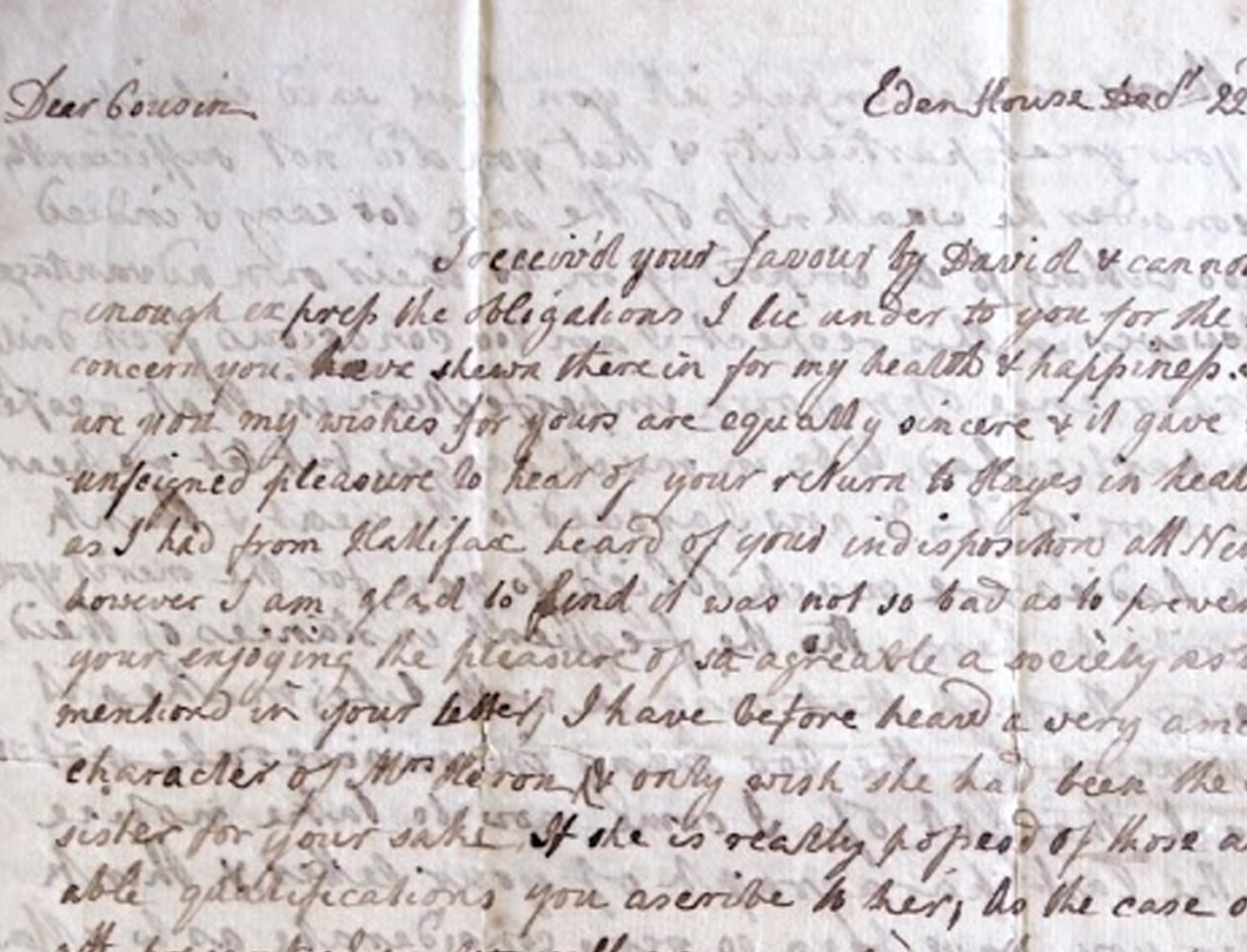
During last month’s research trip to North Carolina, I hoped a search through letters written by Penelope Johnston Dawson (c. 1740-1797) of Eden House would result in proof of a connection between her and my fifth great-grandmother, Margaret Dawson Castellaw (c. 1755-after 1813).
I have seen claims that John Castellaw (c. 1723-1813), my 5th great-grandfather married “a Dawson from Eden House.” There were Dawsons at Eden House. However, it’s looking less likely that the Margaret Dawson that John Castellaw married actually came from that particular Dawson family.
While I found no connecting line between the Dawsons at Eden House and my Castellaw family, the research was not wasted because I am also interested in what Bertie County, N.C. was like when my ancestors left for Haywood County, Tenn.

Reading letters written by Penelope Johnstone Dawson certainly offers a glimpse into the world of those living a life of priveledge in that time and place.
Penelope Johnston Dawson was born into one of the most powerful families in colonial North Carolina. Her father, Gabriel Johnston, was appointed royal governor in 1733 and arrived in North Carolina in 1734. Around 1740, he married Penelope Golland, the wealthy stepdaughter of Gov. Charles Eden and widow of William Maule, John Lovick and George Phenney. Their only child, Penelope Johnston, later married John Dawson of Williamsburg, Va., the son of the president of the College of William and Mary.¹
Penelope’s childhood was shaped by loss, inheritance and status. NCpedia describes her as “a young heiress” and “the orphaned daughter of Governor Gabriel Johnston.” Before her marriage, she had been living in Williamsburg with the family of Gov. Robert Dinwiddie, sharing lessons with the Dinwiddie children and absorbing the manners of the governor’s palace. In 1758, she eloped with John Dawson, a marriage that caused “consternation” in North Carolina but was remembered as a happy match.²

Contemporary reimaging of an existing portrait of John Dawson at an early age.
John Dawson and Penelope Johnston Dawson settled in at Eden House. They had four known children: Mary “Molly” Dawson Allen (c. 1760-c. 1780), who married Nathaniel Allen (c. 1755-1805); Penelope Dawson Lowther (1763-1820), who married Tristrim Lowther (1760-1795); William Johnston Dawson (1765-1796), who died unmarried; and Lucy Dawson who apparently died very young.³
John Dawson died at Eden House around 1770 at about age 40. After that, Penelope remained there as a 30-year-old widow, mother and plantation owner.⁴
That is where these letters become especially interesting.

When just glancing at the rare mention of Penelope as a signer of the Edenton Tea Party declaration you don’t have any idea who she was a person. The Penelope who appears in these letters is more personal. She worries about sick children. She thanks Samuel Johnston for sugar. She apologizes for sending beef late. She complains about weather, headaches, overseers, liquor and disorder at home. She jokes about her “brats.” She teases her cousin about a married woman. She comes across as affectionate, witty and dramatic, but also, completely overwhelmed.
While I transcribed some of the letters, rather than reprint them here, I am sharing 10 things I noticed in Penelope Dawson’s letters that provide a little more color around the family that I have only known as names and dates in old records.
10. She had a polished and affectionate voice
The letters were written to Penelope’s first cousin, Samuel Johnston (1733-1816), of Hayes Plantation near Edenton. Their fathers were brothers: Penelope was the daughter of Gov. Gabriel Johnston (1699-1752), while Samuel was the son of Gabriel’s brother, Samuel Johnston Sr. (1702-1757). The younger Samuel Johnston was born in Dundee, Scotland, came to North Carolina as a child and later became a lawyer, planter, Revolutionary leader, governor, U.S. senator and judge.⁵
Her Dec. 22, 1768, letter from Eden House opens with the formal lanuage used by the wealthy aristocrats of the day, but it still feels personal.
“I received your favour by David & cannot enough express the obligations I lie under to you for the kind concern you have shewn therein for my health & happiness,” she wrote.⁶
She told Samuel that her wishes for his health and happiness were “equally sincere” and that it gave her “unfeigned pleasure” to hear of his return to Hayes in good health.⁷
9. She enjoyed talk of romance
The 1768 letter includes one of the most revealing passages in the group. Samuel was 35 and unmarried. Penelope had heard something about his time with a Mrs. Heron, who apparently had made an impression.
“I have before heard a very amiable character of Mrs. Heron,” Penelope wrote, “& only wish she had been the single sister for your sake.”⁸
She went on to say that if Mrs. Heron really possessed the “amiable qualifications” Samuel had described, she trusted his “prudence” and “good sense” enough to believe he would feel only “esteem & friendship for that lady.”⁹
8. She was self-deprecating, but not weak
Penelope often apologized for taking Samuel’s time or troubling him with her problems. In the same 1768 letter, she said she would “try your patience so far as to give you such an unreasonable deal of nonsense to read.”¹⁰
In another letter, probably written in 1771, she told Samuel she did not expect a reply because he was “distracted with business, not only of your own, but others more in particular.” Then she added, “I shall not attempt to express the sense I have of your goodness, nor how much I feel when I reflect on the trouble you have with me.”¹¹
She was deferential, but direct.
7. She was a mother writing from the middle of the noise of parenthood
The best line in all the letters may be this one from Dec. 22, 1768:
“In such a spell of dismal weather as this it requires double diligence to keep the brats all in good humour when there is so little variety to divert the imagination.”¹²
She added that all the children had “violent colds” except Billy, “who knows no law or order.”¹³
Then, at the bottom of the letter, she added a postscript that made the whole scene come alive for a reader, even 245 years after it was written:
“Pray excuse this for the brats have been all in full cry in the room with me ever since I begun.”¹⁴
6. She was constantly worried about sickness
In a time when so many people died of a variety of sicknesses like cholora, yellow fever and malaria, its not surprising that illness appears in nearly every letter.
In one 1771 letter, she apologized that she had not been able to send beef sooner because bad weather delayed the killing. Then she turned immediately to health, hoping Samuel would “continue to recover,” Mrs. Johnston was “much better” and “the dear little stranger” was still well.¹⁵
In another letter, dated Sept. 16, 1771, she thanked Samuel for his “two last kind favours” and for sending sugar, “which we were in great want of.” But the letter quickly turned to sickness. She had heard Samuel had been “so much indisposd,” along with the rest of the family, “particularly dear little Pen.”¹⁶
Then sickness reached her own household. Molly and Billy, she wrote, had suffered “two slight fits of the ague & fever” since she left home. That afternoon, both were taken sick again and had “very high fevers” and did “nothing but groan & complain terribly of a violent pain in their heads.”¹⁷
5. Widowhood seems to have changed the tone of her life
The 1768 letter, written while John Dawson was still alive, feels social and playful. The 1771 letters feel heavier to me.
In one Thursday night letter from 1771, Penelope said she returned home and found “every thing in so much disorder att home, so much worse than I ever imagin’d.”¹⁸
The overseer had not returned. She had not heard from him. She did not know whether Samuel had agreed with him for the next year. If the overseer stayed, she worried he might expect an allowance for liquor because “he has this year in every respect liv’d as I have found him not only in rum but in butter & every thing else.”¹⁹
The Hayes Collection at UNC documents the Johnston family, the plantations they owned and managed and the enslaved people whose labor, knowledge and skill supported those plantations.²⁰ Penelope’s letters rarely name the people who did that labor, but Eden House existed within that plantation world. Her letters show the burden and authority of a widow managing a household and estate built on a system of enslaved labor.
4. She understood the business side of Eden House
The same 1771 letter gives a glimpse into the day-to-day economics of Eden House. Penelope was trying to think through the overseer’s expected liquor allowance, the tavern and the ferry.
“There is a tavern,” she wrote, “tho indeed I think the ferry of little or no profit only that it affords a little ready money, but the quantity of liquor that is used is much more than that amounts to.”²¹
That one sentence tells us Eden House was not only a plantation house. It was tied to a river, ferry, tavern, cash flow, labor arrangements and the business of hospitality.
NCpedia notes that John Dawson was chiefly occupied with managing Penelope’s large plantations near the Chowan River. After his death, the letters suggest Penelope had to face many of those practical problems herself.²²
3. She belonged to a wide Albemarle social world
The letters move among Eden House, Hayes, Halifax, New Bern and other places difficult to read in the handwriting. They mention Samuel Johnston, Mrs. Johnston, Mrs. Heron, Hannah, Anne, Molly, Billy, Mrs. Pearson and others.
In one Saturday night letter from Eden House she wrote that she was sending the letter by Mr. Nathan, who was leaving for New Bern. She described a frightening trip home through threatening wind and rain, then said she had just parted from Hannah and others aboard what appears to be the Duckenfield, where they had “spent the day together under full sail the whole time.”²³
She had planned to go with them to another house, but changed her mind because Mrs. Johnston was with her and “there was quite too many of us to go to one house.”²⁴
2. Small things were needed for survival
In one of the 1771 letters, she thanked Samuel for sugar. In another, she mentioned a memorandum and said she had forgotten to include a fourth silk handkerchief.²⁵
These seem like minor details, but they help reconstruct daily life.
Sugar mattered. Beef mattered. Handkerchiefs mattered. Boats, ferries, bad roads and weather mattered. A sick child’s fever mattered. A missing overseer mattered.
Penelope’s world was elite, but the letters show the constant work required to maintain a large family in colonial North Carolina.
1. She was part of public history
In 1774, Penelope Dawson was one of the women whose names appeared on the Edenton Tea Party declaration. The declaration said the women could not be “indifferent” to matters affecting the “peace and happiness” of their country and that they were determined to support the political resolves of North Carolina’s First Provincial Congress. The published list of names includes “Penelope Dawson.”²⁶

Robert Sayer and John Bennett (Firm), and Philip Dawe. Mezzotint. 1775. A society of patriotic ladies, at Edenton in North Carolina. London: Printed for R. Sayer & J. Bennett. Item PC 1-5284B, British Cartoon Prints Collection, Library of Congress Prints & Photographs Online Catalog. Source
| The Edenton Tea Party In 1774, Penelope was one of 51 women whose names appeared on the Edenton Tea Party declaration, a written pledge supporting North Carolina’s resistance to British imports. Unlike the Boston Tea Party, this was not a destruction of tea. It was a signed political statement. That distinction makes it even more striking. These women did not hide behind anonymity. They attached their names to the cause, including “Penelope Dawson,” and sent the declaration into a political world still dominated by men. |
That public act places her among a remarkable group of Albemarle women willing to step into political protest during the years before the American Revolution.
But these letters show something more intimate than a signature on a political declaration. They show a woman who could write with elegance, tease her cousin about romance, worry over her family’ illnesses, complain about an overseer and express frustration because children were crying in the room while she wrote.
Penelope Johnston Dawson died in 1797 around age 57, apparently after living out her final years at Eden House. I have not found a reliable source giving her cause of death. Her son, William Johnston Dawson, the “Billy” mentioned in her letters, went on to a brief but notable public career. Reared at Eden House and educated in England, he served in the North Carolina House of Commons, helped select the site of Raleigh and represented North Carolina in Congress from 1793 to 1795. He returned to Eden House at the end of his term and died there Jan. 16, 1796 around age 30, still a young man and unmarried. His death came about a year before his mother’s, leaving Eden House to pass through a fourth Penelope: PenelopeDawson Lowther’s line rather than through a Dawson son.
You can read more about the Dawson family and Eden House in this blog post.
You can read more about my 50th Birthday Genealogy Road Trip in this blog post.
Endnotes:
- Jaquelin Drane Nash, “Johnston, Gabriel,” NCpedia, State Library of North Carolina, 1988, https://www.ncpedia.org/biography/johnston-gabriel; Jaquelin Drane Nash, “Dawson, John,” NCpedia, State Library of North Carolina, 1986, https://www.ncpedia.org/biography/dawson-john-0.
- Nash, “Dawson, John.”
- Nash, “Dawson, John.”
- Nash, “Dawson, John”; “Skinner Family Papers, 1705-1900,” Southern Historical Collection, Louis Round Wilson Special Collections Library, University of North Carolina at Chapel Hill, https://finding-aids.lib.unc.edu/catalog/00669.
- Anna Withers Bair, “Johnston, Samuel,” NCpedia, State Library of North Carolina, 1988, revised February 2023, https://www.ncpedia.org/biography/johnston-samuel.
- Penelope Johnston Dawson to Samuel Johnston, December 22, 1768, Eden House, Hayes Collection, 1694-1928, Southern Historical Collection, Louis Round Wilson Special Collections Library, University of North Carolina at Chapel Hill.
- Dawson to Johnston, December 22, 1768.
- Dawson to Johnston, December 22, 1768.
- Dawson to Johnston, December 22, 1768.
- Dawson to Johnston, December 22, 1768.
- Penelope Johnston Dawson to Samuel Johnston, undated letter, likely 1771, Hayes Collection, 1694-1928, Southern Historical Collection, Louis Round Wilson Special Collections Library, University of North Carolina at Chapel Hill.
- Dawson to Johnston, December 22, 1768.
- Dawson to Johnston, December 22, 1768.
- Dawson to Johnston, December 22, 1768.
- Penelope Johnston Dawson to Samuel Johnston, Thursday night, 1771, Hayes Collection, 1694-1928, Southern Historical Collection, Louis Round Wilson Special Collections Library, University of North Carolina at Chapel Hill.
- Penelope Johnston Dawson to Samuel Johnston, September 16, 1771, Eden House, Hayes Collection, 1694-1928, Southern Historical Collection, Louis Round Wilson Special Collections Library, University of North Carolina at Chapel Hill, Box __, Folder __.
- Dawson to Johnston, September 16, 1771.
- Dawson to Johnston, Thursday night, 1771.
- Dawson to Johnston, Thursday night, 1771.
- “Hayes Collection, 1694-1928,” Southern Historical Collection, Louis Round Wilson Special Collections Library, University of North Carolina at Chapel Hill, https://finding-aids.lib.unc.edu/catalog/00324.
- Dawson to Johnston, Thursday night, 1771.
- Nash, “Dawson, John.”
- Penelope Johnston Dawson to Samuel Johnston, Saturday evening, Eden House, likely 1770 or 1771, Hayes Collection, 1694-1928, Southern Historical Collection, Louis Round Wilson Special Collections Library, University of North Carolina at Chapel Hill.
- Dawson to Johnston, Saturday evening, likely 1770 or 1771.
- Dawson to Johnston, September 16, 1771; Dawson to Johnston, undated letter, likely 1771.
- “Primary Source: The ‘Edenton Tea Party,’” ANCHOR, North Carolina History Online Resource, State Library of North Carolina, https://www.ncanchor.org/anchor/primary-source-edenton-tea.
- Nash, “Dawson, John.”


Leave a Reply